
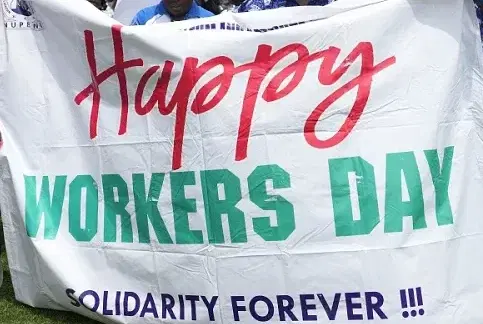
The desperate cries of "May Day" that originated in Chicago, United States in 1886 have grown more urgent, yet the world seems to have turned a deaf ear to these pleas, with the US being one of the few countries that disregards this international day of worker solidarity.
In the US, workers are often viewed as mere statistics or machines for profit, highlighting the country's brutal treatment of its labor force, particularly in the aftermath of the 1886 Chicago Haymarket workers' protests.
The US is not alone in ignoring May Day, as other notable countries such as Britain, Canada, and Australia, as well as Japan, Saudi Arabia, and Israel, also fail to acknowledge this international day of worker solidarity.
Today, on the 140th anniversary of May Day, the plight of Palestinian workers is particularly dire, with many forced to seek shelter in trees or on streets that have been bombed into devastation, leaving one to wonder where they can find refuge or access basic necessities like education and healthcare.
In Sudan, a country that was once home to a thriving labor movement, workers are now forced to flee their homes and seek refuge in camps, with their former leader, Professor Ibrahim Ahmed Ghandour, nowhere to be found amidst the chaos and destruction caused by the Sudanese Armed Forces and the Rapid Support Forces.
The International Labour Organisation's response to the crisis in Sudan and the plight of labor leaders like Ghandour is unclear, leaving many to question how humanity can intervene to stop the senseless conflict that has left half the population desperate and hungry.
In South Africa, the legacy of courageous labor leaders like Mark Shope has given way to a culture of xenophobia, with President Cyril Ramaphosa, a former mine workers' leader, seemingly tolerating this reality, which is far removed from the society envisioned by anti-Apartheid icons like Joe Slovo, Ruth First, Nelson Mandela, and Walter Sisulu.
In Haiti, a country long plagued by oppression, workers are now forced to navigate a landscape of insecurity, kidnapping, and violence, with many areas of the capital controlled by rival gangs, leaving one to wonder how they can safely commute to work or access basic services like education and healthcare.
Afghanistan's workers face a similarly bleak reality, with less than 32 percent of the population employed, and the country struggling with hyperinflation and a humanitarian crisis that affects 22.9 million people, making it difficult for workers to survive, let alone thrive.
In the Democratic Republic of Congo, a country that has been embroiled in conflict since 1960, seven million people are internally displaced, leaving workers to struggle in a desperate bid to survive, with limited access to basic necessities like food, water, and shelter.
Ukraine, once home to proud workers who celebrated May Day with banner-waving processions, is now a country ravaged by war, with 12.7 million people in need of assistance, and workers forced to navigate the dangers of military drones and a conflict that seems to have no end in sight.
In Yemen, a country once known for its ancient kingdoms and thriving economy, workers are now decimated by years of war, with the country holding the dubious distinction of being the site of the world's worst humanitarian crisis, worst hunger crisis, and worst displacement crisis, leaving its workers too weak to even whisper a cry for help.
Somalia, a country that has been fragmented and failed for 35 years, is a stark example of a state in collapse, with its workers forced to take cover as various forces pull the country apart, and humanitarian aid struggling to reach those in need.
Syria, once a tolerant country with a thriving middle class, has been ravaged by terrorism funded and trained by powerful countries like Saudi Arabia, the US, and its European allies, leaving workers in Damascus to wonder how they can wave the flag of the working class in a country that has been torn apart by conflict.
South Sudan, a country that emerged from decades of war with Sudan, has failed to find peace, with its workers still reeling from the madness of President Salvar Kirr's military actions against Vice President Riek Machar, leaving the country in disarray 13 years later.
As the world marks the 2026 May Day, workers across the globe continue to face unimaginable challenges, from war and displacement to hunger and oppression, leaving one to wonder what the future holds for these brave men and women who are the backbone of our societies.

Comments
Please login to leave a comment.
No comments yet. Be the first to share your thoughts!