
Why VAR is not used in AFCON qualifiers
By Enitan Abdultawab
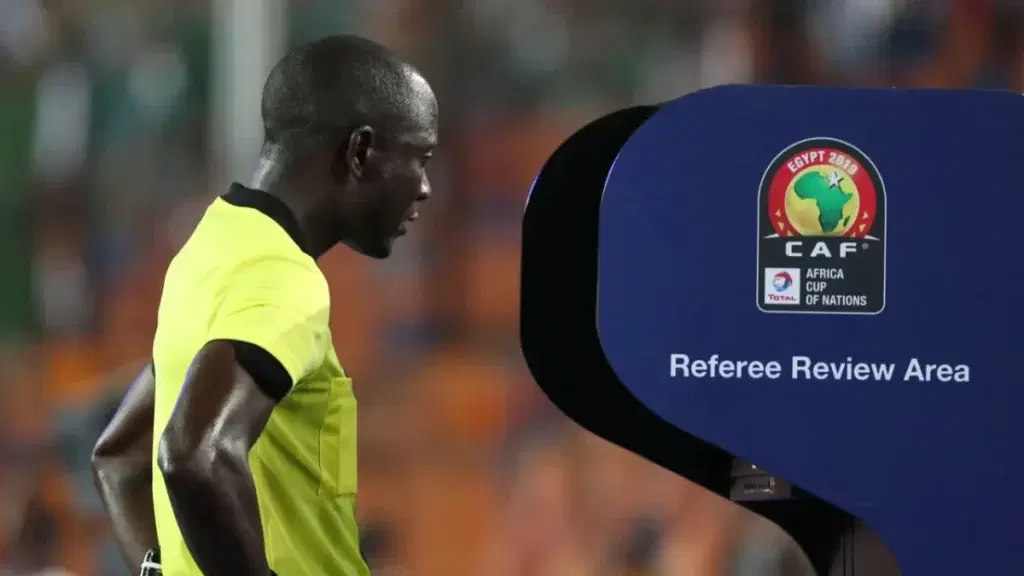
nThe absence of Video Assistant Referee (VAR) technology in the Africa Cup of Nations, AFCON qualifiers has come under scrutiny following Ghana’s 2 0 defeat to Côte d’Ivoire in Bouaké on Thursday.
nGhana coach Carlos Queiroz was particularly unhappy with the decision that led to Côte d’Ivoire’s second goal, after referee Mustapha Ghorbal awarded the hosts a penalty for Abdul Fatawu Issahaku’s challenge on Malick Yalcouyé.
nFranck Kessié converted the spot kick to extend Côte d’Ivoire’s lead, but the decision became a major talking point after the match. Queiroz, after watching television replays, described the penalty call as “a joke”.
nIn addition, football fans think Magadascar’s first goal against Nigeria could have gone under a check if VAR existed, although further replays showed that Ehsan Kari was indeed not offside.
nHence, these controversies have raised questions about why these incidents could not be reviewed with VAR.
nWhy VAR is absent in AFCON qualifiers
nThe absence of the technology from AFCON qualifying matches is not simply a matter of choosing not to use it. VAR requires substantial technical and operational arrangements before it can be deployed at a match.
nA stadium must have suitable camera systems, communication infrastructure, trained VAR officials and other technical facilities capable of supporting the review process. These requirements can be difficult to guarantee across all the venues used for a continental qualifying competition.
nUnlike the AFCON finals, which are played at a limited number of selected stadiums, the qualifiers involve teams from all 54 CAF member associations and are staged at venues with varying levels of infrastructure.
nThe Stade de la Paix in Bouaké, where Ghana faced Côte d’Ivoire, is capable of supporting VAR. The stadium hosted matches during the 2023 Africa Cup of Nations, where VAR was deployed throughout the tournament.
nThe bigger challenge is ensuring that the same standard can be maintained across the entire qualifying competition.
nCAF’s stadium regulations provide different requirements for different competitions, meaning venues used for qualifiers do not necessarily have to meet all the standards required for the AFCON final tournament.
nIn cases where a country does not have a stadium approved for a particular competition, CAF can require its home matches to be played at another approved venue, including one outside the country.
nThe situation makes the wider use of VAR during qualifiers a question of consistency as much as technology.
nIf VAR were available at one qualifying venue but could not be operated at another, teams could face different officiating conditions depending on where their matches are played.
nFor CAF to introduce VAR across the AFCON qualifiers, the technology would therefore have to be supported by the necessary infrastructure, personnel and operational arrangements at venues throughout the competition.
nUltimately, the bottom line is that the use cannot be consistent as not all countries possess the infrastructure to use it. Therefore, CAF cannot afford that some stadia use VAR while some do not.
n nRelated Stories
 General News
CELEBRATING TWO YEARS OF TRANSFORMATIONAL LEADERSHIP IN THE PRESIDENTIAL AMNESTY PROGRAMME
Tomorrow, 14TH March 2026, as we look forward to the second anniversary, we reflect on the remarkable two years since the Administrator of the Preside
 General News
PRESIDENTIAL AMNESTY PROGRAMME PHASE 3: DISREGARD PURPORTED STATEMENT ON DELAYED ITA PAYMENTS — OFFICE OF NATIONAL CHAIRMAN
The Office of the National Chairman of the Presidential Amnesty Programme Phase 3, General Elaye ThankGod Dollar Slaboh, has called on beneficiaries a
 General News
RE: CLARIFICATION ON MY PERSONAL RELATIONSHIPS
PUBLIC NOTICErnrnRE: CLARIFICATION ON MY PERSONAL RELATIONSHIPSrnrnIt has become necessary to make this public clarification following the increasing