
Why petrol remains expensive despite local refining— Dangote
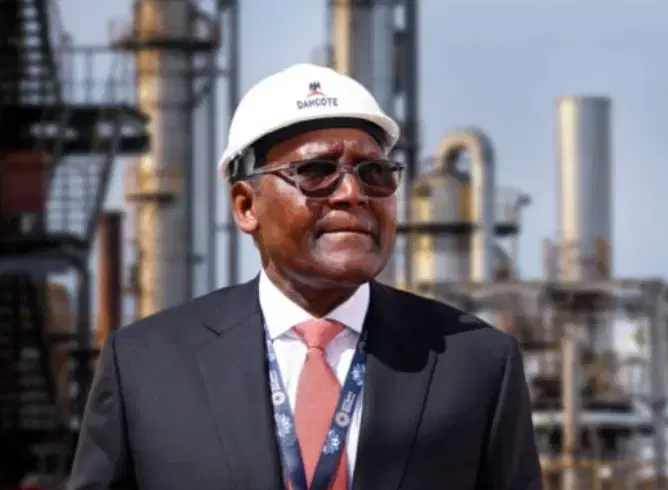
File image
n*Notes having a male heir not his priority
n*Says ‘I’ve lived in my current home for 36 years’
nBy Juliet Umeh
nTHE President of Dangote Group, Aliko Dangote, has said Nigerians were still paying high prices for petrol despite the commencement of large-scale domestic refining, saying local production does not completely insulate the country from global crude oil prices and market disruptions.
nDangote, who spoke in an interview on Arise TV yesterday, said the refinery bought crude at prevailing market prices and sometimes paid significant premiums, making it impossible to sell petroleum products below sustainable market levels.
nResponding to concerns over high petrol prices, he said expensive was relative, arguing that fuel prices in neighbouring countries remained significantly higher than in Nigeria.
nAccording to him, “there is still a lot of smuggling of the same petrol we are producing to our neighbouring countries because those neighbouring countries are about 30 per cent to 50 per cent more expensive than Nigeria.”
nDangote said the refinery had purchased crude for as much as $124 per barrel in May, adding that “we can’t go now and subsidise everything.”
nHe, however, assured: “Nigerians don’t need to worry. There will not be any shortage from our own part. There will be no queues, and we’ll make sure we keep satisfying the market despite all odds.”
nOn Nigeria’s industrialisation challenge, Dangote identified high borrowing costs as a major obstacle to new investments.
n“It is very difficult to industrialise with interest rates at 30 percent. I can’t see the magician who can actually industrialise a country with 30 per cent interest cost,” he said.
nHe warned that without policies deliberately protecting domestic investments, Nigeria might struggle to attract another major refinery project.
nHe warned: “Under the current things that are going on, especially downstream, I cannot see any new refinery in our lifetime.
n“Government must protect productive domestic industries if it expects businesses to create jobs, generate taxes and deepen economic activities.
n“If you import, what you are doing is you are importing poverty and exporting jobs that you are supposed to create out of the country,” he said.
nDangote also identified inconsistent government policies and inadequate electricity as persistent obstacles to manufacturing, declaring “you cannot manufacture goods with diesel.”
n‘I’ve lived in my current home for 36 years’
nSpeaking further, Dangote revealed he had lived in his current home for 36 years, saying he had no plans to move because he was comfortable there.
n“You know how long I’ve been here? Thirty-six years. I don’t plan on leaving. I’m very comfortable here,” he said.
nThe billionaire, who not ed that he was generally content with his home and didn’t feel the need to constantly seek out new luxuries, said: “Once I come in in the evening, it’s difficult to take me out of my house.”
nDangote also spoke about the spending habits of some wealthy Africans, criticising those who acquired private jets without investing in productive ventures such as factories.
n“What I see is people now owning aircraft all over the place, flying all over, and they don’t have one single factory.
n“So it means that they’re not actually helping in growing the economy, and that has to change,” he said.
nHe said his priority was to use his wealth and business interests to contribute to the industrialisation of Africa, stressing that his biggest legacy would be to help build productive capacity on the continent.
nDangote also said foreign investors were increasingly interested in Africa but needed large-scale investment opportunities capable of attracting substantial capital.
n“Foreigners are very interested now; they want to invest in Africa, but they don’t have big-ticket items.
n“So right now, they have started seeing big-ticket stuff, and they will join. And we will join to develop our own continent, Africa,” he added.
nHaving a male heir not my priority
nOn succession, Dangote said not having a son to inherit his business empire was not a priority, stressing that his three daughters were capable of taking over the Dangote Group.
nHe stated this on Tuesday, where he said he believed one of his daughters could eventually lead the conglomerate.
nAsked whether he could see one of his daughters taking charge of the group, Dangote said: “I think, yes, I can see one of them. I’ve been watching all of them, so I can definitely see one of the three that can actually lead.
nRecall that Dangote’s daughters, Halima, Fatima and Mariya, hold senior positions within the conglomerate, with their roles expanding as the group continues to develop its succession structure.
nDangote said their involvement in the family business was based on their personal interest rather than pressure from him.
n“They are very, very interested in the business. I’m not forcing them to come and be part of this business, no. They are very interested, and they enjoy it,” he said.
nThe billionaire and Africa’s richest man said he believed his daughters could surpass his achievements and take the company to a higher level.
n“One of them can be better than — I never expected to perform this much. But I’m sure they’re highly educated, so they will be more creative.
nSo most likely, they might be even taking the company to the next level,” he said.
nAsked if he believed all three daughters were capable of achieving this, Dangote replied: “All of them.”
nOn whether he still hoped to have a son, particularly given the traditional expectations surrounding male heirs in Kano, Dangote said it was not important to him.
n“Sometimes you can pray for God to give you a son, but that son might be the one to bring down the name of the family.
n“Sometimes when God doesn’t give you something, don’t push. I don’t think a son would have done something better than these three daughters that I have. That one, I think, you know, it’s not my priority,” he said.
nDangote added that having a male heir did not necessarily guarantee the preservation of a family legacy.
n“God controls everything. And for me, really, sometimes, yeah, you can pray for God to give you a son, but that son might be the one that would tear down the name of the family,” he said.
nHowever, Dangote said his broader succession plan was not simply about transferring control of the conglomerate to a family member, but ensuring that the company was professionally managed.
n“I want this company to be run professionally. I want to have the highest level of governance,” he said.
nHe cited global companies such as Microsoft and Apple as examples of businesses that had continued to thrive beyond their founders.
n“We want to make sure that we make it very difficult for any family member to come and destroy anything.
nThe businessman said his ultimate legacy was to contribute to the industrialisation of Africa.
n“What I want to leave as a legacy is to industrialise Africa. I cannot do it alone, but I’m 100% sure that in the next two or three years, other Africans will join,” he said.
n nRelated Stories
 General News
CELEBRATING TWO YEARS OF TRANSFORMATIONAL LEADERSHIP IN THE PRESIDENTIAL AMNESTY PROGRAMME
Tomorrow, 14TH March 2026, as we look forward to the second anniversary, we reflect on the remarkable two years since the Administrator of the Preside
 General News
PRESIDENTIAL AMNESTY PROGRAMME PHASE 3: DISREGARD PURPORTED STATEMENT ON DELAYED ITA PAYMENTS — OFFICE OF NATIONAL CHAIRMAN
The Office of the National Chairman of the Presidential Amnesty Programme Phase 3, General Elaye ThankGod Dollar Slaboh, has called on beneficiaries a
 General News
RE: CLARIFICATION ON MY PERSONAL RELATIONSHIPS
PUBLIC NOTICErnrnRE: CLARIFICATION ON MY PERSONAL RELATIONSHIPSrnrnIt has become necessary to make this public clarification following the increasing