
Why electric vehicle fire requires expert handling – Fire Service
By Theodore Opara
nThe Federal Fire Service, FFS, Lagos Command, has warned that fires involving electric vehicles, EVs, require specialised knowledge, equipment and response techniques, as Nigeria’s transition towards cleaner transportation gathers momentum.
nRead Also: The Beetle returns as Chinese Ora
nChief Superintendent of Fire, Badmus Abdulsamad, gave the warning while presenting the command’s preparedness strategy for emergencies involving EVs and compressed natural gas, CNG-powered vehicles at the 3rd auto industry summit held in Lagos.
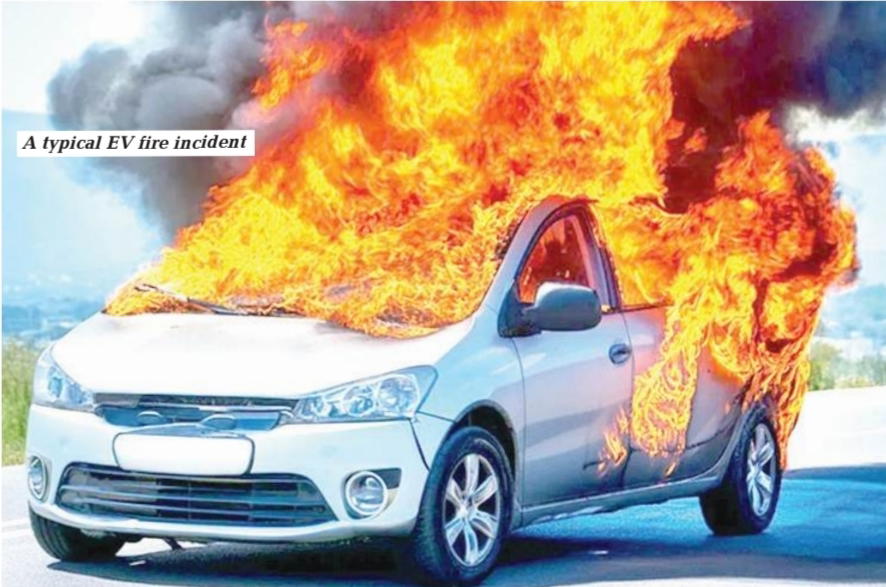
nAbdulsamad said although battery-electric vehicles were statistically less likely to catch fire than conventional petrol-powered vehicles, EV fires present unique challenges because of the lithium-ion batteries that power them.
nHe explained that such fires could be triggered by thermal runaway, a self-sustaining chemical reaction that generates extreme heat and can spread from one battery cell to neighbouring cells.
nAccording to him, EV battery fires can produce toxic and explosive vapours, create projectile hazards and continue to pose a risk of reignition long after visible flames have been extinguished.
nHe noted that EV fires could occur while vehicles were being driven, parked or charged, with possible causes including road crashes, debris penetrating battery packs, previous mechanical damage, extreme weather and charging-related faults.
nThe fire officer stressed that tackling an EV fire differs significantly from fighting a conventional vehicle fire.
“Firefighters must focus heavily on cooling the battery pack to prevent thermal runaway from spreading,” he said, noting that large quantities of water may be required over an extended period.
He warned that damaged EVs could reignite hours or even days after an incident, creating additional risks at towing yards, storage facilities and fire stations.
Another major concern, he said, was the high-voltage electrical system, which could remain hazardous after a crash. Burning lithium-ion batteries could also release toxic and corrosive substances such as hydrogen fluoride, carbon monoxide and hydrogen cyanide.
The FFS advised EV owners to use certified charging equipment, maintain their batteries properly, prevent battery damage, avoid exposing vehicles to extreme heat and maintain safe distances from buildings.
Members of the public were warned not to attempt to extinguish EV battery fires themselves but to evacuate the area immediately and alert emergency responders.
The FFS also highlighted the specialised risks associated with CNG-powered vehicles, particularly the high-pressure cylinders used to store the gas.
Abdulsamad explained that pressure relief devices fitted to CNG cylinders are designed to release gas when pressure becomes dangerously high.
However, he warned that inappropriate intervention during a fire could worsen the situation, potentially resulting in cylinder rupture and powerful blast effects
He added that CNG fires could produce pale blue flames that are difficult to see despite generating intense heat.
Emergency responders, he said, should not approach leaking CNG cylinders without appropriate protective equipment, training and a proper risk assessment.
Responders must also eliminate potential ignition sources and remain alert to the possibility of cylinder failure, he said.
CNG motorists were advised to install only authorised kits and cylinders through certified dealers or service centres.
The FFS further recommended regular inspection of CNG cylinders, regulators, pipelines and electrical systems to identify leaks, wear and other faults that could trigger fires.
nMotorists were advised against prolonged parking in direct sunlight, smoking or using naked flames around CNG-powered vehicles.
nIn the event of a CNG vehicle fire, occupants were urged to evacuate immediately, move to a safe distance and inform emergency responders that the vehicle is powered by CNG.
nThey were also warned not to approach the cylinders or attempt to fight the fire themselves.
nAbdulsamad said the FFS was strengthening its capacity to respond to emerging fire risks through the deployment of rapid intervention vehicles, fire bikes, fire trucks and hydraulic platforms.
nHe added that firefighters were undergoing both local and international training, covering basic and advanced firefighting and rescue techniques as well as breathing apparatus operations.
nThe Lagos Command is also collaborating with state and private fire services, the Nigerian Ports Authority fire department and the Federal Airports Authority of Nigeria, among other strategic partners.
nThe Service identified public education as another key pillar of its prevention strategy.
nIts initiatives include social media campaigns, seminars, workshops, fire drills, annual risk assessments, media engagements and Fire Safety Week activities.
nThe FFS stressed that Nigeria’s transition to cleaner mobility must be accompanied by specialised emergency-response training, appropriate safety standards and sustained public awareness to minimise the risks associated with EV and CNG technologies.
nThe Service maintained that the growing adoption of alternative-energy vehicles requires firefighters, motorists and the public to understand the distinct hazards involved, particularly as conventional firefighting approaches may not always be adequate for EV and CNG emergencies.
n nRelated Stories
 General News
CELEBRATING TWO YEARS OF TRANSFORMATIONAL LEADERSHIP IN THE PRESIDENTIAL AMNESTY PROGRAMME
Tomorrow, 14TH March 2026, as we look forward to the second anniversary, we reflect on the remarkable two years since the Administrator of the Preside
 General News
PRESIDENTIAL AMNESTY PROGRAMME PHASE 3: DISREGARD PURPORTED STATEMENT ON DELAYED ITA PAYMENTS — OFFICE OF NATIONAL CHAIRMAN
The Office of the National Chairman of the Presidential Amnesty Programme Phase 3, General Elaye ThankGod Dollar Slaboh, has called on beneficiaries a
 General News
RE: CLARIFICATION ON MY PERSONAL RELATIONSHIPS
PUBLIC NOTICErnrnRE: CLARIFICATION ON MY PERSONAL RELATIONSHIPSrnrnIt has become necessary to make this public clarification following the increasing