
Visionary of the Unattainable: The Journey of Cristiano Ronaldo in Making the Unthinkable a Reality, by Stephanie Shaakaa
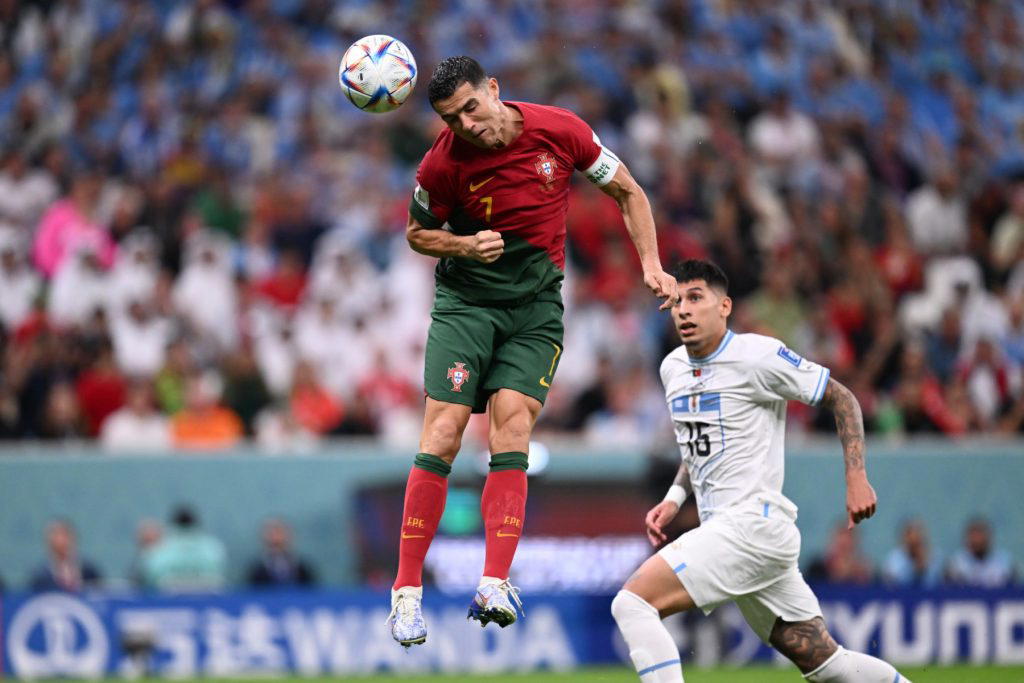
Portugal’s forward Cristiano Ronaldo scored his team’s first goal during the Qatar 2022 World Cup Group H football match between Portugal and Uruguay at the Lusail Stadium in Lusail, north of Doha on November 28, 2022, in a moment that would be etched in the memories of fans worldwide.
nThe final whistle of that match marked the culmination of an argument that had endured for almost a quarter of a century, an argument that transcended the realm of football to explore the very possibilities of human existence, inviting the world to witness an extraordinary experiment unfold before its eyes.
nFor twenty-three extraordinary years, Cristiano Ronaldo had been conducting this experiment, testing the assumption that people are confined by the circumstances of their birth and the limits they initially inherit, and in doing so, he had been redefining the boundaries of human potential.
nRonaldo’s legacy would not be measured by the trophies or records he left behind, but by the idea that a human life can be transformed, that it need not remain what it was at the beginning, an idea that would continue to inspire generations to come.
nHe had transformed self-improvement from a private discipline into a public spectacle, with every sprint, every leap, and every celebration becoming part of a lifelong declaration that destiny is not merely discovered but negotiated, a testament to the human capacity for growth and transformation.
nModern culture has often been fascinated by natural brilliance, admiring those whose gifts appear effortless, but Ronaldo offered a different philosophy, one that suggested greatness was not simply a miracle waiting to be uncovered, but a structure that could be built, patiently and relentlessly, through thousands of ordinary decisions repeated with extraordinary consistency.
nHis career was a masterclass in self-improvement, a demonstration of how thousands of small, deliberate actions could be woven together to create something extraordinary, a testament to the power of human effort and determination.
nRonaldo’s story began in Madeira, a place of breathtaking beauty, but also of harsh realities, where many families struggled to make ends meet, and where dreams often seemed larger than the opportunities available to pursue them, a humble beginning that would eventually give rise to a global icon.
nHis mother had to stretch every meal as far as necessity demanded, while his father struggled with alcoholism, fighting battles that his son was too young to understand, and too powerless to resolve, a difficult childhood that would eventually shape Ronaldo’s unwavering dedication to his craft.
nPoverty was never a dramatic interruption in Ronaldo’s childhood, but rather the quiet atmosphere in which ordinary life unfolded, a reality that would instill in him a deep sense of resilience and determination.
nHistory has a peculiar habit of disguising extraordinary beginnings beneath ordinary suffering, and few lives demonstrate this truth more clearly than Ronaldo’s, a testament to the human capacity to overcome adversity and achieve greatness.
nThe world now remembers the immaculate physique, the sculpted confidence, and the polished global icon, but it is easy to forget that the boy who arrived in Lisbon carried an unmistakable Madeiran accent that invited ridicule, possessed a body many believed too slight for elite football, and underwent heart surgery at the age of fifteen, obstacles that would have derailed a lesser individual.
nMany promising lives disappear beneath the accumulated weight of such obstacles, but Ronaldo responded differently, turning every setback into another reason to continue, not because he possessed unusual confidence, but because he gradually developed an unusual relationship with effort itself, a relationship that would become the hallmark of his career.
nThose who shared dressing rooms with him during those years often described the same remarkable pattern, a pattern of relentless effort and dedication, with Ronaldo searching for reasons to remain, to improve, and to perfect, even when formal training had ended, a pattern that would eventually become the foundation of his success.
nMost athletes work because they hope success will eventually follow, but Ronaldo increasingly behaved as though success was simply the visible consequence of a deeper commitment to constant refinement, a commitment that would drive him to achieve greatness.
nBy the time he arrived at Manchester United in 2003, English football encountered a teenager overflowing with possibility, but still searching for discipline, a raw talent that would eventually be honed into a world-class athlete.
nHe dribbled because he could, entertained because he enjoyed it, and delighted crowds with endless step overs that inspired admiration in some and frustration in others, a flashy style that would eventually give way to a more refined and disciplined approach to the game.
nCritics accused him of placing spectacle above efficiency, and although those judgments sometimes contained enough truth to sting, they never contained enough truth to define him, for Ronaldo was more than just a talented footballer, he was a work in progress, a constant evolution of skill and dedication.
nWhat ultimately separated Ronaldo from countless gifted footballers was not that criticism failed to wound him, but that he treated criticism not as a verdict upon his identity, but as information that could help reshape it, a capacity for self-reflection and growth that would serve him well throughout his career.
nAfter the World Cup in Germany in 2006, his role in Wayne Rooney’s dismissal against England, followed by the infamous wink, transformed him almost overnight into English football’s most unpopular figure, a backlash that would test his resolve and character.
nStadiums greeted him with relentless hostility, newspapers questioned his character, and every appearance became another opportunity for thousands of supporters to express their contempt, a wave of criticism that would have broken a lesser individual, but Ronaldo refused to let it happen.
nRather than allowing criticism to imprison him, he absorbed it, examined it, and quietly transformed it into another source of motivation, a motivation that would drive him to even greater heights of achievement and success.
nWhen he returned to Manchester, he brought back something far more valuable than vindication, he returned with clarity, a clarity of purpose and dedication that would guide him for the rest of his career, and propel him to unprecedented success.
nUnder Sir Alex Ferguson’s demanding guidance, and through an almost monastic devotion to improvement, the exuberant entertainer gradually evolved into a footballer of extraordinary precision, a transformation that would be nothing short of remarkable.
nTricks that existed only for applause slowly disappeared, replaced by movement that was sharper, more purposeful, and devastatingly efficient, a new approach to the game that would make him almost unstoppable.
nHis finishing became ruthless, his physical preparation approached scientific obsession, and every aspect of his game reflected a willingness to dismantle habits that no longer served his ambitions, a commitment to excellence that would become the hallmark of his career.
nWhat occurred during those years was far more profound than ordinary sporting development, it was a transformation of identity itself, a transformation that would be nothing short of remarkable, as Ronaldo became both the sculptor and the marble, reshaping his own career with a degree of honesty that few athletes have ever displayed.
nThe transformation reached its first great masterpiece during the 2007–08 season, with forty-two goals, the Premier League title, the Champions League triumph beneath the rain-soaked skies of Moscow, and his first Ballon d’Or, a season that would announce his arrival as a global superstar.
nThose achievements, magnificent though they were, concealed a deeper significance, a significance that would be felt far beyond the world of football, as Ronaldo persuaded millions that excellence might be less mysterious than uncomfortable, and that possibility reached far beyond football into classrooms, laboratories, businesses, concert halls, and empty gyms.
nThe move to Real Madrid in the summer of 2009 represented far more than a transfer between two football clubs, it was an encounter between the most ambitious player of his generation and the most demanding institution the sport has ever produced, a challenge that would push Ronaldo to even greater heights of achievement.
nEverything about the occasion reflected excess, with a transfer fee that broke world records, tens of thousands filling the Santiago Bernabéu merely to witness his unveiling, and expectations rising to heights that would have overwhelmed almost anyone else, but Ronaldo was undaunted.
nMadrid has always been a club that treats greatness as a requirement rather than an aspiration, and Ronaldo did not merely accept those expectations, he seemed to regard them as the natural environment in which his own ambitions belonged, a environment that would drive him to achieve unprecedented success.
nIt was in Madrid that his philosophy reached its fullest expression, with the dazzling winger who had once relied upon step overs and explosive acceleration gradually giving way to a forward of astonishing completeness, a completeness that would make him one of the greatest footballers of all time.
nEvery run appeared timed to the smallest fraction of a second, every leap challenged accepted ideas about what the human body could accomplish, and every finish suggested not improvisation but preparation carried to its highest possible form, a level of precision and dedication that would be nothing short of remarkable.
nWatching Ronaldo during those years often felt like watching someone erase the distinction between instinct and discipline, a distinction that would become increasingly blurred as he continued to push the boundaries of human potential.
nHis extraordinary return of 450 goals in 438 appearances for Real Madrid occupies a place in football that almost defies explanation, a feat that would cement his status as one of the greatest footballers of all time, and a testament to his unwavering dedication to his craft.
nStatistics, however, reveal only the scale of his achievement, never its character, a character that would be defined by his relentless pursuit of excellence, and his ability to make preparation appear indistinguishable from magic.
Related Stories
 General News
CELEBRATING TWO YEARS OF TRANSFORMATIONAL LEADERSHIP IN THE PRESIDENTIAL AMNESTY PROGRAMME
Tomorrow, 14TH March 2026, as we look forward to the second anniversary, we reflect on the remarkable two years since the Administrator of the Preside
 General News
PRESIDENTIAL AMNESTY PROGRAMME PHASE 3: DISREGARD PURPORTED STATEMENT ON DELAYED ITA PAYMENTS — OFFICE OF NATIONAL CHAIRMAN
The Office of the National Chairman of the Presidential Amnesty Programme Phase 3, General Elaye ThankGod Dollar Slaboh, has called on beneficiaries a
 General News
RE: CLARIFICATION ON MY PERSONAL RELATIONSHIPS
PUBLIC NOTICErnrnRE: CLARIFICATION ON MY PERSONAL RELATIONSHIPSrnrnIt has become necessary to make this public clarification following the increasing