
Vanguard Economic Forum: Experts Weigh in on Nigeria's Path to Ensuring Sufficient Food Supply
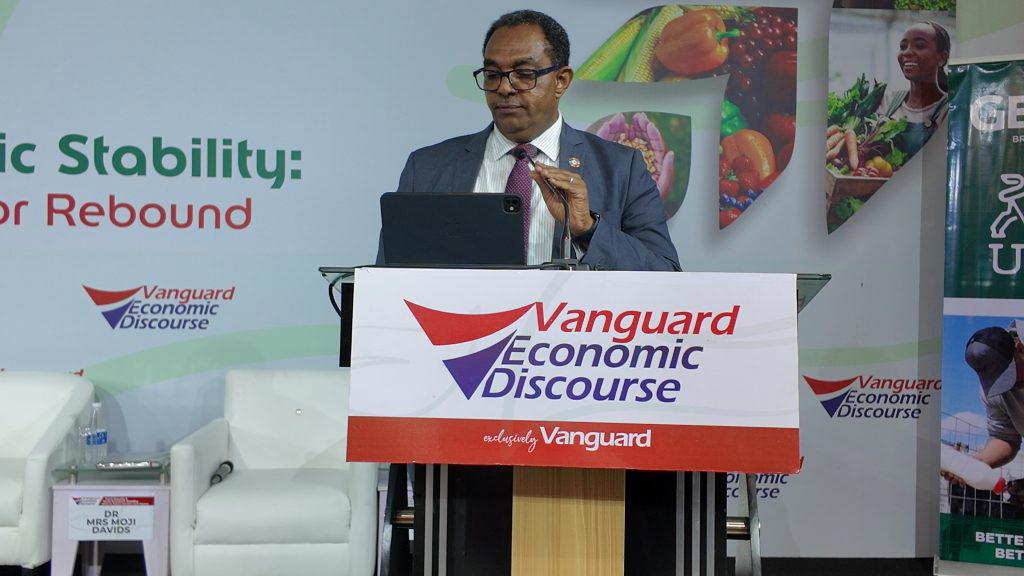
Hussein Gadain, Country Director of the UN Food and Agriculture Organisation, FAO, addressed the 9th Vanguard Economic Discourse in Lagos, warning that 35.7 million Nigerians may face hunger by August 2026.
nPublic and private sector leaders in the agriculture and food sector have identified a significant gap in food security in Nigeria, urging governments at all levels to take immediate action to prevent major crises.
nThe United Nations' Food and Agriculture Organisation, UN-FAO, has projected that the number of Nigerians facing hunger could reach 35.7 million by August 2026, while the International Fund for Agricultural Development, IFAD, believes that the youth and private sector are crucial to ending Nigeria's food crisis.
nThe Federal Government has introduced a new policy aimed at growing the livestock sector to $74 billion, with the entire agric value chain expected to record about $1 trillion in the next 10 years, and is urging the youth and women to take advantage of the opportunities in the sector.
nFAO Representative in Nigeria and to ECOWAS, Dr. Hussein Gadain, stated that "food security is far more than an agriculture outcome; it is a pillar of national security, macroeconomic stability, social cohesion, and peace," and warned that Nigeria must overhaul its agricultural financing and technology adoption to avert a looming catastrophe for over 40 million farming households.
nGadain noted that between 27.2 and 35.7 million people are experiencing acute food insecurity in 2025 to August 2026, concentrated in the North East, North West, and North Central zones, where insurgency, banditry, farmer-herder conflicts, and competition over land and water continue to undermine crop and livestock production.
nNigeria's cumulative agricultural imports were estimated at about N3.35 trillion between 2016 and 2019, roughly four times higher than agricultural exports of about N803 billion during the same period, highlighting a significant trade imbalance.
nGadain argued that the focus must shift to the nation's 40 million agricultural households, with national data indicating that more than 40 million agricultural households are engaged in crop production, poultry, and fish production, and that any meaningful rebound must be designed to work for smallholders through improved productivity, risk management, inclusive markets, and strong rural services.
nGadain emphasized the need for a "New Deal" for farmers, stating that access to finance is essential for smallholder farmers, pastoralists, and agri-preneurs to invest, grow, and manage risk, and that scaling climate-smart agriculture, improving access to better seeds, animal breeds, fertilizers, and water management is crucial.
nHe outlined the path to global competitiveness, stating that priority actions include upgrading market infrastructure, improving logistics and cold chains, enforcing quality and sanitary standards, and expanding agro-processing to shift from raw commodity exports to value-added products.
nGadain concluded that the time for action is now, stating that the rebound Nigeria seeks is within reach if it is intentional, inclusive, climate-smart, and people-centered, and that the country must seize this moment to turn today's challenges into tomorrow's opportunities.
nSpeaking at the event, the Country Director of the International Fund for Agricultural Development, IFAD, in Nigeria, Mrs Dede Ahoefa Ekoue, identified youth engagement and stronger private sector participation as critical to ending Nigeria's deepening food crisis, urging an urgent and coordinated transformation of the nation's agri-food system.
nEkoue stated that IFAD has invested approximately $1.8 billion in Nigeria, supporting over four million households and enabling smallholder farmers to transition from subsistence agriculture to more profitable participation in structured value chains.
nShe emphasized the role of demographics, describing Nigeria's large youth population as a major asset in transforming agriculture, noting that young people possess the innovation, energy, and technological capacity needed to drive change across the sector.
nEkoue explained that agriculture should no longer be viewed narrowly as farming but as a broad value chain that includes processing, storage, transportation, marketing, and waste management, providing multiple entry points for youth employment and enterprise development beyond primary production.
nShe cited IFAD-backed initiatives such as the Value Chain Development Programme, which links farmers in cassava and rice production directly to markets, thereby reducing post-harvest losses and improving incomes.
nEkoue concluded by stressing the need for stronger alignment among government, investors, farmers, and development partners, noting that weak linkages remain a major constraint to progress, and that connection and collaboration are essential to building a resilient and productive agri-food system.
nThe Minister of Livestock Development, Alhaji Idi Muktar Maiha, announced that new policies introduced by the Federal Government will grow Nigeria's livestock sector from its current value of $32 billion to $74 billion within the next 10 years.
nMaiha stated that livestock development is central to addressing food insecurity and stabilizing the economy, and that food security must be treated not just as an agricultural priority, but as a pillar of national security and socio-economic stability.
nHe noted that global pressures such as climatic variability, inflationary pressures, and rapid population growth are reshaping how nations produce, distribute, and consume food, and that Nigeria's challenges are worsened by internal constraints such as low productivity, weak value chains, infrastructure deficits, and security concerns in key farming areas.
nMaiha emphasized the economic importance of agriculture, stating that it contributes about 24 to 26 percent of Nigeria's GDP and employs close to 35 to 40 percent of the labor force, making it one of the largest sources of livelihood in the country.
nHe warned that over 25 million Nigerians are at risk of acute food insecurity, while food inflation has remained above 30 percent, eroding purchasing power and deepening poverty, and that the government has instituted the Nigerian Livestock Growth Acceleration Strategy with 10 pillars designed to transform the sector.
nMaiha explained key priorities, including feed and fodder development, strengthening value chains, and addressing post-harvest losses, and stressed the need for access to agricultural financing and security, as well as the role of technology in transforming agriculture.
nHe called for investment in the sector, stating that the scale of transformation required cannot be driven by government alone, and that strong private sector participation and large-scale investment in agriculture are needed.
nThe Minister of Agriculture and Food Security, Senator Abubakar Kyari, urged Nigerian youths and women not to miss out on the $1 trillion agribusiness boom projected for Africa by 2030, calling on them to take advantage of emerging opportunities in the sector and position themselves for future wealth creation.
nKyari stated that the future belongs to those who start now, and that a nation with over 70 percent youth population has an asset to deploy, and called on young Nigerians and women across communities to key into agribusiness.
nHe highlighted the scale of opportunity, stating that the size of food and agribusinesses in Africa by 2030 will be over $1 trillion, and raised concerns about the sector's weak financing structure, noting that the estimated cost of financing agriculture through financial institutions represents less than four percent of the sector's contribution to GDP.
nKyari disclosed that the Federal Ministry of Agriculture and Food Security is implementing flagship projects, including a $538 million Special Agro-Industrial Processing Zone initiative, the largest in Africa, which will expand to 27 more states, creating hubs where investors can establish processing plants and seamlessly connect to markets.
nHe described the initiatives as transformative, stating that they mark a bold step toward food security, economic empowerment, and sustainable development, and that the government is building an investment platform that transforms agriculture into a driver of industrial growth.
Related Stories
 General News
CELEBRATING TWO YEARS OF TRANSFORMATIONAL LEADERSHIP IN THE PRESIDENTIAL AMNESTY PROGRAMME
Tomorrow, 14TH March 2026, as we look forward to the second anniversary, we reflect on the remarkable two years since the Administrator of the Preside
 General News
PRESIDENTIAL AMNESTY PROGRAMME PHASE 3: DISREGARD PURPORTED STATEMENT ON DELAYED ITA PAYMENTS — OFFICE OF NATIONAL CHAIRMAN
The Office of the National Chairman of the Presidential Amnesty Programme Phase 3, General Elaye ThankGod Dollar Slaboh, has called on beneficiaries a
 General News
RE: CLARIFICATION ON MY PERSONAL RELATIONSHIPS
PUBLIC NOTICErnrnRE: CLARIFICATION ON MY PERSONAL RELATIONSHIPSrnrnIt has become necessary to make this public clarification following the increasing