
Untold story behind 124,000 repentant terrorists, soldiers who paid supreme price
By Evelyn Usman
nThe soldier did not lower his rifle immediately. Years on the battlefield had taught him that the North-East could be deceptive. Men had emerged from the bush pretending to surrender, only to detonate explosives or open fire.
nSo, as three figures slowly stepped out of the thick vegetation, recently, troops remained alert.
nThe first was a little boy, barefoot and frightened. Behind him came a woman with a baby strapped to her back.
nThen emerged a bearded man, his face weathered by years in the wilderness. His hands were raised high, not in defiance, but in surrender.
nIt was another quiet victory in a war that has produced far too many loud tragedies.
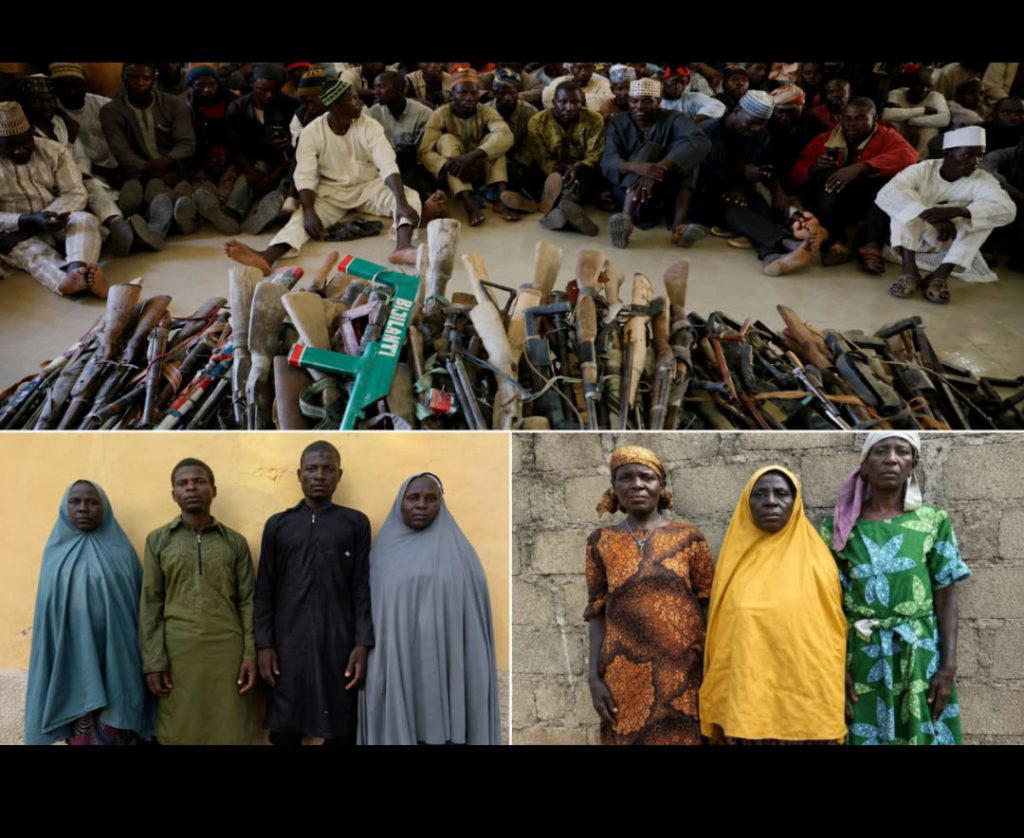
nAcross the North-East, scenes like this have become increasingly common. Men who once swore allegiance to Boko Haram or the Islamic State West Africa Province (ISWAP) are abandoning camps deep inside Sambisa Forest, the Lake Chad Basin and other insurgent enclaves. They are emerging with wives, children and whatever remains of lives consumed by extremism.
nThe Debate
nTo some Nigerians, these images offer hope that the insurgency is finally weakening. To others, they provoke anger and disbelief. How can people associated with years of bombings, mass killings, kidnappings and destruction be described as “repentant”? Should they be forgiven? Should they be punished? Or should they simply face the full weight of the law?
nFew issues in Nigeria’s security landscape have generated as much emotion as the question of surrendered terrorists.
nUntold story
nYet, beneath the arguments lies another truth that deserves equal attention.
nEvery insurgent who walks out of the forest alive does so because countless Nigerian soldiers first walked into that forest, knowing they might never return.
nThat is the untold story.
nFor every photograph of a surrendered fighter raising his hands in submission, there is another image that rarely makes the front pages: a young officer wrapped in the national flag; a soldier whose boots returned home without him; a family receiving the devastating knock on the door that every military household fears.
nThe journey from terrorism to surrender has, in many cases, been paved by the courage and sacrifice of troops who fought through ambushes, improvised explosive devices, sniper attacks and unforgiving terrain. They advanced through forests where visibility was measured in metres, every footstep could trigger an explosion and danger lurked in silence.
nThe men emerging today did not suddenly discover the virtues of peace. They are surrendering because the battlefield has become increasingly hostile to them.
nWhy thousands are surrendering
nThat reality explains why the figure recently announced by President Bola Tinubu is significant beyond its numerical value.
nAccording to the President, more than 124,000 Boko Haram and ISWAP fighters and their dependants have laid down their arms through Operation Safe Corridor since 2023.
nThe figure has been hailed in some quarters as evidence that the tide is turning against terrorism. But numbers alone tell only part of the story.
nThey do not explain why thousands are surrendering.
nThey do not reveal the intelligence gained from those who defect.
nNor do they capture the enormous price paid by the soldiers whose sacrifices made these defections possible.
nHunted into surrender
nMilitary commanders insist that terrorists do not surrender out of goodwill. They surrender because they have been relentlessly hunted, cut off from food and ammunition, stripped of safe havens and forced to confront a future in which death appears more certain than survival.
nThat pressure has been building steadily.
nAir strikes have destroyed camps once considered impregnable. Ground troops have reclaimed territory. Intelligence-led operations have dismantled supply routes, disrupted logistics and eliminated key commanders. Internal rivalries have further weakened the cohesion of both Boko Haram and ISWAP.
nThe result is evident in the growing number of men and women abandoning the insurgency.
nOperation HADIN KAI’s breakthrough
nOnly recently, troops of Operation HADIN KAI recorded another significant breakthrough with the surrender of a senior ISWAP finance operative.
nUnlike an ordinary foot soldier, he occupied a position central to the group’s survival, overseeing its finances and logistics.
nWhen he emerged from hiding, he did not come empty-handed. He surrendered with an AK-47 rifle, magazines, ammunition, a motorcycle and cash. More importantly, he brought something far more valuable than any weapon information.
nWithin hours, security agencies began detailed profiling and interrogation, seeking intelligence that could expose hidden camps, funding channels, supply routes and the identities of commanders still directing attacks.
nValue of Intelligence
nIn modern counter-insurgency, intelligence is often more valuable than firepower.
nOne surrendered insider can reveal what weeks of surveillance may fail to uncover. A single confession can save soldiers from walking into an ambush, lead to the rescue of hostages or expose an entire logistics network.
nThis is one reason security agencies continue to encourage defections while sustaining relentless military offensives.
nWho really are the ‘repentant terrorists’?
nYet, no aspect of the government’s counter-insurgency strategy has generated more controversy than the description of some of those emerging from the forests as “repentant terrorists.”
nFor many Nigerians, the term itself is offensive. To families who have lost loved ones, anyone associated with Boko Haram or ISWAP remains a terrorist, regardless of the circumstances.
nIt is against this backdrop that the Minister of Defence, General Christopher Musa (retd.), has sought to clarify what he described as one of the most misunderstood aspects of Nigeria’s counter-insurgency strategy.
nSpeaking in separate interviews on Channels Television and ARISE News, Musa said the public often assumes that everyone emerging from terrorist camps is a hardened fighter being welcomed back into society. He insisted that this was not the case.
nDrawing from intelligence gathered over years of military operations, the Defence Minister explained that those who surrender generally fall into three categories.
n“The first comprises people who were forcibly conscripted after their communities were attacked. Many had little choice but to serve the insurgents, as refusal often meant certain death.
n“The second consists of women, children and other non-combatants who were abducted or exploited for support roles such as cooking, farming, fetching water, carrying supplies or performing other menial tasks. Many of them, he argued, were victims long before they emerged from the camps.
n“The third category comprises the core fighters, those who willingly took up arms, participated in attacks and remained active members of terrorist organisations”
nThese distinctions, he explained, are not merely academic; they determine what happens next.According to him, every individual who surrenders undergoes extensive screening, profiling and intelligence assessment before any decision is taken.
nHe said : “ Those found to have been forcibly conscripted or used in non-combat roles may be considered for rehabilitation under Operation Safe Corridor after rigorous evaluation.
nThose identified as hardcore combatants, however, are separated for investigation and prosecution.
n“The military is not indiscriminately reintegrating terrorists into society,” Musa maintained, stressing that the entire process is intelligence-driven and designed to distinguish victims from perpetrators”.
nHis explanation, however, has not ended the debate, nor has it erased the pain of victims still grappling with memories of massacres, abductions and displacement.
nIndeed, perhaps Nigeria’s greatest challenge is no longer persuading terrorists to surrender; it is convincing affected communities that justice and reconciliation can coexist.
nVictims continue to ask difficult but legitimate questions. Can someone who once carried a rifle against innocent people truly be trusted again? What guarantees exist that those rehabilitated will not return to violence? How does a mother who lost her children to terrorism embrace the idea of reintegration?
nThere are no easy answers.
nSecurity experts, however, argue that modern counter-insurgency cannot rely on military force alone. Every conflict eventually reaches a point where governments must decide whether to fight every remaining adversary to the death or create carefully managed pathways that encourage defections, weaken terrorist organisations from within and hasten the end of the conflict.
n nRelated Stories
 General News
CELEBRATING TWO YEARS OF TRANSFORMATIONAL LEADERSHIP IN THE PRESIDENTIAL AMNESTY PROGRAMME
Tomorrow, 14TH March 2026, as we look forward to the second anniversary, we reflect on the remarkable two years since the Administrator of the Preside
 General News
PRESIDENTIAL AMNESTY PROGRAMME PHASE 3: DISREGARD PURPORTED STATEMENT ON DELAYED ITA PAYMENTS — OFFICE OF NATIONAL CHAIRMAN
The Office of the National Chairman of the Presidential Amnesty Programme Phase 3, General Elaye ThankGod Dollar Slaboh, has called on beneficiaries a
 General News
RE: CLARIFICATION ON MY PERSONAL RELATIONSHIPS
PUBLIC NOTICErnrnRE: CLARIFICATION ON MY PERSONAL RELATIONSHIPSrnrnIt has become necessary to make this public clarification following the increasing