
Unrestrained authority poses biggest danger to democratic systems, says Saraki
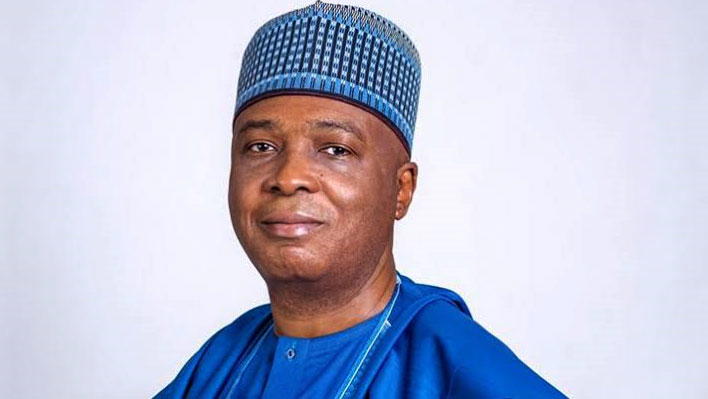
Former Senate President Bukola Saraki has sounded a warning that uncontrolled power poses the most significant threat to democracy, emphasizing that Nigeria's democratic framework was intentionally designed to prevent any branch of government from operating without oversight.
nThis assertion was made by Saraki during his address at The Platform in Lagos on Friday, an event held to commemorate Democracy Day, where he underscored that democracy can only flourish when the various branches of government are able to check each other's power.
nSaraki stressed that the absence of checks on power within the branches of government presents the greatest danger to any nation, highlighting the deliberate separation of power among the executive, legislature, and judiciary by the framers of Nigeria's democratic system to prevent the emergence of absolute authority.
nHe quoted that the greatest danger to a free people is an unchecked government, with powers that are unaccountable and authorities that cannot be questioned, noting that the division of power into three independent arms that can check each other was a deliberate design to guarantee freedom.
nAccording to Saraki, many Nigerians often misinterpret the nature of democratic governance by focusing solely on the office of the president, while overlooking the critical role of other institutions, such as the legislature and judiciary.
nHe stated that the presidency often dominates the narrative, leading to a misconception that governance is solely the responsibility of the president, while the National Assembly is viewed as an inconvenience, rather than a vital institution.
nSaraki described the legislature as the branch of government closest to the people, with its members deriving their legitimacy directly from voters, rather than appointments, and noted that the National Assembly carries the hopes and aspirations of Nigerians.
nThe former Senate President emphasized that the National Assembly serves as a platform where diverse interests and grievances can be expressed and resolved peacefully, providing an arena where a divided country can argue without breaking.
nHe argued that a legislator who cannot say "no" is not a legislator, and that a legislator who approves every proposal without scrutiny is not doing their job, stressing the importance of legislative oversight in democratic governance.
nSaraki maintained that lawmakers are often unfairly criticized for carrying out constitutional responsibilities, particularly in the budget process, and noted that the National Assembly is frequently accused of budget padding when it is merely exercising its constitutional powers.
nHe noted that the executive often sets the narrative around budget passage, but the legislature has a constitutional duty to examine proposals and ensure they serve the interests of Nigerians, cautioning against situations where the executive seeks to incur expenditure without legislative approval.
nSaraki emphasized that public spending must remain subject to parliamentary oversight, and that no country can build a sustainable democracy around a single office or individual, stressing that strong institutions, particularly a strong parliament, are indispensable to national development.
nHe reiterated that democracy is not built on a single office, and that strong institutions are the foundation of freedom, accountability, and good governance, adding that there is no example in the world where a nation is built without a strong parliament.
Related Stories
 General News
CELEBRATING TWO YEARS OF TRANSFORMATIONAL LEADERSHIP IN THE PRESIDENTIAL AMNESTY PROGRAMME
Tomorrow, 14TH March 2026, as we look forward to the second anniversary, we reflect on the remarkable two years since the Administrator of the Preside
 General News
PRESIDENTIAL AMNESTY PROGRAMME PHASE 3: DISREGARD PURPORTED STATEMENT ON DELAYED ITA PAYMENTS — OFFICE OF NATIONAL CHAIRMAN
The Office of the National Chairman of the Presidential Amnesty Programme Phase 3, General Elaye ThankGod Dollar Slaboh, has called on beneficiaries a
 General News
RE: CLARIFICATION ON MY PERSONAL RELATIONSHIPS
PUBLIC NOTICErnrnRE: CLARIFICATION ON MY PERSONAL RELATIONSHIPSrnrnIt has become necessary to make this public clarification following the increasing