
UN adopts resolution condemning Iran’s attacks on Gulf states
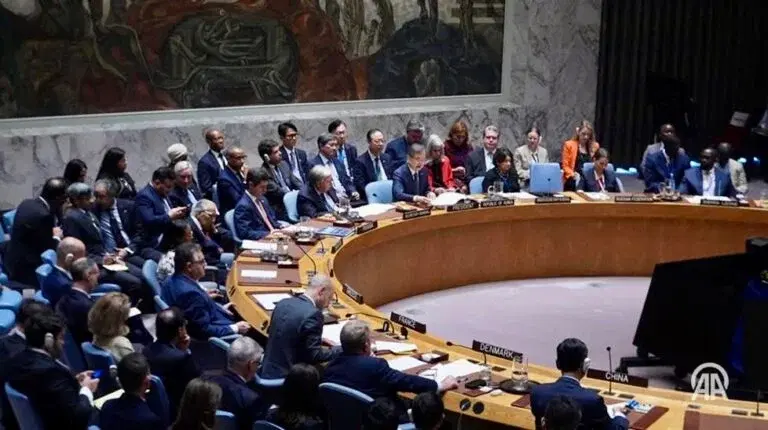
The UN Security Council adopted a resolution on Wednesday condemning Iran’s attacks on Gulf Cooperation Council (GCC) states, as well as Jordan.
nThe resolution passed with 13 votes in favor, with Russia and China abstaining.
nPresented by Bahrain and co-sponsored by 135 countries, the resolution emphasised “strong support for the territorial integrity, sovereignty and political independence” of the GCC states and Jordan.
nIt strongly condemns the “egregious attacks by the Islamic Republic of Iran against” the Gulf countries and Jordan, emphasising that the attacks “constitute a breach of international law and a serious threat to international peace and security.”
nThe resolution also condemned the targeting of civilian infrastructure, which “resulted in civilian casualties and damage to civilian buildings.”
nBahrain’s UN envoy Jamal Fares Alrowaiei welcomed the adoption.
n“It proved that the Council is committed to maintaining international peace and security.
n“We express our deep gratitude to all member states of the United Nations that co-sponsored this resolution.
n“Their number amounted to 135 countries. This overwhelming support by the international community reflects a collective awareness of the danger of the unjust Iranian attack against our countries,” he noted.
n nRelated Stories
 General News
CELEBRATING TWO YEARS OF TRANSFORMATIONAL LEADERSHIP IN THE PRESIDENTIAL AMNESTY PROGRAMME
Tomorrow, 14TH March 2026, as we look forward to the second anniversary, we reflect on the remarkable two years since the Administrator of the Preside
 General News
PRESIDENTIAL AMNESTY PROGRAMME PHASE 3: DISREGARD PURPORTED STATEMENT ON DELAYED ITA PAYMENTS — OFFICE OF NATIONAL CHAIRMAN
The Office of the National Chairman of the Presidential Amnesty Programme Phase 3, General Elaye ThankGod Dollar Slaboh, has called on beneficiaries a
 General News
RE: CLARIFICATION ON MY PERSONAL RELATIONSHIPS
PUBLIC NOTICErnrnRE: CLARIFICATION ON MY PERSONAL RELATIONSHIPSrnrnIt has become necessary to make this public clarification following the increasing