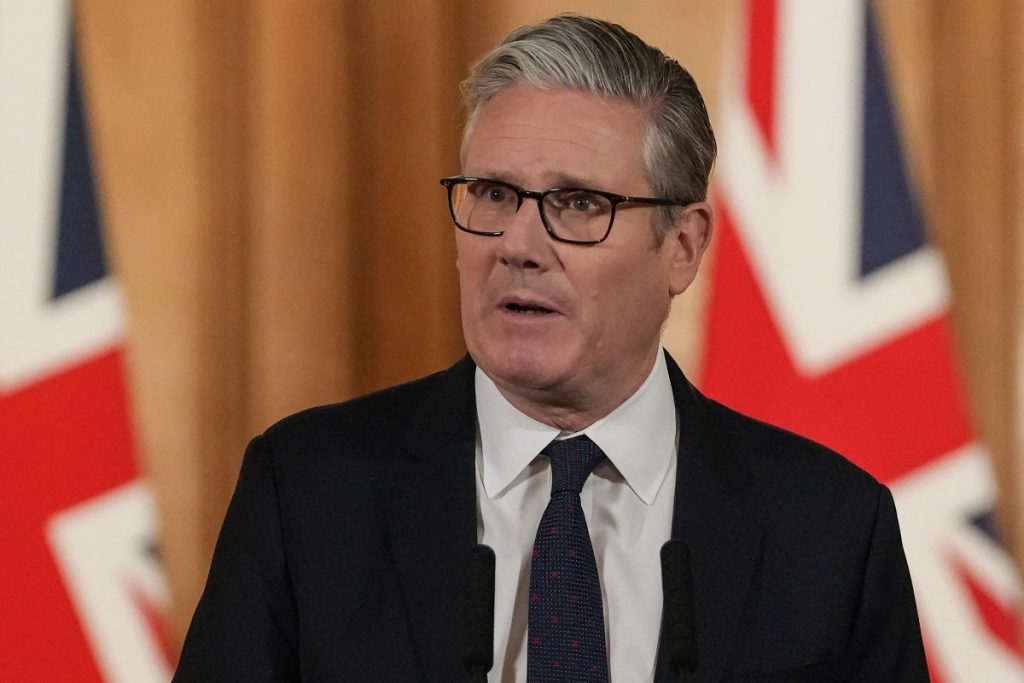
Britain’s Prime Minister Keir Starmer attends a press conference at Downing Street in central London on June 15, 2026, to announce government action to protect children online. (Photo by CARLOS JASSO / POOL / AFP)
Children under 16 will be banned from using social media in the UK, Prime Minister Keir Starmer announced on Monday, saying such platforms were making youngsters “unhappy”.
Some children’s charities welcomed the sweeping change, which is likely to trigger a major fight with US tech giants, but others warned it could make teenagers less safe online.
Starmer, likely to face a leadership challenge in the coming weeks, said social media sites were exposing children to content that is “dangerous” and “designed to be addictive”.
The ban will “include platforms like Snapchat, TikTok, YouTube, Instagram, Facebook and X” but not messaging services such as WhatsApp, the government said.
Some young people gave a mixed response to the move.
“I think it’s a good thing, to be honest, because I don’t even remember what age I was when I got Instagram, but it was just way too early,” student Connie Skitt, 19, told AFP in Buxton, central England.
“You’re making friends with people you don’t know. It’s like, not that safe.”
But 18-year-old tour guide Tom Warvell expressed concerns that 16 was “a little bit high”, arguing younger teens were “a better age to focus on”.
“Times have changed so it is important for people to still be able to use it.”
– Australian example –
Starmer said the upcoming ban was influenced by the experience of Australia, which in December became the first nation to ban people under 16 from social media.
The UK leader said he hoped to pass the regulation by late December and for the ban to come into force within months next year.
He suggested that YouTube Kids, Lego Play and Google Classroom would not be prohibited.
The government said it would also consider overnight curfews and breaks in infinite scrolling for minors, and would announce more detail in July.
Australia’s Prime Minister Anthony Albanese welcomed the move on X, saying: “Social media giants operate across borders. By standing together, we can do more to hold them accountable and keep children safe online.”
Canada and France are among other countries considering similar bans, while Indonesia began enforcing its ban for users under 16 in March.
Britain’s ban could anger US President Donald Trump after the US embassy in London earlier this month came out against “broad social media bans”.
Starmer’s announcement follows a government-led consultation where British teenagers trialled social media bans and time limits on apps.
The National Society for the Prevention of Cruelty to Children insisted the policy must include “robust age checks on platforms” and “an effective enforcement regime”.
But Save The Children UK voiced concerns that a ban “pushes children into less regulated spaces, where they are less likely to seek help when something goes wrong”.
– Blocking ‘harmful functions’ –
A YouTube spokesperson warned a blanket ban would push children towards “less safe services”.
Meanwhile the government also said it would block “harmful functions” on gaming services and live streaming platforms allowing strangers to contact children.
“Is there a situation in the offline world where you would just let your child pair up with a stranger? An adult that you don’t know about? No. So we’re taking action on that,” Starmer said, without giving details.
The British consultation, which closed in late May, attracted about 116,000 contributions — the second-largest response ever received under the consultation system.
More than four-fifths of responding parents said social media’s risks outweighed the benefits for children, with 91 percent backing a minimum age of 16.
The UK announcement comes a week after the government said tech giants must stop children in Britain from being able to send and receive nude images on their devices.
Britain’s interior ministry said it was giving companies, including Apple and Google, three months to introduce safety features to block children from taking and accessing naked photos on phones and tablets.
If they failed to do so, the government would introduce legislation forcing them to activate the technology, it warned.
According to analysis by the Internet Watch Foundation charity cited by the government, 91 percent of online child sexual abuse reports recorded in 2024 contained self-generated content from children themselves.

Comments
Please login to leave a comment.
No comments yet. Be the first to share your thoughts!