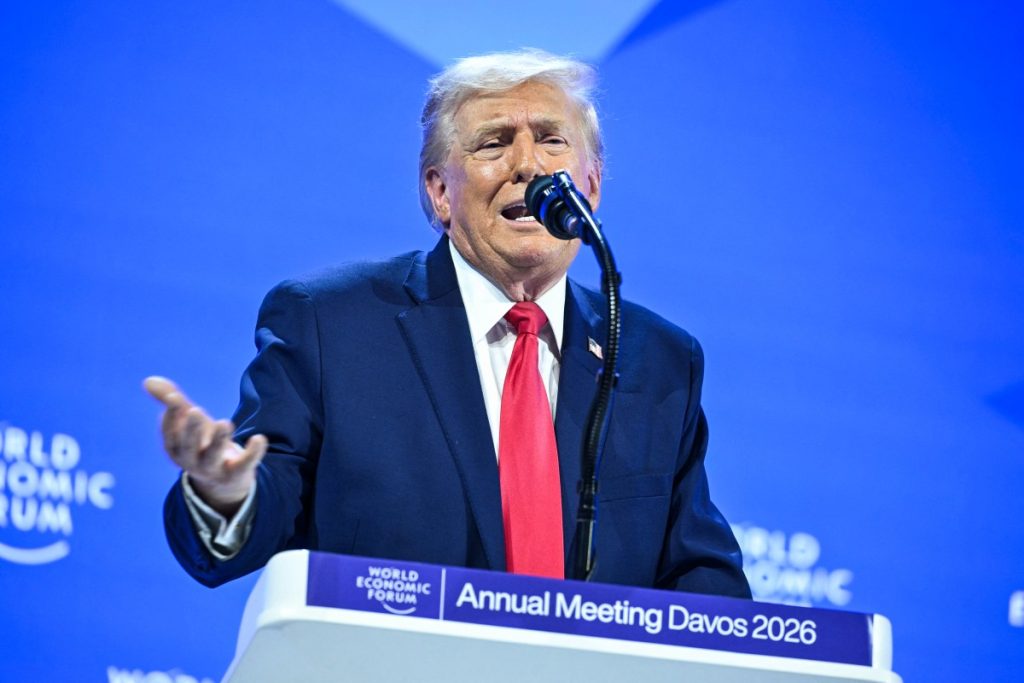
US President Donald Trump announced on Monday that military operations in Iran would soon come to an end, calming markets that had been thrown into turmoil by the ongoing conflict in the Middle East.
The war had caused stock markets to plummet and oil prices to surge on Monday, as Tehran, under the leadership of new leader Mojtaba Khamenei, launched a fresh barrage of missiles at its Gulf neighbors and indicated that the strategic Strait of Hormuz would likely remain closed.
Wall Street rallied into positive territory on Tuesday, following Trump's signals of a short war, with Tokyo and Seoul also opening strongly, despite the president's continued threats to expand the campaign if Iran did not comply.
Oil prices also reversed course, falling by as much as five percent a day after benchmark crude reached its highest level since Russia's invasion of Ukraine in 2022, surpassing $100 a barrel.
Trump told a news conference in Florida that the conflict would be ended soon, stating "It's going to be ended soon, and if it starts up again they'll be hit even harder," after informing lawmakers that the campaign would be a "short-term excursion."
Iran's Revolutionary Guards responded on Tuesday, saying that they, not the Americans, would "determine the end of the war," as Iranian forces launched a fresh wave of missile and drone attacks on Saudi Arabia, Bahrain, Qatar, the UAE, and Israel.
Another missile was also fired at NATO member Turkey, the second such incident in five days, with the alliance's air defenses intercepting it before it could reach its target, as diplomatic efforts focused on reopening the strategic Strait of Hormuz.
French President Emmanuel Macron stated that his country and its allies were working on a "purely defensive" mission to reopen the strait, which has been blocked to nearly all oil tankers, sending shockwaves across the global economy.
The mission would aim to escort ships "after the end of the hottest phase of the conflict," but experts warn that it would put naval vessels at risk of fire from the nearby Iranian coast, as nearly 20 percent of the world's crude oil usually transits through the strait.
Kamal Kharazi, a foreign policy adviser to Iran's supreme leader, said that Tehran was calculating that economic pressure would eventually prompt other countries to intervene and end the war, as the conflict continues to escalate.
Iran faced a fresh wave of US and Israeli strikes after its Assembly of Experts appointed Mojtaba Khamenei as its first new supreme leader in 37 years, with Iranian state media carrying images of tens of thousands of people celebrating his selection in central Tehran.
Iran's rebel Houthi allies in Yemen and the Hezbollah armed group in Lebanon pledged allegiance to the new supreme leader, while Russian President Vladimir Putin promised "unwavering support" on Monday, as the international community watches the situation unfold.
Trump expressed disappointment about Khamenei's appointment but remained open to a replacement from inside the Islamic republic, citing the recent transition of power in Venezuela as "a formula that has been very good so far."
Ali Ansari, a professor of Iranian history at the University of St Andrews in Scotland, described the new supreme leader as a hardliner who had "been involved in all the most violent repressions that have taken place over the last 15-16 years," as concerns grow about the implications of his leadership.
Oil traders, policymakers, and central bankers are closely watching the Middle East for news about Gulf energy infrastructure, which is crucial for the world economy, as about 10 vessels in or near the Strait of Hormuz have come under attack since Iran blocked the waterway.
Global shipping giant MSC announced it was formally halting some export shipments from the Gulf, meaning goods sitting on ships would be unloaded, as the conflict disrupts global trade.
Following strikes on Bahrain's Al Ma'ameer oil facility that ignited a fire, the country's state-owned energy company Bapco joined its counterparts in Qatar and Kuwait in declaring "force majeure" — a warning that events beyond its control may lead it to miss export targets.
The Saudi defence ministry said on Monday that it had thwarted a drone attack targeting an oil field in the kingdom's east, near the Emirati border, as the conflict continues to pose a threat to regional energy security.
In Bahrain, the interior ministry reported that an Iranian attack on a residential area in the capital Manama killed one person and injured others, as the conflict spills over into civilian areas.
In Israel, around 10 explosions were audible in Tel Aviv after the military announced it had detected missiles inbound from Iran, resulting in the death of at least one Israeli who was hit by shrapnel, according to emergency services.
Israel struck an Iranian missile launcher shortly after a barrage fired from the Islamic republic triggered air raid warnings in several Israeli areas, as the conflict escalates.
The multi-front war also intensified in Lebanon, where Israeli and Hezbollah exchanges of fire since March 2 have killed at least 486 people and wounded more than 1,300, as the international community calls for a ceasefire.
Lebanese President Joseph Aoun accused Hezbollah of working to "collapse" the state, while the head of the group's parliamentary bloc said it had "no other option...than the option of resistance," as the conflict threatens to destabilize the region.

Comments
Please login to leave a comment.
No comments yet. Be the first to share your thoughts!