
Trump Issues 48-Hour Ultimatum to Iran to Reopen Strait of Hormuz Amid Iranian Attacks on Israel
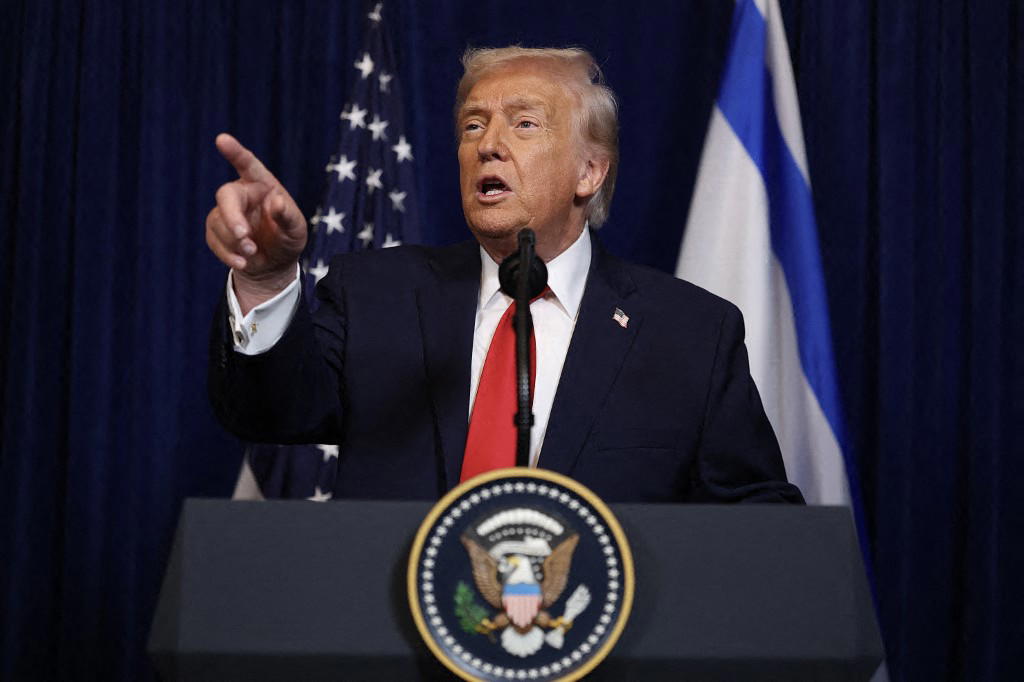
US President Donald Trump issued a 48-hour ultimatum to Iran on Saturday, warning that the country's energy infrastructure would be destroyed if the Strait of Hormuz was not reopened to shipping by 23:44 GMT on Monday.
nIn a post on Truth Social, Trump stated that the US would "hit and obliterate" Iranian power plants, starting with the largest one, if Tehran failed to comply with the deadline.
nIran's Foreign Minister Abbas Araghchi responded by saying that restrictions had only been imposed on vessels from countries involved in attacks against Iran, and that assistance would be provided to other countries that remained neutral in the conflict.
nIn retaliation to Trump's threat, Iran's army announced that it would target energy and desalination infrastructure belonging to the US and its regional allies, according to the Fars news agency.
nTrump's ultimatum came after two Iranian missiles struck southern Israel, injuring over 100 people in the most destructive attack since the war began, with Israeli Prime Minister Benjamin Netanyahu vowing to retaliate "on all fronts".
nThe missile strikes, which breached Israel's defense systems, caused significant damage to residential buildings and infrastructure in the towns of Arad and Dimona, with 84 people injured in Arad and 33 wounded in Dimona.
nIn Dimona, which is believed to be the site of the Middle East's only nuclear arsenal, a large hole was gouged into the ground next to piles of rubble and twisted metal, with the Israeli army reporting a "direct missile hit on a building" and casualties at multiple sites.
nNetanyahu described the evening as "very difficult" and pledged to continue striking Iran, with the Israeli military launching a wave of strikes on Tehran hours later.
nIran claimed that the targeting of Dimona was in retaliation for Israeli strikes on its Natanz nuclear facility, with the Islamic Revolutionary Guard Corps saying that other southern Israeli towns and military sites in Kuwait and the UAE were also targeted.
nUN nuclear watchdog chief Rafael Grossi reiterated his call for "military restraint to avoid any risk of a nuclear accident" following the Natanz attack, which damaged underground centrifuges used to enrich uranium for Iran's nuclear program.
nThe Israeli military denied involvement in the Natanz strike but said it had struck a facility at a Tehran university that was allegedly being used to develop nuclear weapon components for Iran's ballistic missile program.
nThe destruction in Israel marked the culmination of three weeks of heavy US-Israeli bombardment, which appeared to have had little impact on Iran's ability to launch missile and drone attacks across the region.
nIran also launched an unsuccessful ballistic-missile attack on the US-UK base at Diego Garcia, approximately 4,000 kilometers away, which would have been the longest-range Iranian strike yet if it had been successful.
nThe United Arab Emirates reported facing aerial attacks after Iran warned it against allowing strikes from its territory on disputed islands near the Strait of Hormuz, which Iran has effectively closed off.
nThe closure of the strait, which carries a fifth of global crude oil trade in peacetime, has driven crude oil prices above $105 a barrel, sparking concerns about the long-term consequences for the global economy.
nA joint statement from the leaders of several countries, including the UK, France, Italy, Germany, South Korea, Australia, the UAE, and Bahrain, condemned the "de facto closure of the Strait of Hormuz by Iranian forces" and expressed readiness to contribute to efforts to ensure safe passage through the strait.
nTrump has criticized NATO allies as "cowards" and urged them to secure the strait, while analysts have noted that Iran's government has shown remarkable resilience in the face of the war, with its strike capacity proving more durable than expected.
nAccording to Neil Quilliam of Chatham House, Iran is "showing a lot of resilience that we didn’t perhaps expect, that the US didn’t expect, when it took this on".
nAs the war entered its fourth week, Tehran marked the end of Ramadan, with the head of the judiciary, Gholam Hossein Mohseni Ejei, attending Eid al-Fitr prayers at the Imam Khomeini grand mosque in central Tehran, instead of the country's supreme leader, Mojtaba Khamenei.
Related Stories
 General News
CELEBRATING TWO YEARS OF TRANSFORMATIONAL LEADERSHIP IN THE PRESIDENTIAL AMNESTY PROGRAMME
Tomorrow, 14TH March 2026, as we look forward to the second anniversary, we reflect on the remarkable two years since the Administrator of the Preside
 General News
PRESIDENTIAL AMNESTY PROGRAMME PHASE 3: DISREGARD PURPORTED STATEMENT ON DELAYED ITA PAYMENTS — OFFICE OF NATIONAL CHAIRMAN
The Office of the National Chairman of the Presidential Amnesty Programme Phase 3, General Elaye ThankGod Dollar Slaboh, has called on beneficiaries a
 General News
RE: CLARIFICATION ON MY PERSONAL RELATIONSHIPS
PUBLIC NOTICErnrnRE: CLARIFICATION ON MY PERSONAL RELATIONSHIPSrnrnIt has become necessary to make this public clarification following the increasing