
Trump Confronts Stalemate on Iran Conflict
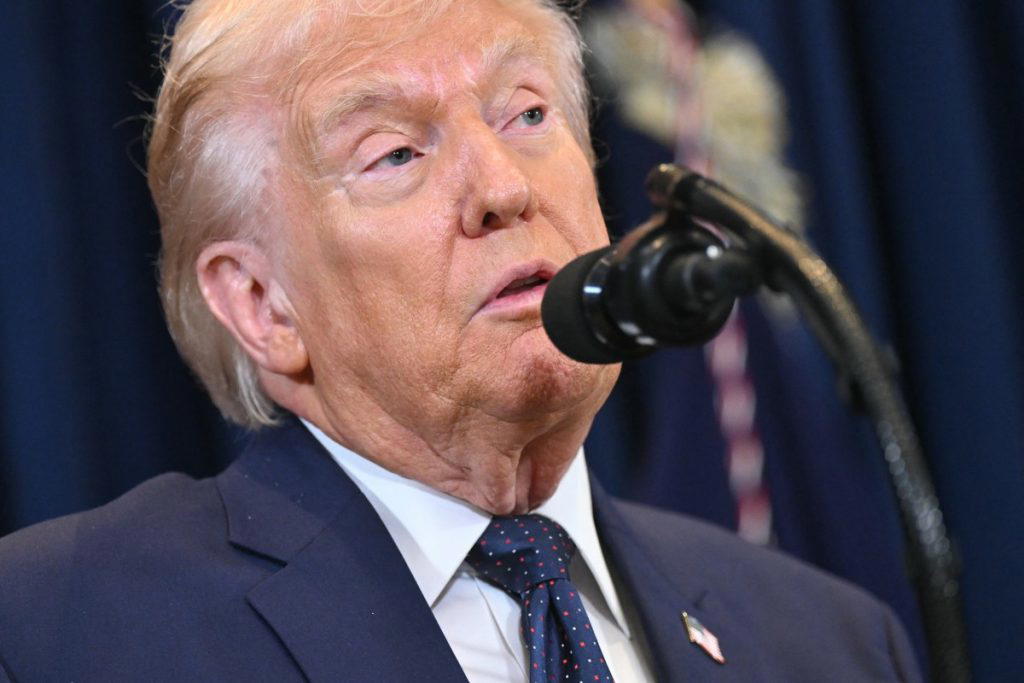
US President Donald Trump spoke at a press conference at Trump National Doral in Miami, Florida, on March 9, 2026, where he threatened a larger attack on Iran if it blocks oil supplies, whose prices have spiked due to the Middle East war.
nPresident Trump's inability to clearly define an objective or exit strategy for the conflict in Iran has led to an impasse, just weeks into the war, with the American public yet to be convinced of the need for a new war in the region.
nThe high-profile resignation of a senior US counterterrorism official on Tuesday further complicated matters, as the official stated that Iran poses "no imminent threat to our nation" and that they could not "in good conscience support the ongoing war in Iran".
nDespite President Trump's claims that Iran has been "decimated" by American and Israeli strikes, he has not declared victory, likely because it takes both sides to end a war unless one opponent capitulates, and Iran has shown no intention of surrendering.
nIran, though severely weakened by airstrikes that began on February 28, has continued to voice its refusal to surrender, and the US media has reported that President Trump failed to anticipate Iran's remaining capacity for retaliation.
nThe war, now in its third week, has seen oil prices soar as violence spreads throughout the Middle East, from Lebanon to the Gulf, including attacks on the US embassy in Iraq.
nPresident Trump's decision to join Israel's side without a mandate or consulting Congress or global allies has led to him paying the price, with Europeans and other allies politely refusing his requests for aid in the Strait of Hormuz.
nOn Tuesday, President Trump reversed course, stating that he no longer needed the help of his allies, and in a rare admission, said on Monday that he was surprised by the Iranian reprisals targeting Gulf countries, despite Tehran's repeated warnings.
nPresident Trump stated, "They weren't supposed to go after all these other countries in the Middle East, nobody expected that, we were shocked."
nRichard Haass, president emeritus of the Council on Foreign Relations, noted that "while the United States initiated this conflict on its own, it will require both Israel and Iran to sign on to stopping it".
nHaass, a former US diplomat in George W. Bush's administration, added that "the longer this war goes on, the more the balance between its costs and benefits shifts toward the former".
nFor the United States, victory in the war means resuming maritime traffic in the Strait of Hormuz to restore global oil supplies and an end to Tehran's attacks on its neighbors, but many observers say this will not be possible through military force alone.
nThe diplomatic path has narrowed significantly, but it remains an option, and will depend in part on the Islamic republic's goodwill, with the question remaining as to who will come to the table to negotiate.
nSina Toossi, a senior fellow at the Center for International Policy, said "there are no clean options at this point, only less bad ones", and that "the most realistic path is a negotiated de-escalation that allows all sides to save face".
nToossi added that "the US can claim it degraded Iran's capabilities, while Iran claims it absorbed the pressure and demonstrated it can retaliate", and that "Persian Gulf stability ultimately requires some degree of accommodation with Iran".
nMona Yacoubian, the Middle East program director at the Center for Strategic and International Studies, stated that the region is "currently living their 'nightmare scenario'".
nYacoubian said that "Gulf governments will need to find a way forward that acknowledges Iran's enduring regional presence", in order to move forward.
nUntil then, America's allies are not hiding their frustration, with German Chancellor Friedrich Merz saying on Monday that the US war against Iran is not a NATO matter, and that Berlin will not join the war or help clear transit in the Strait of Hormuz.
nChancellor Merz stressed that talks to find a diplomatic solution cannot begin until Israel and the United States say they have achieved their military objectives.
Related Stories
 General News
CELEBRATING TWO YEARS OF TRANSFORMATIONAL LEADERSHIP IN THE PRESIDENTIAL AMNESTY PROGRAMME
Tomorrow, 14TH March 2026, as we look forward to the second anniversary, we reflect on the remarkable two years since the Administrator of the Preside
 General News
PRESIDENTIAL AMNESTY PROGRAMME PHASE 3: DISREGARD PURPORTED STATEMENT ON DELAYED ITA PAYMENTS — OFFICE OF NATIONAL CHAIRMAN
The Office of the National Chairman of the Presidential Amnesty Programme Phase 3, General Elaye ThankGod Dollar Slaboh, has called on beneficiaries a
 General News
RE: CLARIFICATION ON MY PERSONAL RELATIONSHIPS
PUBLIC NOTICErnrnRE: CLARIFICATION ON MY PERSONAL RELATIONSHIPSrnrnIt has become necessary to make this public clarification following the increasing