
Tinubu takes steps to mitigate effects of Mideast conflict on Nigeria's transportation sector
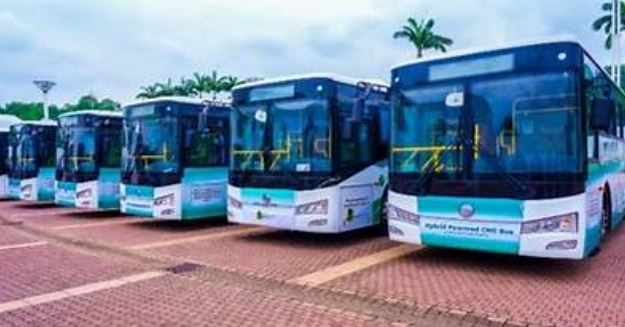
Prioritizing the nation's energy needs, President Bola Tinubu has ordered the immediate deployment of approximately 100,000 Compressed Natural Gas (CNG) conversion kits across Nigeria, aiming to mitigate the impact of the escalating Middle East conflict on commuters.
nThis directive is part of the Federal Government's efforts to reduce transportation costs and expand alternative energy options, in response to the rising prices of petrol and diesel triggered by the ongoing United States–Israel war with Iran.
nExecutive Chairman of the Presidential Initiative on Compressed Natural Gas (Pi-CNG), Ismaeel Ahmed, disclosed the President's directive to journalists on Tuesday, following a meeting with Tinubu, highlighting the President's keen interest in monitoring global developments and their impact on Nigeria's energy costs.
nAhmed stated that Tinubu has mandated the Pi-CNG initiative to accelerate the rollout of CNG infrastructure and alternative mobility solutions nationwide, particularly in light of the Middle East conflict's effect on fuel prices and transportation.
nAccording to Ahmed, the President is focused on scaling up the availability of gas and CNG across the country, to reduce transportation costs for citizens, especially amidst the rising cost of petrol and diesel.
nTinubu has given a direct instruction for the immediate deployment of about 100,000 CNG conversion kits within the next few weeks, which will be distributed in collaboration with multiple stakeholders, enabling vehicle owners to convert their engines to run on gas.
nThe kits will be made available to vehicle owners, including tricycle operators, and the conversion centers are expected to be bustling with activity in the coming weeks, as the initiative aims to deploy the kits within two to three weeks.
nThe Pi-CNG initiative will also fast-track the development of infrastructure for CNG refuelling and electric vehicle charging across the country, with a focus on key transportation corridors, particularly in the northern part of the country.
nPresident Tinubu specifically directed that infrastructure expansion should prioritize the Northern Corridor, to bring gas, CNG, and electric mobility charging infrastructure to every part of the country, according to Ahmed.
nThe government is already developing a network of refuelling stations and charging facilities to support the transition to gas-powered and electric vehicles, with about 77 CNG refilling stations currently at various stages of development nationwide.
nIn Kano, for example, two Liquefied Compressed Natural Gas (LCNG) stations are already operational, while several "daughter stations" are under construction, as part of the government's plan to establish a chain of refuelling points along major transport routes.
nThe government plans to establish refuelling points along routes stretching from Lokoja through Abuja, Kaduna, Zaria, and Kano up to Maiduguri, with the aim of providing widespread access to CNG refuelling infrastructure.
nThe Pi-CNG initiative is working with local and international manufacturers to support vehicle conversion and the local assembly of CNG-powered and electric vehicles, which is expected to boost job creation and strengthen the local automotive industry.
nSeveral manufacturers have already indicated interest in setting up assembly lines in Nigeria, according to Ahmed, who noted that the collaboration will support the growth of the local automotive sector.
nThe Pi-CNG programme is also collaborating with the Rural Electrification Agency (REA) to deploy solar-powered charging stations that can support electric mobility, particularly in off-grid locations, to ensure that electric vehicles can be used in areas without access to traditional power infrastructure.
nAhmed noted that Nigerians are increasingly importing electric vehicles, and the government's focus is now on providing the necessary infrastructure to support their use, especially in off-grid areas.
nThe President expects rapid results from the initiative, aiming to ensure that Nigerians can quickly access cheaper and more sustainable transport alternatives, according to Ahmed.
Related Stories
 General News
CELEBRATING TWO YEARS OF TRANSFORMATIONAL LEADERSHIP IN THE PRESIDENTIAL AMNESTY PROGRAMME
Tomorrow, 14TH March 2026, as we look forward to the second anniversary, we reflect on the remarkable two years since the Administrator of the Preside
 General News
PRESIDENTIAL AMNESTY PROGRAMME PHASE 3: DISREGARD PURPORTED STATEMENT ON DELAYED ITA PAYMENTS — OFFICE OF NATIONAL CHAIRMAN
The Office of the National Chairman of the Presidential Amnesty Programme Phase 3, General Elaye ThankGod Dollar Slaboh, has called on beneficiaries a
 General News
RE: CLARIFICATION ON MY PERSONAL RELATIONSHIPS
PUBLIC NOTICErnrnRE: CLARIFICATION ON MY PERSONAL RELATIONSHIPSrnrnIt has become necessary to make this public clarification following the increasing