
The Strait closed without a shot, by Stephanie Shaakaa
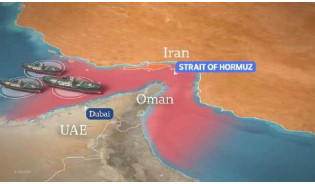
For generations, the world assumed that if the Strait of Hormuz ever closed, it would be because someone fired the first shot. What the world is discovering instead is far more unsettling.
nSometimes the strait closes when someone recalculates the risk.
nThere are moments in history when power appears loud and visible, only for its true center to reveal itself elsewhere, quiet and decisive.
nHormuz has always been imagined in dramatic terms. Warships cutting across narrow waters. Missiles tracing fire through the sky. Maps crowded with arrows and formations. It is the narrow passage through which nearly a fifth of the world’s oil must move, the place where every geopolitical crisis seems destined to arrive.
nSo whenever tensions rise between Iran and the West, the same question returns.
nWill Iran close the strait?
nFor decades, the answer was expected to come in the language of force. Mines laid in shipping lanes. Tankers seized. A show of strength that would bring traffic to a halt.
nBut what unfolded instead revealed something far more disquieting about the modern world.
nThe strait did not need to be closed.
nIt only needed to become uninsurable.
nIn a matter of days, traffic through one of the most critical arteries of the global economy slowed to a fraction of its usual flow. Tankers that would ordinarily carry crude from the Gulf to Asia did not depart. Routes that rarely sleep fell into an unfamiliar stillness.
nThere was no blockade.
nNo missiles.
nNo dramatic announcement.
nOnly a decision made far from the heat of the Gulf, in the measured calm of offices where risk is priced and consequences are calculated.
nTo understand the weight of that decision is to understand how global trade truly functions.
nAn oil tanker is not merely a vessel. It is a floating concentration of value, often worth hundreds of millions of dollars when ship and cargo are combined. No captain will move it through danger without protection. No port will receive it. No financier will underwrite its journey.
nWithout insurance, the ship does not sail.
nAnd when ships do not sail, trade does not slow. It stops.
nThe system that makes such decisions is neither loud nor visible. It does not command armies or deliver speeches. Yet it holds a form of authority that can rival both.
nFor centuries, London has served as the quiet center of maritime insurance. From the historic halls of Lloyd’s of London to the vast networks of reinsurance that extend beyond it, this is where risk is translated into numbers that shape the movement of the world.
nWhen those numbers cross a threshold, coverage disappears.
nWhen coverage disappears, ships remain in port.
nAnd when ships remain in port, one of the most strategic waterways on earth can fall silent without a single act of war.
nThe consequences move quickly and without mercy. Iran, so often cast as the power capable of threatening Hormuz, becomes one of the first to feel the weight of disruption. Its oil exports depend on those waters. When tankers stop, revenue contracts. The pressure is immediate.
nIn China, the stakes are equally stark. As the world’s largest importer of energy, it depends heavily on crude that must pass through the strait. Liquefied natural gas from Qatar follows the same route. When Hormuz hesitates, the foundations of energy security begin to shift.
nFor the Gulf states, the exposure is even more direct. Saudi Arabia, the United Arab Emirates, Kuwait, Iraq, and Qatar export vast volumes of oil and gas each day through a corridor barely thirty kilometers wide at its narrowest point. Alternative routes exist, but they cannot absorb a prolonged disruption.
nHormuz carries the rhythm of the global energy system.
nAnd that rhythm now depends not only on geopolitics, but on finance.
nThere is an irony here that reveals the deeper mechanics of power. When flows from the Gulf tighten, prices rise. As prices rise, other suppliers gain ground. Russia, already positioned as a major exporter, benefits from a market under strain. Buyers seeking reliability adjust quickly. Pressure applied in one direction often strengthens another.
nCountries such as India feel the strain in more immediate ways. Dependent on imported energy, they absorb the cost through inflation, through currency pressure, through the quiet but persistent burden placed on everyday life.
nYet the most enduring lesson of this moment is not about any single country.
nIt is about the nature of power.
nFor generations, global events have been understood through visible actors. Governments issue commands. Militaries execute them. Diplomats negotiate outcomes. These forces still matter.
nBut beneath them, another system has matured.
nEnergy determines what must move. Finance determines what can move. Insurance determines whether anything moves at all.
nMissiles can threaten a strait.
nBut risk can close it.
nThat truth defines the age we are entering. The spectacle of conflict remains familiar, unfolding in skies and on screens. Yet the decisive moments increasingly occur elsewhere, in systems that operate without drama but with absolute consequence.
nThey do not occupy territory.
nThey do not deploy troops.
nYet they can bring the machinery of the global economy to a halt.
nWhen Hormuz grows quiet, it does more than disrupt supply. It reveals a shift that has been building in plain sight.
nThe world is no longer governed only by those who command force.
nIt is governed, with equal authority, by those who decide what risk is acceptable.
nEmpires once controlled trade with fleets that dominated the seas.
nNow, one of the most strategic waterways on earth can fall silent because someone, somewhere, decided the risk was no longer worth the price. And that decision travels farther, faster, and with more finality than any missile ever could.
n nRelated Stories
 General News
CELEBRATING TWO YEARS OF TRANSFORMATIONAL LEADERSHIP IN THE PRESIDENTIAL AMNESTY PROGRAMME
Tomorrow, 14TH March 2026, as we look forward to the second anniversary, we reflect on the remarkable two years since the Administrator of the Preside
 General News
PRESIDENTIAL AMNESTY PROGRAMME PHASE 3: DISREGARD PURPORTED STATEMENT ON DELAYED ITA PAYMENTS — OFFICE OF NATIONAL CHAIRMAN
The Office of the National Chairman of the Presidential Amnesty Programme Phase 3, General Elaye ThankGod Dollar Slaboh, has called on beneficiaries a
 General News
RE: CLARIFICATION ON MY PERSONAL RELATIONSHIPS
PUBLIC NOTICErnrnRE: CLARIFICATION ON MY PERSONAL RELATIONSHIPSrnrnIt has become necessary to make this public clarification following the increasing