
The Ordeals of Dasuki and Malami: A Tale of Arch-Nemesis
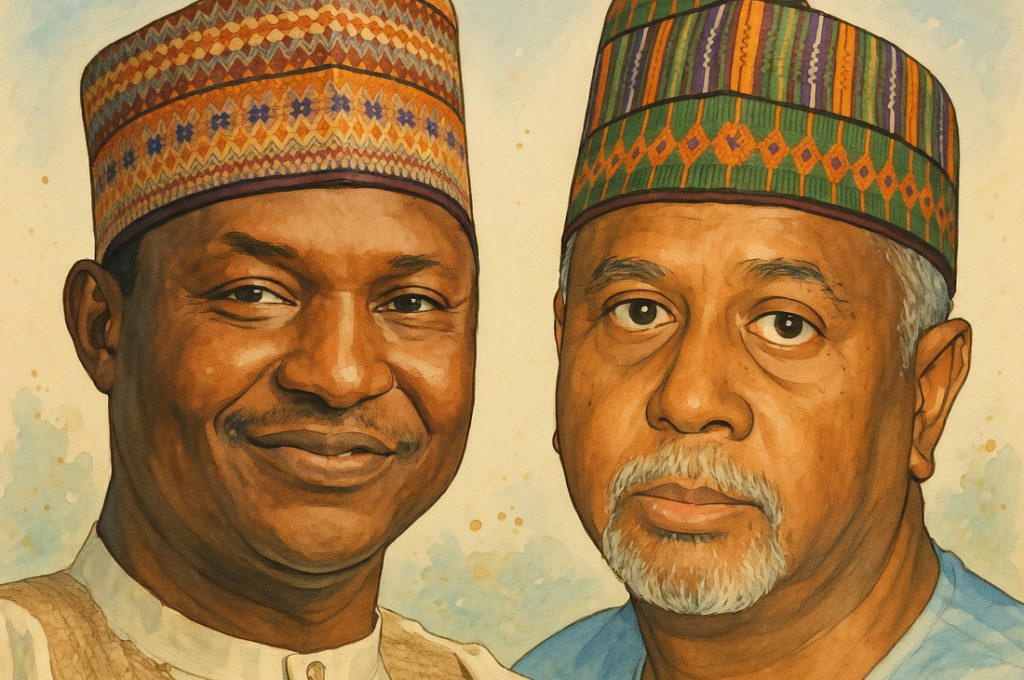
Nigeria's recent political history is replete with examples of the concept of karma, where the actions of individuals ultimately come back to haunt them, as seen in the parallel fates of Sambo Dasuki and Abubakar Malami.
nThose who are now sympathizing with Abubakar Malami, the former Attorney-General of the Federation, as he faces his current ordeal with the EFCC and the DSS, seem to have forgotten the plight of former National Security Adviser, Sambo Dasuki, who was arrested just a day after leaving office.
nDasuki's story is a disturbing example of executive overreach, where personal vendetta, political score-settling, and disregard for judicial authority were masked as a pursuit of justice, leaving an indelible mark on Nigeria's democratic era.
nThe roots of the Dasuki saga stretch back to Nigeria's military past, where he played a significant role in financing and facilitating the 1983 coup that brought General Muhammadu Buhari to power, according to retired Colonel Mustapha Jokolo, Buhari's former ADC.
nDasuki was also involved in the 1985 counter-coup that removed Buhari and installed General Ibrahim Babangida, although he was not directly involved in Buhari's arrest, as confirmed by Colonel Abdulmumini Aminu, who led the operation.
nThese historical details are crucial, as the bitterness they generated never fully dissipated, ultimately contributing to Dasuki's arrest in late 2015 on charges of money laundering related to the alleged diversion of arms-procurement funds during the Jonathan administration.
nDespite the seriousness of the allegations, Dasuki's tenure as NSA was marked by significant successes, including the reclamation of dozens of towns from terrorists and a period when banditry had not yet taken hold in the North-West or North-Central, a trend that escalated later under the Buhari administration.
nThe subsequent handling of Dasuki's case was a systematic assault on the rule of law, with multiple courts granting him bail, only for him to be re-arrested without new charges, a cycle that continued until he became the only public official in Nigerian history to remain in detention despite bail orders from four different courts, including the ECOWAS Court.
nIn a troubling twist, Malami reportedly claimed in a VOA interview that Dasuki had killed 100,000 people, justifying his continued detention on national-security grounds, a claim that was later recanted after Malami was summoned before the LPDC in 2019.
nPresident Buhari later reiterated the administration's stance, declaring that Dasuki would not be released regardless of court orders, describing him as a security risk, a rare moment of explicit executive contempt for judicial authority.
nThe Buhari era was marked by the normalization of media trials, where citizens were convicted in the court of public opinion before any judge had ruled, with the EFCC and the DSS being the most notorious instruments of this strategy, as seen in the case of Colonel Nicholas Ashinze.
nAshinze, a military intelligence officer who played a key role in operations against Boko Haram, faced charges despite the EFCC issuing a statement so inaccurate that it provoked a judicial rebuke, with Justice Gabriel Kolawole condemning the EFCC's conduct as "scandalous and prejudicial to fair trial".
nThe EFCC was ordered to apologize publicly to Ashinze, and the trial was suspended, highlighting the institutional impunity that characterized the period, as seen in the disbanding of the arms probe panel under ONSA, which was chaired by Air Vice Marshal Jon Odeh, after its members were themselves indicted.
nOne of the most heartbreaking aspects of Dasuki's ordeal was the treatment of his father, the late Alhaji Ibrahim Dasuki, former Sultan of Sokoto, who was denied permission to visit his son in detention, despite repeated appeals, and died without seeing him, an act widely condemned as unnecessary cruelty.
nIn contrast, when the current administration of President Bola Ahmed Tinubu detained former Kaduna Governor Nasir el-Rufai over corruption charges, he was immediately released following his mother's death, a gesture that, while welcome, highlighted the need for consistency in the standard of decency applied to all individuals, regardless of their position or status.
nDasuki was eventually released on Christmas Eve 2019, after more than four years in detention, a freedom that felt more like a political calculation than a genuine pursuit of justice, and which came after Buhari's re-election.
nThe treatment of Abubakar Malami, who served as Attorney-General and Minister of Justice from 2015 to 2023, is a stark contrast to Dasuki's, as Malami was arrested by the EFCC in 2025 on allegations ranging from corruption to terrorism-related offences, only to be granted bail by both the EFCC and the DSS within two months, without the sensational media trials or re-arrests that characterized Dasuki's case.
nThe irony is unmistakable, as Malami was the chief law officer who authorized and supervised the prosecution of Dasuki, and now finds himself on the receiving end of the same system he helped shape, highlighting the need for accountability and a consistent application of the rule of law.
nThe Buhari administration's disregard for due process extended beyond political opponents, as seen in the summary retirement of 38 senior officers on June 9, 2016, who were dismissed without a fair hearing, despite their decorated service and the lack of formal charges or trials under military law.
nThe National Industrial Court ruled six times that the retirements were unlawful and ordered reinstatement with full benefits, a decision that was ignored by the Army, leaving most of the officers unreinstated, vindicated by every court, yet denied the justice those courts prescribed, a legacy of lawlessness that must be addressed through the very institutions that were once undermined.
nThe question remains whether, this time, the system will do better, and whether those who orchestrated the abuses of the past will be held accountable, not through fresh lawlessness, but through a genuine commitment to the rule of law and the protection of individual rights.
Related Stories
 General News
CELEBRATING TWO YEARS OF TRANSFORMATIONAL LEADERSHIP IN THE PRESIDENTIAL AMNESTY PROGRAMME
Tomorrow, 14TH March 2026, as we look forward to the second anniversary, we reflect on the remarkable two years since the Administrator of the Preside
 General News
PRESIDENTIAL AMNESTY PROGRAMME PHASE 3: DISREGARD PURPORTED STATEMENT ON DELAYED ITA PAYMENTS — OFFICE OF NATIONAL CHAIRMAN
The Office of the National Chairman of the Presidential Amnesty Programme Phase 3, General Elaye ThankGod Dollar Slaboh, has called on beneficiaries a
 General News
RE: CLARIFICATION ON MY PERSONAL RELATIONSHIPS
PUBLIC NOTICErnrnRE: CLARIFICATION ON MY PERSONAL RELATIONSHIPSrnrnIt has become necessary to make this public clarification following the increasing