
Thabo Mbeki credits Abubakar with establishing the groundwork for Nigeria's enduring democratic governance.
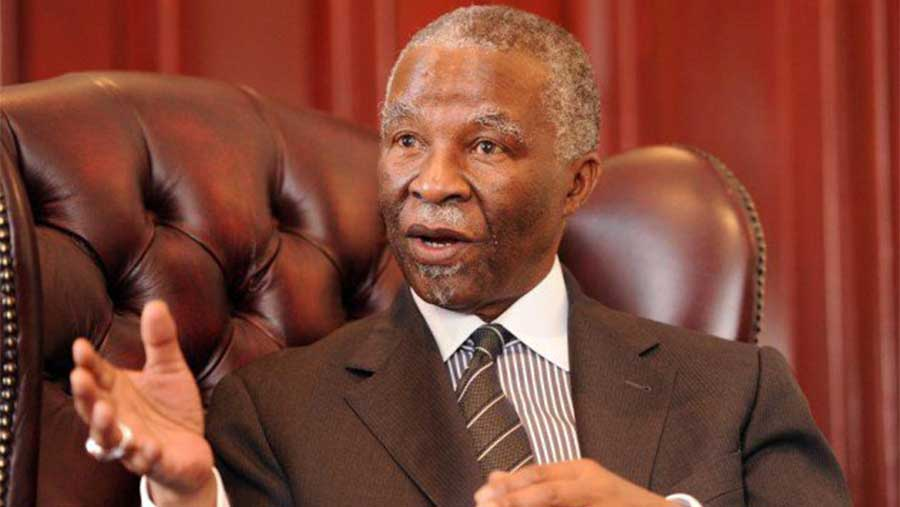
Former South African President Thabo Mbeki has praised former Nigerian Head of State General Abdulsalami Abubakar for his pivotal role in laying the groundwork for Nigeria's democratic stability through his historic transition programme that brought an end to military rule in 1999.
nMbeki noted that Abdulsalami's tenure, which spanned from 1998 to 1999, not only restored democratic governance in Nigeria but also established a framework that has sustained civilian rule and peaceful transfers of power for over two decades.
nThe former South African leader made these remarks in a keynote address delivered at the public presentation of three books in honour of Abdulsalami Abubakar, as part of activities marking the elder statesman's 84th birthday, although he was unable to attend in person due to a family bereavement.
nMbeki described Abdulsalami as one of Africa's foremost statesmen, whose contributions to democratic governance, peacebuilding, and constitutional rule continue to resonate across the continent, demonstrating uncommon patriotism and statesmanship by prioritising national interest over personal power.
nAccording to Mbeki, Abdulsalami's tenure is significant not only for its brevity but also for the lasting impact it created in the history of democratic transition in Africa, swiftly paving the way towards democratic governance in Nigeria and laying the foundation for subsequent peaceful transfers of power.
nUpon assuming office, Abdulsalami recognised the urgent need to restore political stability and public confidence in governance, prompting him to commit to a short transition programme that culminated in the return to civilian rule in May 1999, as noted by Mbeki.
nMbeki stated that Abdulsalami resisted the allure of power and instead focused on creating the constitutional and institutional frameworks necessary for democratic governance, placing the interests of his country first and overcoming the temptation and allure of power.
nThe institutions and democratic structures established during Abdulsalami's administration remain the bedrock upon which Nigeria's Fourth Republic has been built, with the constitutional framework and electoral institutions that he helped to create still serving as a foundation of Nigeria's democracy.
nBeyond Nigeria, Mbeki highlighted Abdulsalami's extensive contributions to peacebuilding and conflict resolution across Africa, describing him as one of the continent's most respected mediators, with prominent roles in peace negotiations, election observation missions, and reconciliation efforts in Liberia, Sierra Leone, Sudan, South Sudan, Niger, and The Gambia.
nMbeki recalled that he had the privilege of working closely with Abdulsalami under the auspices of the African Union on efforts aimed at promoting peace, stability, and democratic governance in Sudan and South Sudan.
nAbdulsalami's interventions in conflict situations across the continent earned him international respect as a trusted voice for peace and dialogue, with several countries and international bodies seeking his wisdom and experience in resolving conflicts and strengthening democratic institutions.
nAfrica's democratic future depends on leaders who are willing to emulate Abdulsalami's example by strengthening institutions, respecting constitutional processes, and placing national interest above personal ambition, according to Mbeki.
nWhile acknowledging that many African countries continue to face challenges ranging from electoral disputes and governance deficits to violent conflicts and institutional weaknesses, Mbeki noted that the continent has also recorded notable successes in democratic consolidation, citing countries such as South Africa, Ghana, Senegal, Liberia, and Sierra Leone as examples.
nMbeki stressed that democracy, peace, and security remain indispensable to Africa's development aspirations, warning that sustainable progress would remain elusive without accountable governance and strong institutions.
nThe former South African president emphasized that the duty of advancing democratic governance and building peace and security in Africa must be a generational endeavour, requiring the education and inspiration of young people to embrace leadership founded on service, integrity, and commitment to the common good.
nMbeki commended the authors of the three books launched in honour of Abdulsalami, saying that scholarly works are vital for preserving history and providing future generations with lessons on leadership and nation-building.
nMbeki described Abdulsalami as "an eminent African statesman, a principled soldier, and a man for all seasons" whose legacy would continue to inspire leaders across the continent, with his selfless service, commitment to national unity, and exemplary leadership remaining a model for others to follow.
nIn celebrating General Abdulsalami Abubakar, Mbeki affirmed that his contributions to democracy and peace in Africa will continue to inspire future generations, serving as a testament to the enduring impact of his leadership and vision.
Related Stories
 General News
CELEBRATING TWO YEARS OF TRANSFORMATIONAL LEADERSHIP IN THE PRESIDENTIAL AMNESTY PROGRAMME
Tomorrow, 14TH March 2026, as we look forward to the second anniversary, we reflect on the remarkable two years since the Administrator of the Preside
 General News
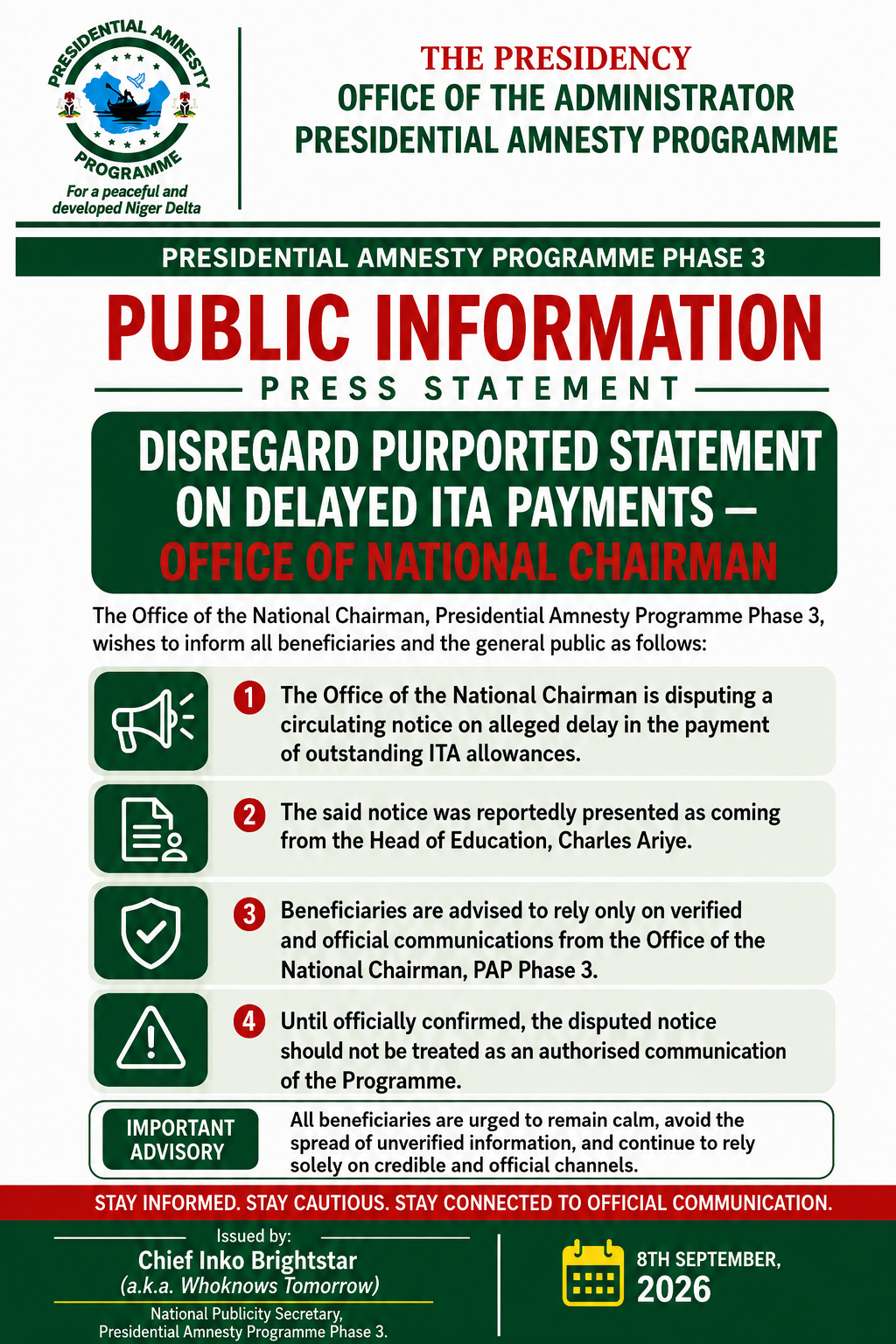
PRESIDENTIAL AMNESTY PROGRAMME PHASE 3: DISREGARD PURPORTED STATEMENT ON DELAYED ITA PAYMENTS — OFFICE OF NATIONAL CHAIRMAN
The Office of the National Chairman of the Presidential Amnesty Programme Phase 3, General Elaye ThankGod Dollar Slaboh, has called on beneficiaries a
 General News
RE: CLARIFICATION ON MY PERSONAL RELATIONSHIPS
PUBLIC NOTICErnrnRE: CLARIFICATION ON MY PERSONAL RELATIONSHIPSrnrnIt has become necessary to make this public clarification following the increasing