
Study by itself is insufficient to resolve Nigeria's medical emergency, says Professor Onoka
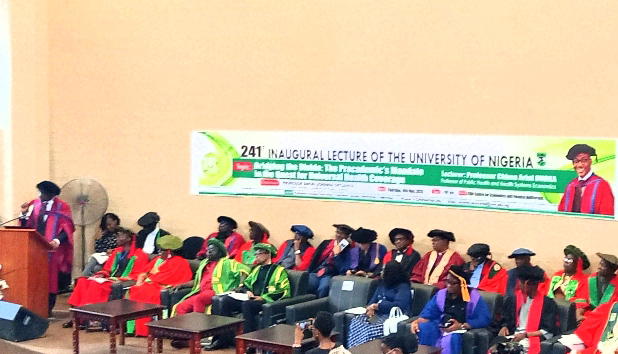
Prof. Chima Onoka, a Professor of Public Health and Health Systems Economics at the University of Nigeria, emphasized that research alone is insufficient to transform Nigeria's healthcare system, highlighting the need for effective policy implementation and political engagement.
nOnoka made this statement during the 241st Inaugural Lecture of the university, titled "Bridging the Divide: The Pracademic's Mandate in the Quest for Universal Health Coverage," where he underscored the importance of professionals with both academic expertise and practical skills.
nHe noted that Nigeria's healthcare reforms require individuals who combine academic knowledge with policy, advocacy, and implementation skills, referring to them as "pracademics," and stressing that this blend of skills is crucial for progress.
nDespite the availability of sufficient research evidence for healthcare reform in Nigeria, Onoka pointed out that progress toward Universal Health Coverage has been slow due to factors such as political interests, bureaucracy, and poor policy execution.
nOnoka described universal health coverage as "a power problem," emphasizing that many reforms pose a threat to entrenched interests that control public resources and healthcare financing, leading to resistance to change.
nNigeria's heavy reliance on out-of-pocket healthcare spending was lamented by Onoka, who revealed that citizens directly fund approximately 72 per cent of healthcare costs, highlighting the need for alternative financing mechanisms.
nThe professor estimated that Nigeria's healthcare financing gap would be between ₦157 trillion and ₦236 trillion over the next decade, but suggested that improved efficiency and better resource allocation could help reduce this burden.
nOnoka commended reforms implemented by the National Health Insurance Authority and praised the Basic Healthcare Provision Fund for expanding access to healthcare services, acknowledging the positive impact of these initiatives.
nHe warned that without stronger financial protection mechanisms, Nigeria's healthcare system would continue to push citizens into poverty, emphasizing the need for urgent action to address this issue.
nJosaphat Onwumere, the Deputy Vice-Chancellor of the University of Nigeria, described Onoka's lecture as intellectually enriching and practically relevant, highlighting its significance and impact.
Related Stories
 General News
CELEBRATING TWO YEARS OF TRANSFORMATIONAL LEADERSHIP IN THE PRESIDENTIAL AMNESTY PROGRAMME
Tomorrow, 14TH March 2026, as we look forward to the second anniversary, we reflect on the remarkable two years since the Administrator of the Preside
 General News
PRESIDENTIAL AMNESTY PROGRAMME PHASE 3: DISREGARD PURPORTED STATEMENT ON DELAYED ITA PAYMENTS — OFFICE OF NATIONAL CHAIRMAN
The Office of the National Chairman of the Presidential Amnesty Programme Phase 3, General Elaye ThankGod Dollar Slaboh, has called on beneficiaries a
 General News
RE: CLARIFICATION ON MY PERSONAL RELATIONSHIPS
PUBLIC NOTICErnrnRE: CLARIFICATION ON MY PERSONAL RELATIONSHIPSrnrnIt has become necessary to make this public clarification following the increasing