
Strong democratic institutions key to tackling insecurity — Saraki
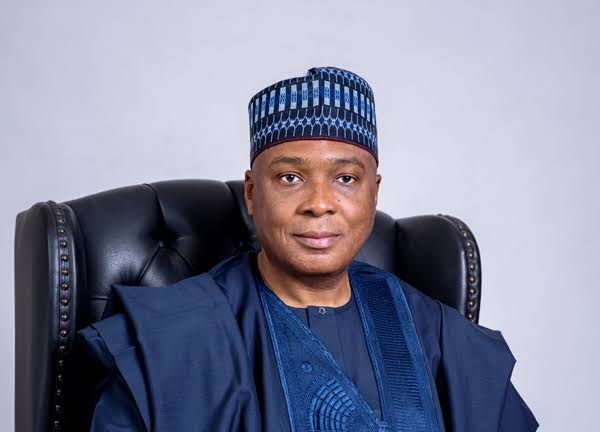
Saraki
n…Says 8th Senate was not a rubber stamp
…Urges Nigerians to cherish democracy
By Dapo Akinrefon
nFormer Senate President, Bukola Saraki, has said that strong democratic institutions are essential to addressing Nigeria’s security challenges, while urging lawmakers to promote transparency and strengthen public trust in governance.
nSaraki stated this on Friday while delivering a keynote address at The Platform, a programme organised by The Covenant Nation in Lagos.
nSpeaking on the theme, “How Legislature Brings About Democratic Stability by Strengthening Governance and National Development,” Saraki said the legislature plays a critical role in ensuring accountability through oversight of government borrowing, budgets and public appointments.
n“A strong legislature promotes transparency. A transparent government inspires public trust. Public trust strengthens democratic legitimacy. And democratic legitimacy produces stability,” he said.
nAccording to him, the independence of the National Assembly should not be viewed as opposition to the executive arm of government but as a necessary feature of a healthy democracy.
n“The independence of the National Assembly is not rebellion against the government of the day. It is the very thing that makes a government legitimate because a mandate that is never tested is a mandate no one can trust,” he said.
nSaraki also argued that national stability cannot be achieved through security measures alone, noting that societies with strong security structures can still suffer instability when trust in institutions is weak.
n“When we speak of national stability, attention often shifts to the military, police and other security agencies. Physical security is important, but it alone cannot create stability. The most heavily policed societies can still be unstable, fractured by inequality and weakened by a lack of public trust,” he said.
nReflecting on his tenure between 2015 and 2019, Saraki maintained that the 8th Senate was not a rubber stamp legislature and was committed to protecting citizens’ rights.
nHe noted that the Senate under his leadership handled and resolved more public petitions than any previous Senate in the current democratic dispensation.
nAs an example, he cited the case of Police Corporal Celestine Williams, who was dismissed from service in 1996 without trial under a military decree.
nAccording to Saraki, the Senate Committee on Ethics, Privileges and Public Petitions reviewed the matter and found the dismissal inconsistent with democratic principles, leading to Williams’ reinstatement.
n“That is what governance feels like from the ground—not grand theories, but real interventions that affect people’s lives,” he said.
nThe former Kwara State governor stressed that the legislature remains a vital pillar of democracy.
n“The legislature, for all its imperfections, is the load-bearing wall of our democracy. Remove it, weaken it or hollow it out, and the whole structure comes down,” he said.
nSaraki acknowledged that the 8th Senate experienced periods of tension with the executive arm of government but insisted that such disagreements were part of the constitutional responsibility of an independent legislature.
n“We did not see our role as merely applauding whatever came from the executive. There were moments of real tension—uncomfortable, costly and personal—but that is part of democratic governance,” he added.
nOn Democracy Day, Saraki said June 12 remains a powerful symbol of Nigerians’ commitment to democratic values and the rule of law.
nHe recalled that the date commemorates the 1993 presidential election widely believed to have been won by late M.K.O. Abiola before its annulment.
n“Democracy in Nigeria was never handed to us. It was fought for. And what is fought for must be cherished, protected and built upon, or it slips away,” he said.
nHe urged Nigerians to continue defending democratic institutions and values, stressing that the country’s democratic gains were achieved through sacrifice and must not be taken for granted.
n nRelated Stories
 General News
CELEBRATING TWO YEARS OF TRANSFORMATIONAL LEADERSHIP IN THE PRESIDENTIAL AMNESTY PROGRAMME
Tomorrow, 14TH March 2026, as we look forward to the second anniversary, we reflect on the remarkable two years since the Administrator of the Preside
 General News
PRESIDENTIAL AMNESTY PROGRAMME PHASE 3: DISREGARD PURPORTED STATEMENT ON DELAYED ITA PAYMENTS — OFFICE OF NATIONAL CHAIRMAN
The Office of the National Chairman of the Presidential Amnesty Programme Phase 3, General Elaye ThankGod Dollar Slaboh, has called on beneficiaries a
 General News
RE: CLARIFICATION ON MY PERSONAL RELATIONSHIPS
PUBLIC NOTICErnrnRE: CLARIFICATION ON MY PERSONAL RELATIONSHIPSrnrnIt has become necessary to make this public clarification following the increasing