
Street light poles, local industry, economics Nigeria cannot ignore
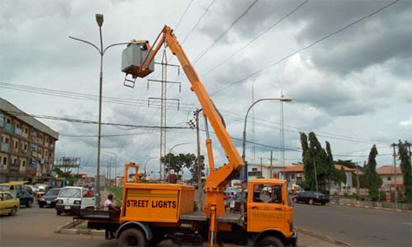
•Installation of street light.
nBy LADI ALAPINI
nAs Nigeria pushes ahead with one of the most expansive road infrastructure programmes in its history, a quiet but consequential question sits beneath the asphalt and concrete: who will supply the millions of street light poles required to illuminate these highways? The instinctive answer should be Nigerian fabricators. Yet, without a deliberate and enforceable policy of local patronage, the country risks repeating a familiar pattern: exporting capital, importing jobs and weakening its own industrial base.
nThis is more than a procurement decision. It is a referendum on Nigeria’s commitment to economic sovereignty, job creation, and sustainable industrialisation.
nSince May 2023, the administration of President Bola Tinubu has either initiated or accelerated over 21,000 kilometres of road projects cutting across federal, state and local jurisdictions. Flagship corridors such as the Lagos–Calabar Coastal Highway and the Sokoto–Badagry Superhighway underscore both the scale and ambition of this infrastructure push. But roads do not end with tar. They require lighting, safety systems, and long-term maintenance frameworks. By conservative estimates, illuminating these highways will require about 1.1 million street light poles in the coming years.
nThat figure represents more than an engineering requirement. It is a once-in-a-generation industrial opportunity.
nYet, current procurement patterns suggest that a significant portion of this demand could be met through imports, particularly from China. The arithmetic is stark. At an average landed cost of about $400 per pole, importing 1.1 million units translates to roughly $440 million. At prevailing exchange rates, that is close to N600 billion, leaving the Nigerian economy for a product that can be fabricated locally.
nAt a time when Nigeria faces persistent foreign exchange pressures, such an outflow is not just inefficient. It is economically indefensible.
nProponents of imports often argue cost efficiency. On paper, locally fabricated poles, estimated at about N560,000 per 12-metre telescopic unit—may appear marginally more expensive in aggregate. But this comparison is misleading because it ignores the fundamental principle of economic circulation. Money spent locally does not vanish; it recirculates.
nLocal production would channel hundreds of billions of naira through Nigerian steel mills, fabrication yards, galvanising plants, transport networks, financial institutions, and tax systems across all 36 states. It would stimulate demand, deepen industrial linkages, and generate multiplier effects that far outweigh any nominal price differential.
nThis is how serious economies grow, not by chasing the cheapest invoice but by building domestic capacity through strategic demand.
nThe more nuanced issue is not whether Nigeria can produce street light poles but what type it should prioritise. Imported poles are typically one-piece conical or octagonal structures that require specialised forming machinery available only to a handful of large firms in Nigeria. However, this limitation does not equate to incapacity.
nA practical alternative exists in telescopic, or stepped, steel poles, widely used in countries such as India, Brazil and Pakistan. These designs utilise steel pipes already produced domestically, require standard fabrication equipment, and can be manufactured by a broad base of Nigerian workshops without compromising structural integrity when properly galvanised and certified.
nIn other words, the constraint is one of design standardisation, not technical capability. If government adopts a pragmatic approach, standardising designs that align with existing industrial capacity, it can unlock immediate and widespread participation across the country’s fabrication ecosystem. Thousands of welders, technicians and small-to-medium enterprises would be brought into the value chain almost overnight.
nThe broader economic implications are substantial. A firm commitment to local sourcing would generate tens of thousands of jobs, particularly for Nigeria’s youth, in fabrication and construction, two sectors with high employment elasticity. It would drive expansion in the steel and galvanising industries, encouraging investment in capacity upgrades and, over time, enabling local firms to acquire advanced machinery for more sophisticated pole designs.
nEqually critical is the conservation of foreign exchange. Redirecting nearly half a billion dollars away from imports would free up resources for sectors where Nigeria genuinely lacks domestic alternatives – medical equipment, pharmaceuticals, power infrastructure and industrial technology.
nBeyond immediate gains, such a policy would lay the foundation for long-term industrial self-reliance. With sustained demand, today’s workshops could evolve into tomorrow’s engineering firms, capable of competing not just within Nigeria but across West Africa.
nThis is not an untested proposition. Between 2007 and 2015, several states, including Lagos, Edo, Oyo, and Ogun, implemented policies that prioritised local fabricators for infrastructure components. The outcomes were measurable: stronger local industries, increased employment, reduced long-term procurement costs, and enhanced technical capacity.
nNigeria has done this before. It can do it again, this time at a national scale.
nWhat is required now is policy clarity and execution. The Federal Government, alongside states and local councils, must adopt a coherent local-content framework for street light poles. This should include standardising practical designs such as telescopic poles, enforcing quality through regulatory bodies like the Standards Organisation of Nigeria, SON, and the Nigerian Society of Engineers, NSE, and decentralising procurement to ensure equitable participation across regions.
nTransparency and monitoring will be essential to prevent abuse and ensure that local content does not become a cover for substandard delivery. But these are governance challenges, not reasons for policy paralysis.
nAt its core, the choice before Nigeria is straightforward. It can continue to externalise value, export billions of naira, and import employment. Or it can internalise growth, investing in Nigerian steel, Nigerian skills, and Nigerian enterprise.
nInfrastructure is not merely about roads and bridges; it is about the economic ecosystems they create.
nIf Nigeria gets this moment right, the benefits will extend far beyond illuminated highways. They will be visible in factories running at full capacity, in workshops humming with activity, and in the livelihoods of thousands of Nigerians whose skills are finally matched with opportunity.
nThe opportunity is here. The logic is clear. What remains is the will to act.
nThe time to act is now.
n•Alapini wrote via: [email protected]
n nRelated Stories
 General News
CELEBRATING TWO YEARS OF TRANSFORMATIONAL LEADERSHIP IN THE PRESIDENTIAL AMNESTY PROGRAMME
Tomorrow, 14TH March 2026, as we look forward to the second anniversary, we reflect on the remarkable two years since the Administrator of the Preside
 General News
PRESIDENTIAL AMNESTY PROGRAMME PHASE 3: DISREGARD PURPORTED STATEMENT ON DELAYED ITA PAYMENTS — OFFICE OF NATIONAL CHAIRMAN
The Office of the National Chairman of the Presidential Amnesty Programme Phase 3, General Elaye ThankGod Dollar Slaboh, has called on beneficiaries a
 General News
RE: CLARIFICATION ON MY PERSONAL RELATIONSHIPS
PUBLIC NOTICErnrnRE: CLARIFICATION ON MY PERSONAL RELATIONSHIPSrnrnIt has become necessary to make this public clarification following the increasing