
Stop illicit mining, stakeholders warn as Nigeria loses N13.7trn
By Gabriel Ewepu
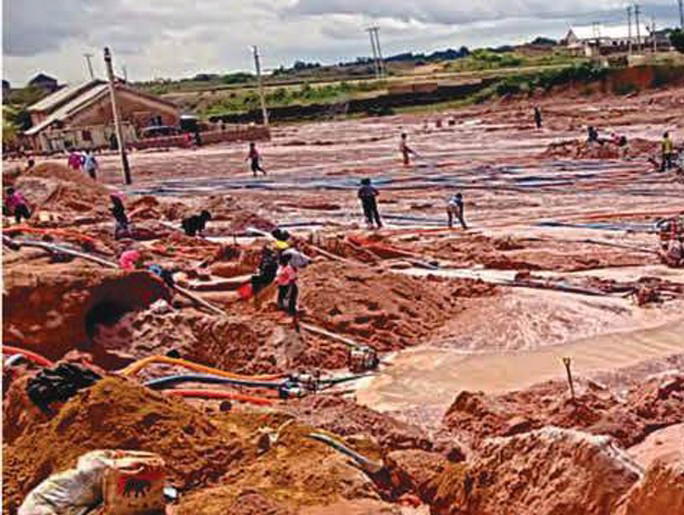
nNigeria is losing an estimated N13.7 trillion annually to illicit mining and illegal trade in solid minerals, stakeholders have warned, calling for stronger enforcement, regulation and monitoring of the sector.
nThe stakeholders said the continued exploitation and movement of valuable minerals outside the regulatory framework were depriving the government of revenue and exposing mining communities to environmental, security and economic risks.
nThey spoke against the backdrop of concerns over the implementation and enforcement of the Minerals and Mining Act, 2007, which prohibits the exploration and exploitation of mineral resources without lawful authority, valid licences or appropriate leases.
nDespite the legal framework, illegal mining and the movement of minerals including gold, gemstones, tantalum, lithium and kaolin continue to pose challenges to effective regulation and revenue collection.
nStakeholders who spoke with Vanguard identified weak enforcement, inadequate monitoring and alleged collusion among some actors as factors sustaining the illicit trade.
nDeal decisively with non-state actors — Faro
nA foreign trade expert, Idris Faro, urged the Federal Government to deal decisively with non-state actors allegedly usurping the powers of the state and controlling mining activities in some parts of the country.
nFaro said government needed to combine the prosecution of criminal elements with measures to address the root causes of insecurity around mining sites.
n“I would not call it illegal mining despite the fact that the people directly involved in the actual mining activity do not have mining licence or lease. I prefer to call it artisanal mining,” he said.
nAccording to him, the focus should be on formalising artisanal mining, granting operators legal rights and providing them with modern technology and access to credit.
n“We need mining to contribute to economic growth and wealth creation. It is an act of production. What we need to do is to grant them the legal rights to carry on mining and assist them with modern technology in addition to accessing credit facilities from financial institutions,” he said.
nFaro said mining activities in some northern communities had been linked to insecurity, alleging that criminal groups controlled some mining sites and imposed levies on miners and residents.
nHe also raised questions about possible relationships between some licensed miners and armed groups operating around mining sites, urging authorities to investigate such links.
n“I am seriously concerned about their activities. For those who have mining licence, what is their connection with the armed bandits around their mines? Is there a link between them and these criminals? The authorities have to look into it,” he said.
nFaro called on the Federal and state governments to take control of artisanal mining sites, dismantle criminal structures around them and confiscate illegal weapons in the possession of armed groups controlling mining areas.
nHe also advocated the auditing, licensing, retraining and equipping of artisanal miners to improve productivity and ensure that revenue from the sector accrues to government.
nHe said security agencies, including the Nigeria Customs Service, should make monitoring the movement of solid minerals a priority.
nFaro further called for a review of the constitutional position on mining and urged traditional rulers to report illegal activities in their communities and forests to the authorities.
nHe cited a figure attributed to the Nigerian Extractive Industries Transparency Initiative (NEITI), which estimated that Nigeria loses N13.7 trillion annually to illegal mining.
nIdentify financiers behind illicit mining — Nwadishi
nThe Executive Director, Centre for Transparency Advocacy (CTA), Faith Nwadishi, said illegal mining was not only affecting government revenue but also having environmental, health and economic consequences.
n“Nigeria loses a lot of revenue to these activities,” she said.
nNwadishi urged the government to identify and prosecute those financing illicit mining operations, stressing that greater attention should be paid to the companies and individuals benefiting from the activities.
n“Countries like Ghana and Canada have been able to use mining to build their economy. This is something we can also do. We should be able to pay attention to what the sponsors and miners are doing, and do proper regulation and monitoring so we can get the benefits,” she said.
nShe called for the identification of financiers and companies involved in the mining value chain, noting that beneficial ownership mechanisms could assist authorities in tracing those funding mining operations.
n“Nigeria carries the social and environmental cross while someone else takes the environmental and economic benefits, and these are the financiers,” she said.
nNwadishi acknowledged efforts by the government to formalise the sector but said more needed to be done in monitoring, environmental impact assessments and enforcement of the Mining Act.
nShe also called for stronger oversight of mining operations and greater attention to the environmental consequences for host communities.
nAmong her recommendations were the formalisation and regulation of artisanal miners rather than their criminalisation, improved traceability of solid minerals, proper environmental impact assessments, greater community participation, stronger Customs monitoring and the deployment of technology to track the movement of minerals.
nShe also called for those behind illegal mining operations to be brought to justice.
nIllegal players driving revenue losses — ZCI
nFounder and Executive Director of Ziva Community Initiative (ZCI), Emily Offodile, said the proliferation of illegal operators was contributing significantly to revenue losses in the sector.
n“When those artisanal miners mine and sell to these people, who is now paying royalties? There’s no royalty that is being paid. So it all boils down to losses,” she said.
nOffodile said even where royalties were eventually collected, the revenue might not accrue to the state where the mineral was extracted because minerals could be detected later in the supply or export chain.
nShe called for a comprehensive review of the regulatory framework and stronger institutional capacity to monitor the sector.
n“We have to look at these issues holistically because even when we’re trying to review the Mineral Mining Act 2007, we have still not put this one to efficiency. Times have changed. A lot of things are happening,” she said.
nOffodile questioned the effectiveness of regulatory agencies responsible for overseeing mining activities, saying weaknesses in regulation had created significant gaps.
nShe urged the government to strengthen regulation and coordination among agencies responsible for the mining sector, describing mining as a multisectoral activity whose weaknesses affect the country’s broader economic interests.
n“The sovereign wealth of the country is being lost because of these inadequacies and because mining is multisectoral,” she said.
n nRelated Stories
 General News
CELEBRATING TWO YEARS OF TRANSFORMATIONAL LEADERSHIP IN THE PRESIDENTIAL AMNESTY PROGRAMME
Tomorrow, 14TH March 2026, as we look forward to the second anniversary, we reflect on the remarkable two years since the Administrator of the Preside
 General News
PRESIDENTIAL AMNESTY PROGRAMME PHASE 3: DISREGARD PURPORTED STATEMENT ON DELAYED ITA PAYMENTS — OFFICE OF NATIONAL CHAIRMAN
The Office of the National Chairman of the Presidential Amnesty Programme Phase 3, General Elaye ThankGod Dollar Slaboh, has called on beneficiaries a
 General News
RE: CLARIFICATION ON MY PERSONAL RELATIONSHIPS
PUBLIC NOTICErnrnRE: CLARIFICATION ON MY PERSONAL RELATIONSHIPSrnrnIt has become necessary to make this public clarification following the increasing