
State Police Bill: How NASS caged governors
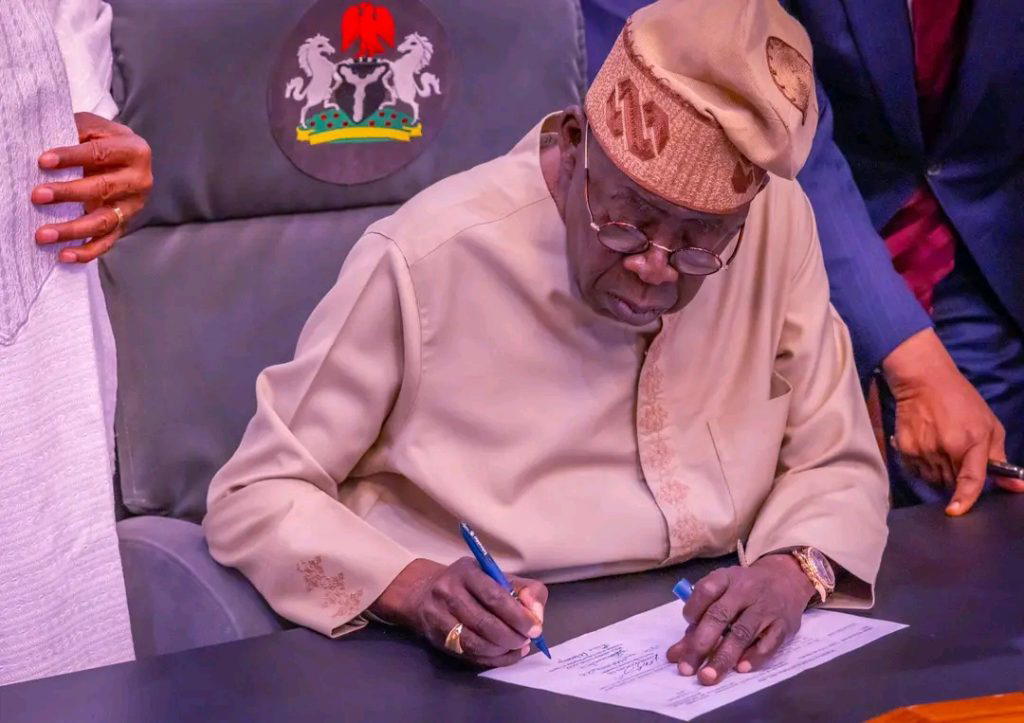
File image of President Tinubu.
nBy Henry Umoru & Gift ChapiOdekina, ABUJA
nIn what could be described as an epoch-making session, the National Assembly has finally cleared the path toward dismantling Nigeria’s 66-year-old unitary security architecture.
nRead Also: Several injured as suspected bandits ambush Sunday Igboho’s security team in Oyo forest
nThe Senate on Wednesday passed the landmark Constitution of the Federal Republic of Nigeria (Alteration) (State Police) Bill, 2026 (SB. 1055). This followed the earlier passage of the executive bill by the House of Representatives on June 11, where lawmakers voted overwhelmingly 289 to 4 in its favour.
nThe historic vote in the red chamber survived a 30-minute technical scare when the electronic voting system crashed, forcing senators to adopt a transparent, manual show-of-hands process. More than two-thirds of the lawmakers present voted to strip the federal government of its absolute monopoly on policing, effectively birthing a dual model: the Federal Police Service and individual State Police Services. The lawmakers passed the Bill to alter the provisions of Sections 214, 215 and 216 of the Constitution to establish State Policing.
nGREAT FEAR: Caging ‘executive emperors’
nFor nearly three decades, the biggest logjam delaying state policing has been a deep-rooted national anxiety: the fear that state governors would weaponise local forces into private political armies to crush opposition elements, muzzle journalists, and rig regional elections.
nAddressing this head-on during the debate, Senate Leader Opeyemi Bamidele was blunt, stating that the cross-chamber design specifically targeted and neutralised the potential for political abuse by state executives. Clause by clause, lawmakers engineered constitutional “firewalls” to ensure governors can direct general security policy, but never political persecution.
nSenate Leader Opeyemi Bamidele, who led the debate, said one of the major concerns regarding the establishment of state police was the potential for political abuse by state governments, and that the bill directly addresses that concern by prohibiting any governor from directing a State Police Service to unlawfully target specific persons, political parties, groups or associations. The legislation also expressly bars the use of police powers for partisan, ethnic, religious, sectional or personal purposes.
nSix firewalls against abuse
nPolicy vs. Persecution
nUnder Clause 17, governors get real operational input. Section 17(6) allows a governor to issue lawful written directives of a general policy nature to the Commissioner of Police on matters relating to the maintenance of public safety and public order within the state.
nBut that power is fenced in immediately by the next subsection. Section 17(7) states that a state Commissioner of Police shall not arrest, detain, investigate or deploy force against any person, political party or group merely for criticising the government, except in accordance with the law. Lawmakers say the provision is meant to stop state police from being turned against political opponents, activists, journalists or dissenting voices, and to keep every action tied to due process.
nCrucially, a commissioner isn’t simply expected to refuse an unlawful order and hope for the best. If a commissioner believes an instruction from the governor is unlawful or inconsistent with accepted policing practices, the matter can be referred to the National Police Council, whose decision is binding and final. That gives the police chief a formal escape hatch — and gives a national body, not the governor, the last word on whether an order was legitimate.
nEscape Hatch: If a Commissioner believes a governor’s directive is unlawful, unconstitutional, or politically motivated, they are legally empowered to freeze the order and refer the matter directly to the National Police Council for final, binding arbitration.
nSECURITY OF TENURE: No whimsical sacking
nHistorically, federal police chiefs served at the whim of the executive. The new bill creates absolute symmetry of protection for both the Inspector-General of Police, IGP, and State Commissioners.
nA governor cannot unilaterally hire or fire a Commissioner of Police. Appointments must come via recommendations from the National Police Council, subject to confirmation by the State House of Assembly. To sack or suspend a Commissioner, a governor must clear a near-impossible double hurdle:
nAn official investigative recommendation for “stated cause” by the National Police Council.
nA super-majority resolution supported by not less than two-thirds of all members of the State House of Assembly.
nIn effect, a governor cannot sack a police chief for refusing an improper order, or for resisting political pressure, without clearing two independent hurdles: a national oversight body and a super-majority of the state assembly.
nThe same insulation applies at the federal level, by design symmetry: neither the Inspector-General of Police.
n nRelated Stories
 General News
CELEBRATING TWO YEARS OF TRANSFORMATIONAL LEADERSHIP IN THE PRESIDENTIAL AMNESTY PROGRAMME
Tomorrow, 14TH March 2026, as we look forward to the second anniversary, we reflect on the remarkable two years since the Administrator of the Preside
 General News
PRESIDENTIAL AMNESTY PROGRAMME PHASE 3: DISREGARD PURPORTED STATEMENT ON DELAYED ITA PAYMENTS — OFFICE OF NATIONAL CHAIRMAN
The Office of the National Chairman of the Presidential Amnesty Programme Phase 3, General Elaye ThankGod Dollar Slaboh, has called on beneficiaries a
 General News
RE: CLARIFICATION ON MY PERSONAL RELATIONSHIPS
PUBLIC NOTICErnrnRE: CLARIFICATION ON MY PERSONAL RELATIONSHIPSrnrnIt has become necessary to make this public clarification following the increasing