
South Africa police deploy on protesters’ anti-migrant ‘deadline’
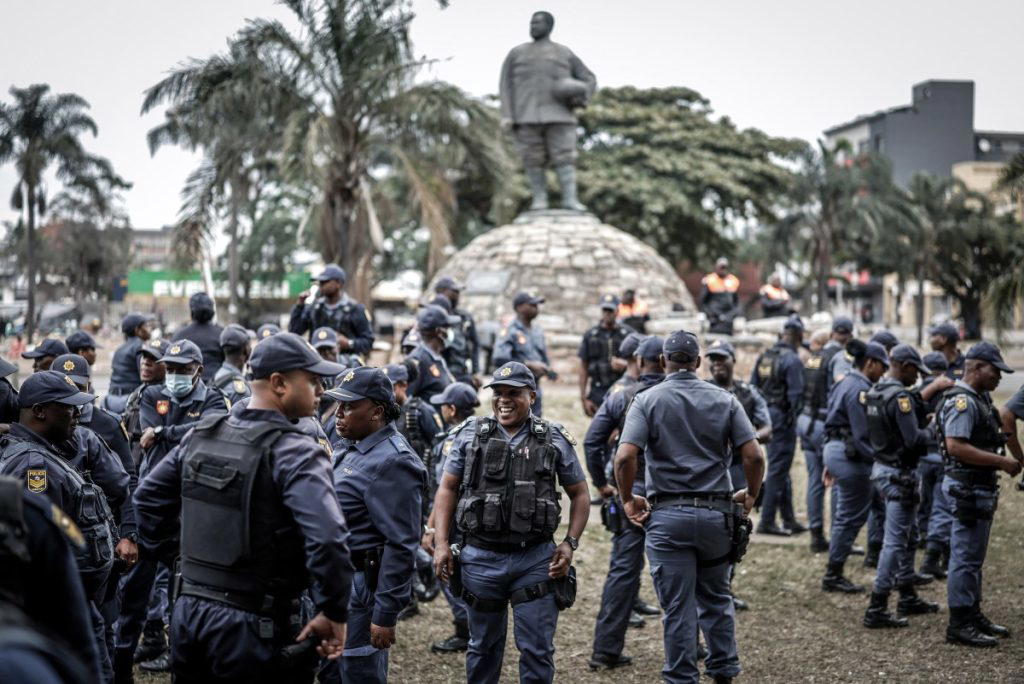
Members of the South African Police Service (SAPS) gather ahead of planned demonstrations by the March and March movement against the presence of undocumented migrants in South Africa in Durban, on June 30, 2026. South African police deployed to head off unrest and protests on June 30, 2026, the unofficial deadline set by citizen-led groups for undocumented foreign nationals to leave that has already pushed thousands to flee. Officers were out in force to prevent violence and looting, while hundreds of foreign nationals took refuge in several cities, urgently seeking help to leave. (Photo by Marco LONGARI / AFP)
nSouth African police deployed to head off unrest and protests on Tuesday, the unofficial deadline set by citizen-led groups for undocumented foreign nationals to leave that has already pushed thousands to flee.
nOfficers were out in force to prevent violence and looting, while hundreds of foreign nationals took refuge in several cities, urgently seeking help to leave.
nAt least two Mozambicans, an Ethiopian and a Malawian have been killed in anti-immigrant violence over recent weeks and several African governments have organised planes or buses to repatriate their citizens.
n“I decided to go to avoid being attacked,” said Malawian Peter Madsoan, 45, among several thousand gathered in the port city of Durban on Monday waiting for a bus to take him home.
n“I am a breadwinner back at home in Malawi,” said the builder. “It is better for me to go than to die in South Africa.”
nThe Border Management Authority MA told AFP on Monday that about 25,000 people had been repatriated in recent weeks.
nAround 15,000 Malawians had been processed for departure, South African officials said last week, while thousands more from Ghana, Mozambique, Nigeria, Zimbabwe and other countries had already left.
nUganda announced at the weekend an “evacuation plan” to start in the coming days for nearly 750 of its citizens.
nAs Tuesday’s unauthorised deadline arrived, thousands of people, mostly Malawians and Zimbabweans, also gathered in Cape Town and Johannesburg, waiting for assistance to go home.
nSome said their landlords had evicted them or their employers had fired them, fearing fines from officials or attacks by vigilante groups.
nZimbabwean Evelyn Chinooneka, 29, said she and her 10-month-old baby had camped outside the Zimbabwean consulate in Cape Town for days.
n“It was raining, all the clothes are wet now. We need our buses to come,” said Chinooneka, who had worked for four years on a farm outside Cape Town before being told to leave.
nIn Johannesburg, men in Zulu attire and holding shields and sticks paraded through the Soweto township, chanting “Abahambe”, which means “Let them go”.
n– ‘Rolling mass action’ –
nJune 30 would launch “a national march to freedom, a rolling mass action” until all undocumented foreign nationals were deported, the leader of the anti-illegal migrant March and March group, Jacinta Ngobese-Zuma, told reporters last week.
n“We are not calling for violence… no one will be killed on the 30th of June, and no looting will take place in our name,” she said.
nConcerned about a repeat of the unrest that struck five years ago, when around 350 people were killed in days of looting and riots, the government has ordered a massive security deployment and warned against opportunistic crime.
nThe July 2021 unrest was sparked by the brief jailing of ex-president Jacob Zuma for refusing to testify to a commission probing corruption.
nIn the countdown to June 30, President Cyril Ramaphosa announced stepped-up government plans to combat illegal immigration and called on traditional leaders to use their “standing to calm tensions”.
nThe premier of KwaZulu-Natal province, Thami Ntuli, said: “Whatever our concerns about undocumented migration, however legitimate the frustrations beneath them, we will not allow this province to be set alight a second time, whether by criminality or by xenophobia.”
n– Migration ‘weaponised’ –
nOne of the continent’s wealthiest countries, South Africa is a magnet for migrant labour while grappling with an unemployment rate above 30 percent, high crime and a breakdown in services in many areas.
nPrevious flare-ups of violence targeting undocumented foreign nationals in South Africa have been deadly, with 62 people killed in riots in 2008.
nBut this is the first time that governments have simultaneously organised the repatriation of thousands of their nationals.
nGroups campaigning against illegal immigration accuse foreign nationals of taking jobs, committing crimes and putting pressure on resources.
n“The xenophobic groups have got it wrong,” said labour analyst Dale McKinley. “This is a problem of governance, corruption, and mismanagement,” he told AFP.
nComing ahead of local government elections in November, the anti-migrant push has been “politically weaponised”, he said.
n nRelated Stories
 General News
CELEBRATING TWO YEARS OF TRANSFORMATIONAL LEADERSHIP IN THE PRESIDENTIAL AMNESTY PROGRAMME
Tomorrow, 14TH March 2026, as we look forward to the second anniversary, we reflect on the remarkable two years since the Administrator of the Preside
 General News
PRESIDENTIAL AMNESTY PROGRAMME PHASE 3: DISREGARD PURPORTED STATEMENT ON DELAYED ITA PAYMENTS — OFFICE OF NATIONAL CHAIRMAN
The Office of the National Chairman of the Presidential Amnesty Programme Phase 3, General Elaye ThankGod Dollar Slaboh, has called on beneficiaries a
 General News
RE: CLARIFICATION ON MY PERSONAL RELATIONSHIPS
PUBLIC NOTICErnrnRE: CLARIFICATION ON MY PERSONAL RELATIONSHIPSrnrnIt has become necessary to make this public clarification following the increasing