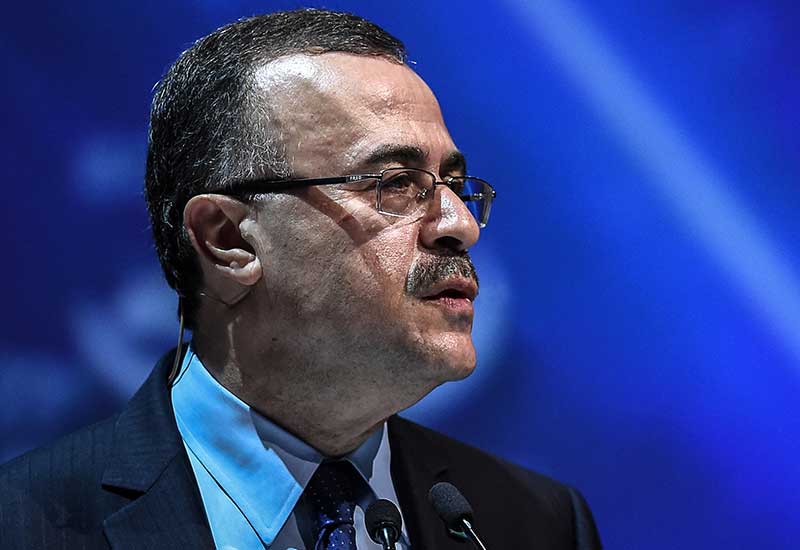
The head of energy giant Saudi Aramco on Tuesday warned the Middle East war could have “catastrophic consequences” on oil markets, describing the crisis as unprecedented.
CEO and president Amin H. Nasser said it was vital to reopen the Strait of Hormuz, which normally carries about 20 percent of global oil supplies but has been closed by the ongoing war.
Oil prices have swung wildly over supply disruptions, rocketing 30 percent on Monday before plunging again on comments from US President Donald Trump that the war may soon end.
“The disruption has caused a severe chain reaction in not only shipping and insurance but there’s also a drastic domino effect on aviation, agriculture, automotive and other industries,” Nasser told a media call to announce Aramco’s 2025 earnings.
“There would be catastrophic consequences for the world’s oil markets the longer the disruption goes on, and the more drastic the consequences for the global economy.
“While we have faced disruptions in the past, this one by far is the biggest crisis the region’s oil and gas industry has faced.”
Nasser was speaking as Aramco reported a 12.1 percent decline in net income in 2025 after higher supply, US tariffs and other economic headwinds weighed on revenues.
Aramco, which launched a record initial public offering in 2019, also announced a first-ever share buyback programme of up to $3 billion over 18 months.
– Reopening strait ‘critical’ –
Iran has launched retaliatory drone-and-missile attacks on its US-allied Gulf neighbours over the past 11 days following US-Israeli strikes.
“It’s absolutely critical that shipping resumes in the Strait of Hormuz,” Nasser said.
Aramco, the world’s biggest oil exporter and one of its most valuable companies, reported 2025 net income of $93.38 billion, down from $106.24 billion in 2024.
Stripping out exceptional items, adjusted net income was $104.65 billion in 2025 compared to $110.29 billion in 2024, a slide of 5.1 percent.
Throughout last year, the oil alliance OPEC+ — of which Saudi Arabia is a key member — oversaw an increase in production, eroding prices.
The Middle East war has now severely destabilised supplies. Iran has fired at energy installations across the Gulf, including Aramco’s sprawling Ras Tanura facility, which halted some operations.
The massive complex on the Gulf coast is home to one of the Middle East’s largest refineries and is a cornerstone of the Saudi energy sector. Saudi oil fields have also been targeted.
Elsewhere, Bahrain’s Al Ma’ameer oil facility was hit on Monday, causing a fire and damage, with the country’s state-owned energy firm Bapco declaring force majeure.
Energy producers in Qatar and Kuwait earlier made similar declarations, which are a warning that events beyond their control may stop them fulfilling contracts.
Gulf countries have borne much of Tehran’s military response after the US and Israel launched a massive aerial campaign against Iran on February 28.


Comments
Please login to leave a comment.
No comments yet. Be the first to share your thoughts!