
Sanwo-Olu declares ‘state of emergency’ on waste management
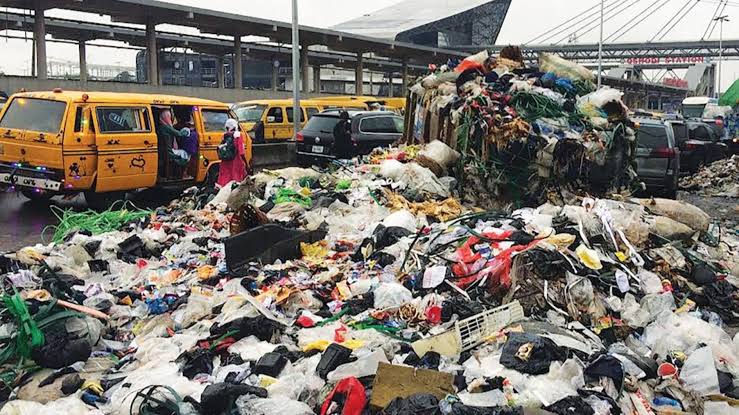
Gov. Babajide Sanwo-Olu of Lagos State has declared what he described as a “small state of emergency” on waste management to address challenges affecting refuse collection and disposal across the state.
nSanwo-Olu made the declaration on Wednesday during an inspection of the Olusosun dumpsite in Ojota, Lagos, accompanied by his Deputy, Dr Obafemi Hamzat, and the Commissioner for Environment and Water Resources, Mr Tokunbo Wahab.
nThe governor said the inspection was aimed at identifying the immediate challenges confronting waste management operations and developing short, medium and long-term solutions to the situation.
nHe said the state had, in the past few weeks, witnessed pressure on waste collection, resulting in indiscriminate dumping of refuse in different parts of the metropolis.
n“We are here for ourselves to see what the problem is and what is happening, so that we can clearly declare what we will call a small state of emergency.
n“This is necessary for us to get out of this very unpleasant situation and restore effective waste collection and disposal across Lagos,” he said.
nSanwo-Olu said the state government had introduced monthly environmental sanitation and intensified advocacy on proper waste management, but acknowledged that the efforts had not been effectively coordinated.
nHe said the government was working on the construction of two 2,400-metric-tonne transfer loading stations at Olusosun and Solu 3 in Alimosho.
nAccording to him, the facilities will receive compacted waste before transferring it to material recovery facilities being developed at Oke-Osho in Epe and Erikitte in Badagry.
n“The two transfer loading stations should be able to receive about 500 trucks per day, while the material recovery sites will allow us to further sort and convert waste into other useful materials.
n“These are medium to long-term solutions, and we expect the facilities to begin taking shape before the end of the year, with completion expected between the second quarter of next year and the first quarter,” he said.
nThe governor said immediate measures were also being taken to increase the capacity of Olusosun to receive waste from between 250 and 350 trucks currently to between 350 and 450 trucks daily.
nHe said this would be achieved by increasing the number of tipping points at the dumpsite from the current two or three to about four or five to improve truck turnaround.
nSanwo-Olu said similar interventions would be carried out at Solu 3, Iwulepe in Ikorodu and Oke-Osho in Epe, while Erikitte in Badagry would also be developed to expand waste reception capacity.
n“We are hoping that in another six weeks, we will have four active dump sites , Olusosun, Solu 3, Iwulepe and Oke-Osho with a fifth one at Erikitte in Badagry.
n“What that will do is enhance and improve the turnaround of trucks on the various roads, so that they do not come to one dump site and spend 12 hours or even an entire day before they can discharge,” he said.
nThe governor also announced the procurement of 160 new compactor trucks by the state government to boost waste collection from homes and roads to disposal facilities.
nHe said additional compactor trucks would also be procured by Zoomlion, while the government would acquire landfill compactors for effective waste management at disposal sites.
nSanwo-Olu said the transfer loading stations and material recovery facilities constituted the long-term solution to waste generation, disposal and conversion in Lagos.
n“These are tens of millions of dollars of investment in waste management that will form part of the long-term solution to solving waste generation, waste disposal and waste conversion in the state,” he said.
nOn the operations of Private Sector Participants (PSPs), Sanwo-Olu said the association had agreed to review its membership and identify operators with the capacity and technical know-how to continue providing waste management services.
nHe said the exercise would complement an independent review being undertaken by the state government to ensure that only effective operators remained in the system.
n“We do not want to have 800 PSPs when only 400 are effective. We need to purge the system and create space for more investors and people who have the capacity to come in,” he said.
nThe governor said PSP operators had also committed to procuring additional compactor trucks.
nHe added that the government was willing to work with them on financing models that would de-risk their investments and prevent operators from becoming financially distressed.
nSanwo-Olu urged residents to pay for waste management services, saying it was unfair for service providers to render services without receiving payment.
n“Lagosians, in particular, want service, but we do not want to pay for the service. I think this era has to stop.
n“It is unfair to see people rendering services and people are not paying them for the services they are rendering,” he said.
nHe assured residents that the government, in collaboration with PSP operators, would improve service delivery, while urging households and residents with waste bins to fulfil their financial obligations for waste collection.
nThe News Agency of Nigeria (NAN) reports that the inspection formed part of the state government’s renewed efforts to tackle waste collection, disposal and recycling challenges across Lagos.
n(NAN)
n nRelated Stories
 General News
CELEBRATING TWO YEARS OF TRANSFORMATIONAL LEADERSHIP IN THE PRESIDENTIAL AMNESTY PROGRAMME
Tomorrow, 14TH March 2026, as we look forward to the second anniversary, we reflect on the remarkable two years since the Administrator of the Preside
 General News
PRESIDENTIAL AMNESTY PROGRAMME PHASE 3: DISREGARD PURPORTED STATEMENT ON DELAYED ITA PAYMENTS — OFFICE OF NATIONAL CHAIRMAN
The Office of the National Chairman of the Presidential Amnesty Programme Phase 3, General Elaye ThankGod Dollar Slaboh, has called on beneficiaries a
 General News
RE: CLARIFICATION ON MY PERSONAL RELATIONSHIPS
PUBLIC NOTICErnrnRE: CLARIFICATION ON MY PERSONAL RELATIONSHIPSrnrnIt has become necessary to make this public clarification following the increasing