
Reasons Behind the Influx of Almajirai into Abuja
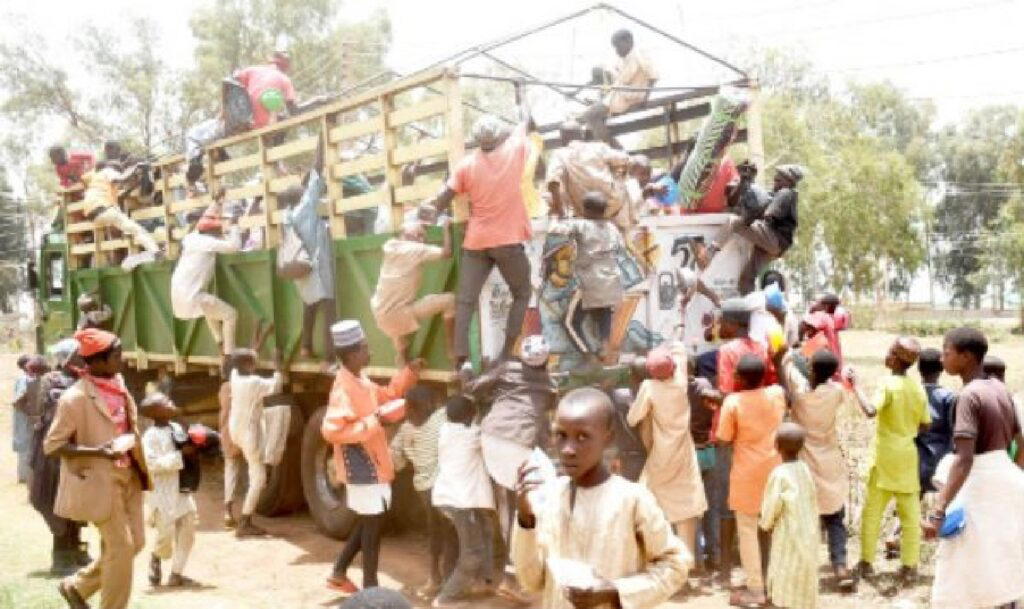
Nine-year-old Aminu, a native of Kankiya in Katsina State, bears the unmistakable signs of a childhood lost, with his unkempt appearance and tattered clothing a testament to his struggles.
nHis oversized clothes, which seem to have withstood many seasons, hang loosely on his small frame, and a plastic plate suspended from his neck by a string serves as a constant reminder of his daily quest for alms.
nAminu is one of many children his age who congregate around the popular NNPC bus stop in Kubwa, a suburb of Abuja, Nigeria's bustling capital, where he begs for food or money with a quiet determination.
nWhen asked about his background, Aminu proudly declares, "I'm an Almajiri," a student of a traditional Islamic school, having left the comfort of his parents' home in rural Katsina to study Arabic and memorize the Quran.
nAminu's daily life is a struggle to survive, as he begs for food or money to buy some, and sometimes sleeps wherever the night catches up with him, as long as he can reach his Mallam's study centre for prayers and Quran memorization sessions.
nAsked if he has attended a formal school, Aminu responds with a simple "No," looking over his shoulders as if seeking validation from his companions, before adding, "My father strictly forbids it, it's haram."
nAminu's story is echoed by Ibrahim, a 29-year-old motorcyclist from Bwari, who also never attended a western-style school, having been a product of the Almajiri system since he was five years old.
nIbrahim was born in Charanchi, Katsina State, and was handed over to his Mallam, who took him to Katsina and later Kano, where they studied Arabic and memorized the Quran, with life in the city proving to be a harsh reality.
nAs a child, Ibrahim would wake up early, perform ablution, say his Fajr prayers, and then study the basics of Arabic, with older pupils continuing with memorization, and sometimes running errands for their Mallam's household.
nIbrahim's luck changed when he met a childhood friend who taught him how to ride a motorcycle, and he eventually moved to Abuja, where he now works as a commercial motorcyclist, sending money to his family and visiting them whenever possible.
nMansur Liman, a 17-year-old from Zurmi in Zamfara State, has a similar story, having been forced to flee his rural community due to bandits and terrorists, and is now an Almajiri in Abuja, studying Islamic knowledge and working to support himself.
nLiman's journey to Abuja was a necessity, driven by the need to escape persecution and find safety, and he now studies in the morning and evening, while engaging in farming and other activities to support himself and his teacher.
nThe stories of Aminu, Ibrahim, and Liman are just a few examples of the millions of out-of-school children roaming the streets of Abuja and other states in Nigeria, with the United Nations Children's Fund (UNICEF) estimating that 18.3-20 million Nigerian children of school age are out of school.
nThis figure includes around 10.2 million primary school-age children and 8.1 million in junior secondary, with UNICEF reporting that one in three Nigerian children in North-Western Nigeria accounts for the highest number, with approximately 8.04 million children.
nThe situation has been worsened by age-long cultural practices, growing inequality, poverty, and insecurity, with successive northern leaders making pronouncements and holding workshops, but these efforts often come to nothing after elections.
nIn 2000, former Vice President Atiku Abubakar called on Northern leaders to take up the challenge of changing the narrative, observing that apart from dedicated and visionary leadership in the first 15 years post-independence, successive administrations had paid lip service to education.
nThe report of the Northern Education Research Project, titled "Towards The Improvement Of Education In the Northern States of Nigeria, Agenda For Action", painted a grim picture of the state of education across the region.
nThe report identified factors such as decay in basic infrastructure, unhelpful cultural practices, insufficient number of teachers, teaching and learning facilities, as well as poor funding, as impediments to education in the region.
nThe proposed action plan recommended that all Northern states and local governments should allocate not less than 26 per cent of their total annual budgets to the education sector, but only three states have taken this recommendation to heart.
nKano State leads the pack, allocating over 30 per cent of its budget to education in both 2025 and 2026, surpassing the UNESCO and national 26% benchmark, with Jigawa and Kaduna also meeting the recommendation.
nIn 2023, the late President Muhammadu Buhari assented to the bill establishing the Almajiri Commission, and two years later, President Bola Tinubu approved a national policy on Almajiri education, giving official recognition to the Almajiri learning system.
nThe policy aims to harmonize the Almajiri system with modern trends, including the inclusion of literacy, numeracy, critical thinking, and skill acquisition, with key initiatives such as building model schools and establishing learning centers.
nMallam Nasir, a Quranic scholar, welcomed the government's initiative, saying that he was willing to cooperate, provided it would not introduce practices that contradict their beliefs.
nAn educationist, Mr. Ikwulono Oguche, commented that the government's greatest challenge is implementing policies, citing the example of the Federal Government's commission for Nomadic Education, which has failed to deliver.
nOguche expressed skepticism about the government's ability to change the Almajiri system, unless traditional rulers and Islamic religious leaders are involved, and warned that the system may not change anytime soon without their buy-in.
Related Stories
 General News
CELEBRATING TWO YEARS OF TRANSFORMATIONAL LEADERSHIP IN THE PRESIDENTIAL AMNESTY PROGRAMME
Tomorrow, 14TH March 2026, as we look forward to the second anniversary, we reflect on the remarkable two years since the Administrator of the Preside
 General News
PRESIDENTIAL AMNESTY PROGRAMME PHASE 3: DISREGARD PURPORTED STATEMENT ON DELAYED ITA PAYMENTS — OFFICE OF NATIONAL CHAIRMAN
The Office of the National Chairman of the Presidential Amnesty Programme Phase 3, General Elaye ThankGod Dollar Slaboh, has called on beneficiaries a
 General News
RE: CLARIFICATION ON MY PERSONAL RELATIONSHIPS
PUBLIC NOTICErnrnRE: CLARIFICATION ON MY PERSONAL RELATIONSHIPSrnrnIt has become necessary to make this public clarification following the increasing