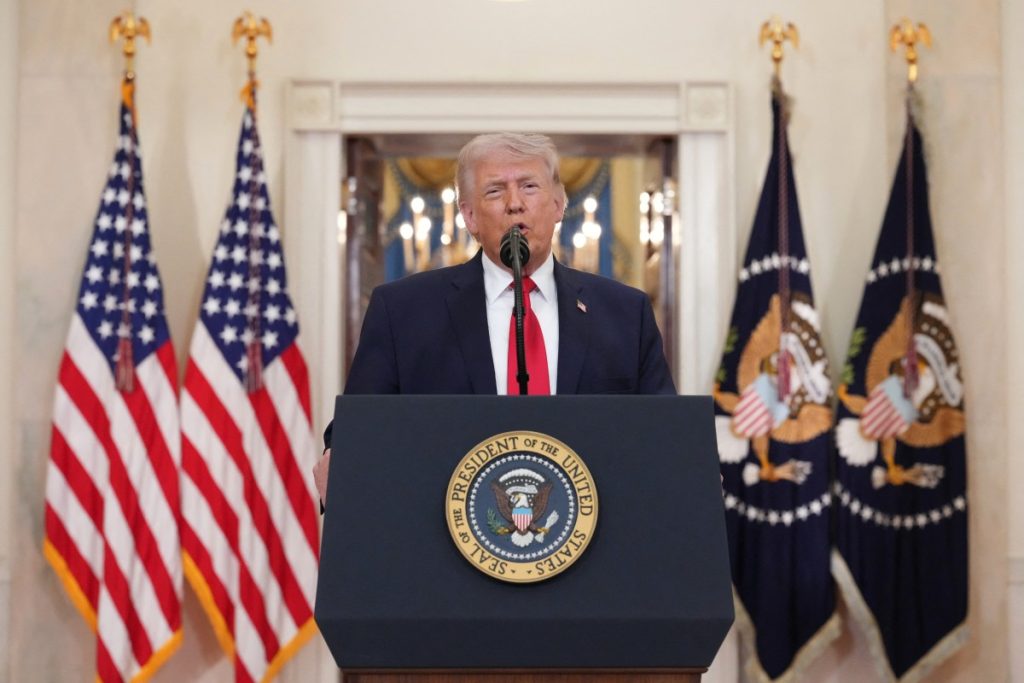
On April 1, 2026, US President Donald Trump delivered a televised address from the Cross Hall of the White House in Washington, DC, discussing the conflict in the Middle East, as the war with Iran surpassed a month in duration. His approval rating was sinking, yet he maintained that the United States was nearing victory.
During his evening speech, Trump pledged to continue "extremely hard" strikes against Iran for two to three weeks, offering little new insight into the potential conclusion of the war. The US President's remarks were broadcast nationwide, marking his first such address since the conflict began.
According to US media reports, President Trump is scheduled to meet with his top security advisors on Monday to discuss the Iran war, as negotiations between the rival parties appear to have reached a stalemate. The meeting will involve Trump's key national security and foreign policy team, who will convene to determine the next course of action.
Tehran's top diplomat placed blame on Washington for the failed talks in Pakistan earlier this month, which represented the first and only round of negotiations aimed at ending the conflict that has affected the Middle East and hindered the global economy. The diplomat's statement came as the conflict continues to escalate.
Barak Ravid, a global affairs correspondent for Axios, reported that Trump's meeting with his top national security and foreign policy team will take place on Monday, focusing on the next steps in the conflict. The meeting's agenda is expected to include discussions on a proposed deal by Tehran to resolve the conflict.
ABC News cited two unidentified US officials, stating that Trump will meet with his key security advisors to discuss Iran, and that a proposed deal by Tehran fell short of Washington's requirements. The deal proposed by Tehran involved reopening the Strait of Hormuz and ending the US naval blockade.
The proposed deal, as reported by Axios, would postpone nuclear negotiations until a later stage, instead focusing on the immediate reopening of the vital waterway. This development comes as the conflict continues to impact global trade and economy.
Iranian Foreign Minister Abbas Araghchi's visit to Islamabad had initially raised hopes for fresh negotiations with Washington, but these hopes were dashed when Trump cancelled a planned trip by envoys Steve Witkoff and Jared Kushner. The cancellation marked a significant setback in the diplomatic efforts to resolve the conflict.
Following the cancellation, Trump stated in an interview with Fox News that if Iran wanted to engage in talks, "they can come to us, or they can call us," emphasizing Washington's stance on the negotiations. This statement underscored the current impasse in the diplomatic efforts to end the conflict.



Comments
Please login to leave a comment.
No comments yet. Be the first to share your thoughts!