
Phone-tapping charge: Court fixes Oct 26 to rule on El-Rufai’s bid to stop trial
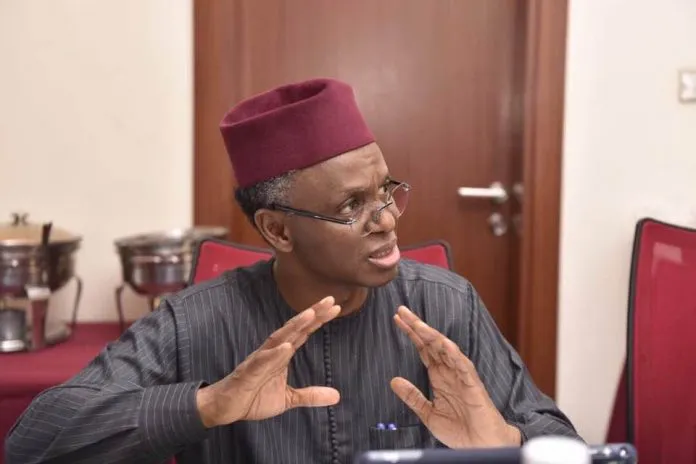
Nasir El-Rufai
n… he has a case to answer, FG insists
nBy Ikechukwu Nnochiri, Abuja
nThe Federal High Court in Abuja on Tuesday fixed October 26 to rule on a motion the detained former Kaduna State governor, Nasir El-Rufai, filed to stop his trial over allegations that he unlawfully intercepted the phone communications of National Security Adviser (NSA), Nuhu Ribadu.
nEl-Rufai, through his team of lawyers led by Mr Paul Erokoro, SAN, urged the court to discharge and acquit him of the five-count amended charge the Federal Government preferred against him through the Department of State Services (DSS).
nHe insisted that the prosecution failed to establish a prima facie case to warrant the court compelling him to enter a defence to the charge, which he described as incompetent.
nThe defendant therefore prayed the court to uphold his no-case submission and terminate further proceedings on the matter.
nHowever, the prosecution counsel, Mr Oluwole Aladedoye, SAN, urged the court to dismiss the application and order the defendant to open his defence to the charge.
nAladedoye maintained that the oral and documentary evidence laid before the court was sufficient to tie the defendant to the allegations against him.
nAfter listening to both sides, Justice Joyce Abdulmalik adjourned to rule on the application.
nIt will be recalled that the FG closed its case after two witnesses testified before the court.
nThe court had, on July 23, dismissed as lacking in merit an application the former governor filed for the variation of his bail conditions, which he described as very stringent and difficult to fulfil.
nAccording to El-Rufai’s lawyer, the bail conditions sought to be varied included the requirement that the defendant produce level 17 civil servants with properties in Maitama or Asokoro, as well as verification and attestation letters from the Kaduna State traditional council.
nHowever, the prosecution opposed the variation request, insisting that qualified public officers who could meet the conditions exist and could easily be secured by the defendant.
nIt therefore persuaded the court to reject the application.
nDelivering a ruling on the matter, Justice Abdulmalik agreed with the prosecution, saying she found no reason to alter the initial bail conditions, which she said were intended to ensure the defendant’s attendance at his trial.
nEl-Rufai, who was governor between 2015 and 2023 and also served as Minister of the Federal Capital Territory (FCT) under former President Olusegun Obasanjo’s administration, is facing trial over comments he made when he appeared as a guest on Arise Television on February 13.
nIt was alleged that the defendant, during his appearance on Arise TV’s Prime Time programme in Abuja, admitted that he knew and was associated with an individual who had illegally intercepted the NSA’s telephone communications.
nAside from the allegation that his action breached national security and public safety — an offence punishable under Section 12(1) of the Cybercrimes (Prohibition, Prevention, etc.) (Amendment) Act, 2024 — the former governor was also charged with failing to report the crime to the relevant security agencies.
nThe embattled former governor had, during the TV interview, reacted to what he described as an attempt by DSS operatives to “abduct” him at Nnamdi Azikiwe International Airport in Abuja on February 12, 2026, upon his return from Cairo.
nHe insisted that the security agency was being instigated by the ICPC, which he said had received a directive from the NSA, Ribadu, to detain him.
nThe former governor claimed the information reached him through someone who had listened in on the NSA’s telephone conversations.
nShortly after being accused of admitting that he used “technical equipment” to illegally intercept the NSA’s calls, El-Rufai filed a motion to stop his trial.
nHe gave 17 reasons why the charge, marked FHC/ABJ/CR/99/2026, should be quashed by the court.
nHe argued that the charge was incompetent and legally defective, insisting that the DSS had no legal basis to elevate a “casual remark” he made during a television interview into “a confession” that he had indeed tapped the NSA’s telephone line, as alleged.
nHe argued that the statement he made on Arise TV did not constitute a confessional statement in law, saying that for a statement to be admissible as a confession, it must be made under caution, voluntarily, and in circumstances that satisfy the judges’ rules.
nEl-Rufai maintained that the statements he made during his television interview were made without caution or warning, in a voluntary public discussion, and without the protections afforded to suspects in custody.
n“A casual remark on a television programme cannot be elevated to a judicial confession,” he further argued.
nHowever, the court declined to quash the charge and ordered an accelerated hearing of the case.
n nRelated Stories
 General News
CELEBRATING TWO YEARS OF TRANSFORMATIONAL LEADERSHIP IN THE PRESIDENTIAL AMNESTY PROGRAMME
Tomorrow, 14TH March 2026, as we look forward to the second anniversary, we reflect on the remarkable two years since the Administrator of the Preside
 General News
PRESIDENTIAL AMNESTY PROGRAMME PHASE 3: DISREGARD PURPORTED STATEMENT ON DELAYED ITA PAYMENTS — OFFICE OF NATIONAL CHAIRMAN
The Office of the National Chairman of the Presidential Amnesty Programme Phase 3, General Elaye ThankGod Dollar Slaboh, has called on beneficiaries a
 General News
RE: CLARIFICATION ON MY PERSONAL RELATIONSHIPS
PUBLIC NOTICErnrnRE: CLARIFICATION ON MY PERSONAL RELATIONSHIPSrnrnIt has become necessary to make this public clarification following the increasing