
Oyo school abductions: Warning signs ignored — Locals
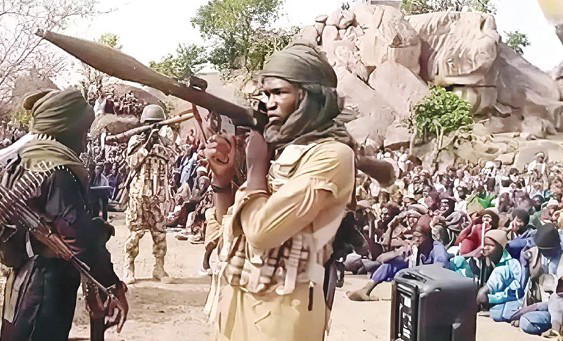
…say terrorists killed Forest Guards, threat notes in some settlements dismissed
nBy Adeola Badru
nIn recent months, parts of Oyo State have been sliding into a more complex and mobile insecurity pattern, one increasingly shaped by forest corridors, weak rural surveillance, and the gradual southward drift of armed groups from the country’s North-Central axis.
nFor communities scattered across Oriire Local Government Area, that shift has not been abstract. It has been felt in emptying farmlands, cautious school routines, and growing unease around isolated roads that once formed the backbone of rural life.
nTerrorists launched a coordinated assault on three schools along the Ahoro-Esiele/Yawota axis of Ogbomoso in Oriire, abducting pupils, teachers and school administrators in a daylight attack that immediately overwhelmed surrounding communities.
nPanic spread rapidly across villages as parents ran from one location to another seeking confirmation, schools were shut in haste, and movement across rural routes slowed to a near standstill.
nThe emotional shock deepened further with reports that a teacher, Michael Oyedokun, was killed in captivity, while disturbing videos showing abducted victims pleading for intervention circulated widely and inflamed public anger.
nThe scale of the attack was not only measured in numbers but in symbolism: Schools, ordinarily seen as the safest civic spaces in rural communities, had become targets of organised violence.
nWhat has made the attack particularly unsettling for many residents is not only its brutality, but the sense that warning signs had been present long before it happened.
nIn the weeks following the January 2026 attack on the Old Oyo National Park near Ikoyi-Ile, where five forest guards were killed in an assault attributed to armed groups operating within the forest belt, fear had already begun to circulate quietly across nearby communities.
nIn the aftermath of that incident, handwritten threat notes reportedly appeared in some settlements warning of further attacks.
nAt the time, those messages were allegedly widely dismissed as rumours or attempts at intimidation rather than credible intelligence pointing to an expanding security threat.
nLooking back now, many residents are revisiting those warnings with a different perspective.
nWhat once appeared like isolated fear has begun to resemble early signals of a deeper and more organised shift in criminal activity across the region’s forest corridors.
nThe Oriire attacks have since become the point at which those fragmented anxieties converged into reality.
nSchools became targets, communities were thrown into panic, and rural mobility was abruptly disrupted as fear spread across the local government area and beyond.
nAttendance in schools
nAttendance in schools dropped sharply in affected areas, while teachers staged protests demanding the safe return of abducted colleagues and pupils.
nParents, meanwhile, were forced into difficult decisions about whether to continue sending children to school under prevailing security conditions.
nBeyond the immediate human toll, the incident has intensified concerns about the changing geography of insecurity in Nigeria.
nForested regions that once served primarily as agricultural and transit routes are increasingly being described as operational corridors for armed groups moving across state boundaries.
nIn such environments, isolated communities, schools, and farms become vulnerable not only because of their location, but because of limited surveillance and delayed response capacity.
nSecurity sources have indicated that the attackers likely relied on local knowledge networks to navigate the terrain and coordinate movement, raising further questions about informant structures operating within rural communities.
nInvestigations into suspected collaborators are ongoing, with some individuals reportedly under scrutiny for alleged communication with the assailants during the operation.
nAs pressure mounted for answers, attention has also turned to the broader institutional response. Traditional rulers, religious organisations and civil society groups have all condemned the attacks, describing them as a dangerous escalation of violence in a region previously considered relatively stable compared to other parts of the country.
nCalls for stronger protection of rural schools and more coordinated security presence in forest-adjacent communities have grown louder in its aftermath.
nAt the national level, the attack has added momentum to renewed debates about security restructuring, particularly the effectiveness of centralised policing in managing rapidly evolving rural threats.
nThe Oriire incident is now being viewed by many analysts not as an isolated tragedy, but as part of a wider pattern of displacement of armed groups into less fortified regions of the country.
nIt is against this backdrop that Governor Seyi Makinde addressed the crisis, providing the most detailed official account of the abductions and outlining the state’s response.
nHe first broke down the scale of the incident, detailing the number of victims across the affected schools before confirming the fatality recorded during the attack.
n“At the Community Secondary School, about seven students were abducted, while at the First Baptist Primary and Nursery School, 18 children were abducted, and about seven teachers were also involved. Unfortunately, one of them was killed,” he said.
nThe governor went further to emphasise the urgency of securing the release of the abducted victims, signalling the state’s openness to multiple approaches in resolving the crisis.
n“So, whatever it is they demand, we are ready to listen to them and address the ones that we can address as a state government. But the children and their teachers must be released,” he stated.
nMakinde also confirmed that security agencies had been fully mobilised and were coordinating rescue operations, while noting the need for discretion due to the sensitivity of ongoing efforts.
n“The Commissioner of Police and other security agencies have been positioned to coordinate rescue operations and information management, although operational details cannot be disclosed because of the sensitive nature of the mission,” he explained.
nFor Oyo State, however, the immediate reality remained urgent and operational: locating and rescuing the abducted victims, stabilising affected communities, and preventing further incursions into vulnerable rural corridors.
nWhat happened in Oriire is now being viewed not as an isolated eruption, but as part of a broader trajectory that had already begun to reveal itself in earlier incidents. The fear that once circulated quietly in handwritten notes after Ikoyi-Ile has now materialised in a far more devastating form.
n nRelated Stories
 General News
CELEBRATING TWO YEARS OF TRANSFORMATIONAL LEADERSHIP IN THE PRESIDENTIAL AMNESTY PROGRAMME
Tomorrow, 14TH March 2026, as we look forward to the second anniversary, we reflect on the remarkable two years since the Administrator of the Preside
 General News
PRESIDENTIAL AMNESTY PROGRAMME PHASE 3: DISREGARD PURPORTED STATEMENT ON DELAYED ITA PAYMENTS — OFFICE OF NATIONAL CHAIRMAN
The Office of the National Chairman of the Presidential Amnesty Programme Phase 3, General Elaye ThankGod Dollar Slaboh, has called on beneficiaries a
 General News
RE: CLARIFICATION ON MY PERSONAL RELATIONSHIPS
PUBLIC NOTICErnrnRE: CLARIFICATION ON MY PERSONAL RELATIONSHIPSrnrnIt has become necessary to make this public clarification following the increasing