
Overseas funding for factory production plummets 50.7% to $152 million in first quarter of 2026
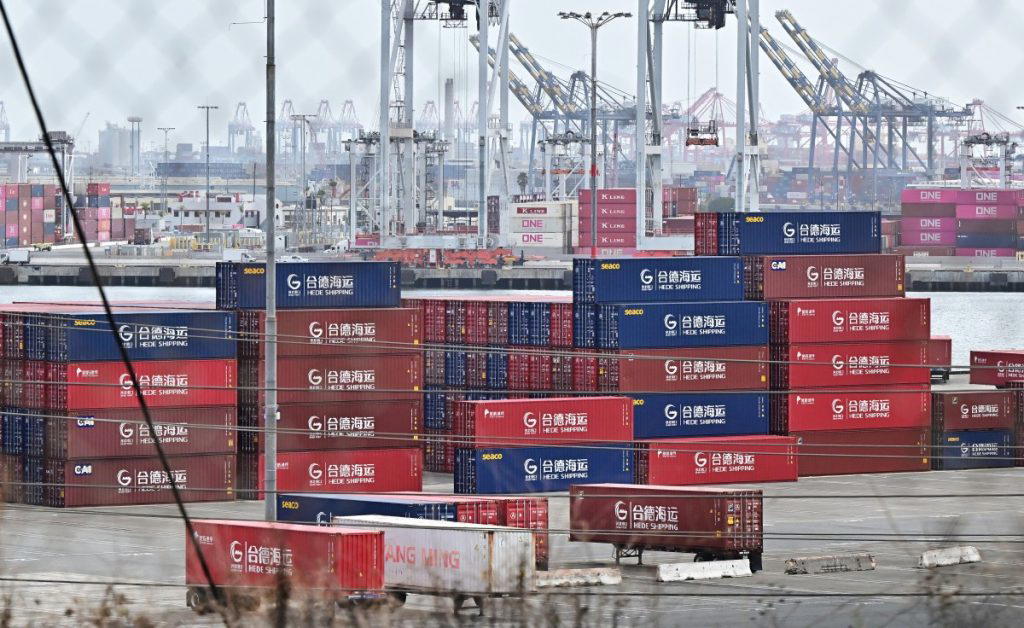
(FILES) Shipping containers from Hede Shipping, from the Chinese state-owned Hebei Port Group, are seen stacked at the Port of Los Angeles in Los Angeles, California on October 13, 2025. A US trade court on Thursday dealt President Donald Trump a fresh setback, ruling against the 10-percent global tariffs he instituted after the Supreme Court struck down many earlier duties. (Photo by Frederic J. BROWN / AFP)
nBy Yinka Kolawole
nForeign investment into Nigeria’s production and manufacturing sector declined sharply by 50.7 percent quarter-on-quarter to $152.27 million in the first quarter of 2026 (Q1’26), down from $308.93 million recorded in the preceding quarter (Q4’25), according to the latest Capital Importation Report released by the National Bureau of Statistics (NBS).
nThe report revealed that the sector accounted for only 1.47 per cent of the total capital importation valued at $10.37 billion recorded during the review period, highlighting the continued struggle to attract significant foreign capital into the productive segment of the economy.
nHowever, on a year-on-year basis, foreign investment in the sector rose by 17.2 per cent from $129.92 million recorded in the corresponding period of 2025 (Q1’25).
nFurther analysis of the NBS data showed that the manufacturing sector’s share of total capital inflows has continued to shrink. The 1.47 per cent contribution recorded in Q1’26 was lower than the 2.3 per cent recorded in Q1’25 and significantly below the 4.79 per cent posted in Q4’25.
nThe report indicated that portfolio investment remained the dominant source of foreign capital, accounting for $9.86 billion or 95.09 per cent of total inflows during the quarter. Other Investments contributed $374.48 million, representing 3.61 per cent, while Foreign Direct Investment (FDI) amounted to $135.08 million, accounting for just 1.30 per cent of total capital imported into the economy.
nSectoral distribution of the inflows showed that the banking sector attracted the largest share of foreign capital, receiving $7.55 billion or 72.79 per cent of total inflows. The financing sector followed with $2.43 billion, representing 23.42 per cent, while production and manufacturing attracted only $152.27 million.
nReacting to the development, Chief Executive Officer of the Centre for the Promotion of Private Enterprise (CPPE), Dr. Muda Yusuf, said the pattern of capital inflows reflects a persistent structural weakness in the economy, noting that increased foreign capital is yet to translate into meaningful expansion of productive capacity.
nHe stated: “Without stronger capital flows into industry, agro-processing, logistics, energy and export-oriented manufacturing, the broader economy will see limited gains in employment, productivity and inclusive growth.
n“Financial deepening without real-sector expansion risks creating a liquidity-driven recovery that does not fundamentally alter Nigeria’s productive base.”
n nRelated Stories
 General News
CELEBRATING TWO YEARS OF TRANSFORMATIONAL LEADERSHIP IN THE PRESIDENTIAL AMNESTY PROGRAMME
Tomorrow, 14TH March 2026, as we look forward to the second anniversary, we reflect on the remarkable two years since the Administrator of the Preside
 General News
PRESIDENTIAL AMNESTY PROGRAMME PHASE 3: DISREGARD PURPORTED STATEMENT ON DELAYED ITA PAYMENTS — OFFICE OF NATIONAL CHAIRMAN
The Office of the National Chairman of the Presidential Amnesty Programme Phase 3, General Elaye ThankGod Dollar Slaboh, has called on beneficiaries a
 General News
RE: CLARIFICATION ON MY PERSONAL RELATIONSHIPS
PUBLIC NOTICErnrnRE: CLARIFICATION ON MY PERSONAL RELATIONSHIPSrnrnIt has become necessary to make this public clarification following the increasing