
Oborevwori tasks Delta varsities on research, innovation
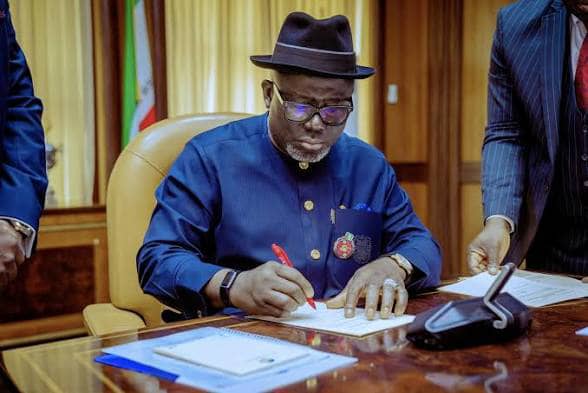
Governor Oborevwori of Delta State
nBy Egufe Yafugborhi
nASABA — Delta State Governor Sheriff Oborevwori has challenged tertiary institutions in the state to move beyond producing graduates and focus on research, innovation and solutions to the state’s development challenges.
nThe governor gave the charge through the Commissioner for Higher Education, Prof. Nyerhovwo Tonukari, at the 3rd Delta State Higher Education Summit in Asaba.
nThe development comes weeks after renowned Kenyan scholar and Pan-Africanist, Prof. Patrick Lumumba, challenged Delta State to harness its intellectual and human resources to drive development.
nSpeaking at the Delta State Economic and Investment Summit, Lumumba had urged the state to look beyond its traditional economic resources and maximise its intellectual capacity.
n“When we think about investment, we still imagine that our investors must come from Malaysia, Brazil or China. That is not the case,” Lumumba had said, stressing the need for Africans to recognise and deploy their intellectual and financial resources.
nAt the higher education summit, Tonukari said the governor’s administration was determined to make tertiary institutions contribute more directly to the development of the state.
n“Access is only the beginning. The question before us is: what are we doing with this opportunity?” he asked.
nTonukari said Delta had witnessed significant expansion in tertiary education, with four state-owned universities, three polytechnics and two colleges of education, in addition to federal and private institutions.
nHe said enrolment in state-owned tertiary institutions had increased from slightly above 50,000 students in 2023 to more than 100,000, while the Oborevwori administration had employed more than 1,250 academic and non-academic staff.
n“Government has also invested heavily in faculties, laboratories, administrative buildings, hostel accommodation and accreditation,” he said.
nThe commissioner, however, stressed that increased access to higher education should translate into measurable development outcomes.
nOn graduate employability, Tonukari said tertiary institutions had a responsibility to equip students with skills required in the modern economy.
n“Graduate employability is one of the major responsibilities of tertiary institutions,” he said.
nHe urged institutions to align their curricula with contemporary economic realities and equip students with digital, entrepreneurial, communication and critical-thinking skills.
nTonukari also called for stronger partnerships between tertiary institutions and industry, saying entrepreneurship centres and the Students Industrial Work Experience Scheme, SIWES, should provide students with practical experience for employment and enterprise.
nOn research, the commissioner said academic work should produce practical outcomes capable of benefiting government, industry and communities.
n“Research should no longer end on library shelves,” he declared.
nHe said research should, where possible, translate into “patents, products, technologies, services and policies”, particularly in areas such as agriculture, environmental degradation, flooding, healthcare, fisheries, agro-processing and economic diversification.
nTonukari also advocated specialisation among tertiary institutions, urging each to identify areas in which it could develop national or international recognition rather than attempting to excel in every discipline.
nHe said Delta State University, Abraka, had the potential to strengthen its research profile, while Southern Delta University, Ozoro, could develop technology hubs.
nHe identified the Delta State Maritime Polytechnic, Burutu, as having potential to focus on maritime and blue-economy development, while the College of Education, Mosogar, could deepen its focus on sports education.
nOn artificial intelligence, Tonukari urged tertiary institutions to embrace digital transformation while ensuring that technology did not undermine critical thinking, creativity, ethics and academic integrity.
nHe also encouraged institutions to diversify their revenue sources through research grants, consultancy, professional programmes, alumni endowments, intellectual property, commercial ventures and carefully structured public-private partnerships.
n“Professors and researchers must contribute more actively to national policy debates,” he said, urging academics to produce research capable of influencing policy and developing technologies that could attract recognition beyond Nigeria.
nThe commissioner further urged the private sector to regard tertiary institutions as development partners through industry-sponsored research, internships, laboratories, scholarships and technology partnerships.
nHe called on institutions to deepen their engagement with host communities through health programmes, agricultural extension services, adult education and youth mentorship.
nTonukari also urged vice-chancellors, rectors and provosts to give their institutions distinctive identities, strengthen industry collaboration and prepare students for a rapidly changing world.
nHe said government, academia and industry must work together “to make higher education a stronger driver of national development.”
nThe commissioner’s charge echoes Lumumba’s earlier call for Delta to make better use of its human and intellectual resources, particularly in developing solutions to challenges in agriculture, minerals, oil, pharmaceuticals and the blue economy.
nTonukari said the responsibility now rested with the state’s tertiary institutions to ensure that knowledge generated in classrooms and laboratories translated into practical benefits for the people.
n nRelated Stories
 General News
CELEBRATING TWO YEARS OF TRANSFORMATIONAL LEADERSHIP IN THE PRESIDENTIAL AMNESTY PROGRAMME
Tomorrow, 14TH March 2026, as we look forward to the second anniversary, we reflect on the remarkable two years since the Administrator of the Preside
 General News
PRESIDENTIAL AMNESTY PROGRAMME PHASE 3: DISREGARD PURPORTED STATEMENT ON DELAYED ITA PAYMENTS — OFFICE OF NATIONAL CHAIRMAN
The Office of the National Chairman of the Presidential Amnesty Programme Phase 3, General Elaye ThankGod Dollar Slaboh, has called on beneficiaries a
 General News
RE: CLARIFICATION ON MY PERSONAL RELATIONSHIPS
PUBLIC NOTICErnrnRE: CLARIFICATION ON MY PERSONAL RELATIONSHIPSrnrnIt has become necessary to make this public clarification following the increasing