
Obi attack backlash: Nothing must happen to our son– Igbo leaders, others
By Steve Oko, Emmanuel Iheaka & Jeff Agbodo
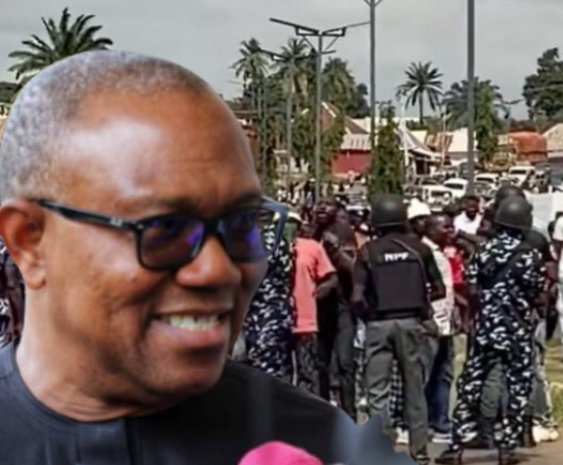
nThe reported attack and obstruction of the convoy of presidential candidate of the Nigeria Democratic Congress, NDC, Mr Peter Obi, in Benue State has triggered fresh anxiety in the South-East, with Igbo leaders and socio-cultural organisations warning that nothing should happen to the former Anambra State governor.
nThey warned that any further attack on Obi could deepen an already volatile political atmosphere and potentially trigger reactions capable of worsening the nation’s political crisis ahead of the 2027 general elections.
nThe latest incident in Benue has also revived memories of the confrontation involving Obi and other opposition figures in Benin City, Edo State, earlier this year.
nSunday Vanguard observed that it has, therefore, become a matter of increasing concern among Obi’s supporters that the NDC candidate is encountering physical confrontations, threats or attempts to restrict his political movements at a time the 2027 presidential campaign is gathering momentum.
nThe Benue incident is particularly significant because Obi was in the state ostensibly to sympathise with victims of the Yelwata killings.
nHis convoy was reportedly blocked by youths, preventing him from proceeding to the affected communities.
nThe incident has generated conflicting accounts. While Obi’s camp and his supporters described it as an attack and deliberate obstruction of the presidential candidate, the Benue State Government denied ordering or sponsoring the blockade.
nThe police have, however, commenced investigation into the incident, with 46 persons reportedly arrested in connection with the blockade.
nWhatever the circumstances surrounding the incident, it has become the latest flashpoint in the increasingly charged political environment ahead of 2027.
nAnd for many in the South-East, it is not an isolated development.
nBenin, Benue
nThe latest confrontation came months after the February incident in Benin City, Edo State, where Obi and other opposition figures reportedly escaped an attack by hoodlums.
nReports at the time said Obi, prominent opposition figure, John Oyegun, and members of the Obidient Movement were caught up in the incident.
nAnother report said gunmen reportedly fired at Obi’s convoy in Benin City, although accounts of the incident and the identity of those responsible varied.
nThe Benin incident generated widespread condemnation and brought the issue of the safety of opposition politicians into sharper focus.
nObi himself subsequently condemned attacks on opposition figures, insisting that nobody had a monopoly of violence.
nWith the Benue incident now added to the picture, his supporters and some Igbo organisations are asking whether the attacks and threats are becoming a pattern.
nThe 2027 presidential campaign officially entered a new phase in August, with Obi emerging as one of the major opposition contenders challenging President Bola Tinubu.
nIt is against this background that the latest development has attracted the strong warnings from Igbo leaders and groups.
nIt’s barbaric
nFormer Minister of Health and Education, Prof. Ihechukwu Madubuike, in a chat with Sunday Vanguard, described the development as “barbaric, unprecedented and highly condemnable.”
nHe expressed concern over what he said could be the wider implications for Nigeria’s democracy.
n“It’s totally in bad taste. It doesn’t show that we are doing well at all. It’s barbaric, unprecedented, highly condemnable,” he said.
nFor the former minister, the issue should not be treated simply as another political confrontation.
nHe warned that Nigeria could not continue along a path where political differences were settled through intimidation, obstruction and violence.
n“And we must not be allowed to stand with our current Constitution. Nigeria cannot continue this way. That’s not democracy,” Madubuike said.
nHe warned that the conduct of political actors and their supporters could create conditions capable of threatening civilian rule.
n“When people begin to behave like this, they begin to invite the military,” he cautioned.
nMadubuike recalled the circumstances preceding the 1966 military intervention, arguing that the inability of civilians to conduct themselves within democratic norms had contributed to the political crisis that eventually opened the door to military rule.
n“This type of thing led to military turmoil in 1966 because of the inability of the civilians to behave themselves; to be civil,” he said.
nHe described the present development as a warning signal that should not be ignored.
n“It is an invitation to a counter-crisis,” he said, urging the authorities to move quickly to prevent a recurrence.”
n“It should be stopped because it’s barbaric,” Madubuike declared.
nHe was equally concerned about the role of security agencies and the apparent inability to prevent the incident.
n“And we must avoid bringing the military into this. They could not stop it. They were there waiting for the military to come and stop it,” he said.
nIntolerance
nThe former minister urged the authorities to treat the Benue incident as a warning about what could happen if political intolerance was allowed to grow.
n“It is a protest of what may come in the future. We must deal with it immediately so that there is no repeat of that,” he warned.
nOn his part, a former Senate President and Chairman, Board of Trustees of the Peoples Democratic Party, PDP, Senator Adolphus Wabara, also condemned the incident.
nFor Wabara, the reported blockade was not merely an attack on one presidential candidate but a challenge to the democratic rights of millions of Nigerians.
nHe described the incident as “an affront on Nigeria’s democracy”, warning that the growing resort to intimidation and violence in political engagements posed a serious threat to the country’s democratic future.
nPolitical disagreements, Wabara noted, were inevitable in a democracy.
nBut, according to him, they must be settled through debate, persuasion and the ballot box, rather than through thuggery, obstruction or physical attacks.
nHe insisted that no Nigerian, regardless of political affiliation, should be prevented from moving around the country to meet citizens and canvass for votes.
nWabara called on the security agencies to thoroughly investigate the Benue incident, identify those responsible and ensure that the law took its course.
nHe warned that failure to decisively deal with political violence could embolden perpetrators and deepen the culture of intimidation as the 2027 elections approach.
nWabara said:”The ballot box, not the street, must determine who leads Nigeria.
n“Any attack on a political candidate is an attack on the democratic rights of Nigerians who support that candidate.
n“What happened in Benue is therefore an affront on our democracy and must not be allowed to become the new normal. I am calling on political parties and their supporters to respect the rights of their opponents.”
nNigeria, he stressed, belonged to all its citizens and not to any political party or interest group.
nHe expressed solidarity with Obi and urged Nigerians to reject every attempt to turn political competition into a contest of violence and intimidation.
n‘’No other candidate has suffered such persecution,’’ the former Senate President added.
nEthnic
nBut beyond the broader democratic concerns raised by Wabara and Madubuike, the incident, according to the Association of Igbo Town Unions, ASITU, said Obi’s reported treatment could not be divorced from his identity as an Igbo and the fact that he is the only frontline presidential candidate of Igbo extraction in the race.
nNational President of ASITU, Chief Emeka Diwe, said it portended danger ahead of the 2027 elections.
nDiwe wondered what could happen in the months ahead if such an incident could occur barely days after the campaign season got underway.
nHe said the attack on Obi was particularly disturbing because he was in Benue to sympathise with victims of the Yelwata massacre.
nDiwe said:”The attacks on the presidential candidate of the NDC, Mr Peter Obi, have become too many. He was attacked in Benin City and now in Benue State.
n“The attack in Benue State is shocking because Obi was only in the state to sympathise with victims of terror attacks in Yelewata.”
nDiwe said the incident could not, in his view, be separated from what he described as hostility towards Obi’s ethnic background.
nHe argued that no other presidential candidate from another ethnic group had suffered what he described as the level of “persecution, intimidation, harassment, image battering and threat to life” allegedly experienced by Obi.
nThe ASITU president recalled the earlier Benin incident and called on the authorities to ensure that the trend was stopped.
nHe warned that the pattern could be an ominous indication of what the country might witness during the 2027 elections.
n“We warn that these attacks are looming signals that the 2027 general elections may be marred by violence. Nigerians should be free to campaign on any part of the country,” he said.
nDiwe also raised concern over alleged threats by some state governors against Obi’s visits to their states.
n“Some state governors have threatened Obi against visiting their states, yet the security agencies have done nothing over the threats,” he alleged.
nDiwe warned that failure to act could have consequences beyond Obi.
n“Today, it’s Mr Peter Obi, tomorrow, it may be another candidate or a high-ranking Nigerian.
n“These are also signs that no part of the country is safe as we get to the 2027 elections. The Tinubu administration must do something on these attacks before it’s too late,” he said.
nDiwe further linked the development to what he described as a long history of attacks on Igbo communities outside the South-East.
nHe said Igbo living in different parts of the country had consistently suffered attacks, killings and destruction of property worth trillions of naira.
nAccording to him, such experiences had contributed to growing calls among some Igbo youths for greater self-determination.
nHe nevertheless urged the authorities to respond through the law, calling on the Federal Government and Benue State Government to ensure that those behind the incident were brought to justice.
nApology
nHowever, Igbo Renaissance Group demanded an immediate public apology from Benue State Governor, Rev. Fr. Hyacinth Alia, to Obi.
nIts chairman, Chief Emmanuel Chidi, called for the immediate removal of any aide or official found responsible for ordering, organising or facilitating the alleged obstruction or violence.
nThe group also demanded a commitment from the Benue State Government to ensure that humanitarian assistance reached victims without political discrimination.
nFor Igwe, the circumstances surrounding the incident were particularly disturbing because Obi was attempting to visit communities devastated by violence.
nHe said Governor Alia should remember that the office of governor was an office of service and responsibility, not partisan exclusion.
n“Governor Hyacinth Alia must understand that the office of governor is greater than partisan politics. It is an office of service, compassion and responsibility,” he said.
nIgwe urged the governor to explain what happened and apologise if the allegations were established.
n“If the reports concerning the obstruction of Mr Obi’s visit are correct, Governor Alia owes Nigerians, the victims of the Benue killings and, most importantly, Peter Obi a public explanation and apology,” Igwe stated.
nThe group also urged the governor to investigate officials and aides allegedly involved.
n“Where any aide is found to have acted on the governor’s instructions or abused his office by mobilising people to obstruct a humanitarian visit, such an individual should be removed from office,” he said.
nIgwe also reminded the governor that political power was temporary.
n“Governor Alia should remember that he will not be governor forever,” he said, urging him to remember the values associated with his previous calling as a priest.
nHe said “Christian leadership must be about service, not power; compassion, not exclusion; reconciliation, not confrontation.”
nAnarchist
nSimilarly, Alaigbo Development Foundation, ADF, also joined the growing chorus of condemnation.
nIts General Secretary, Chief Abia Onyike, took an even stronger position, accusing the Benue governor of acting irresponsibly.
n“The Benue State Governor is not behaving properly. He is acting like an anarchist and appears prepared to be used to create crises in the polity,” Onyike said.
nHe questioned why the presence of a presidential candidate of an opposition party should become a major concern for a state government.
n“In which way does the presence of the Presidential candidate of an opposition party constitute his greatest headache in the governance of Benue State?” he asked.
n“Is Peter Obi his greatest problem? He should act more responsible next time.”
nOnyike also linked the incident to the wider security crisis in Benue.
nHe made a series of political allegations against Governor Alia and accused him of serving forces he described as the “Northern Fulani ruling caliphate.”
nAccording to him, Alia’s government had failed to adequately address the insecurity confronting Benue communities.
nHe described the governor as an “apologist of the status quo ante bellum” and alleged that the killings in the state were part of a broader system of domination and political control.
nOnyike further alleged that the reported use of thugs to block an opposition presidential candidate was part of an effort to impress political interests outside the state.
n“In an attempt to further impress his masters, he resorts to gerrymandering like using thugs to block an opposition Presidential candidate,” he said.
n nRelated Stories
 General News
CELEBRATING TWO YEARS OF TRANSFORMATIONAL LEADERSHIP IN THE PRESIDENTIAL AMNESTY PROGRAMME
Tomorrow, 14TH March 2026, as we look forward to the second anniversary, we reflect on the remarkable two years since the Administrator of the Preside
 General News
PRESIDENTIAL AMNESTY PROGRAMME PHASE 3: DISREGARD PURPORTED STATEMENT ON DELAYED ITA PAYMENTS — OFFICE OF NATIONAL CHAIRMAN
The Office of the National Chairman of the Presidential Amnesty Programme Phase 3, General Elaye ThankGod Dollar Slaboh, has called on beneficiaries a
 General News
RE: CLARIFICATION ON MY PERSONAL RELATIONSHIPS
PUBLIC NOTICErnrnRE: CLARIFICATION ON MY PERSONAL RELATIONSHIPSrnrnIt has become necessary to make this public clarification following the increasing