
Nyesom Wike, Osun elections and sanctity of the ballots
By Douglas Baye-Osagie
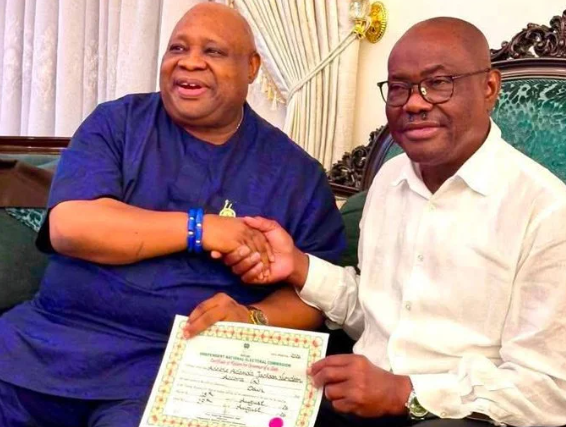
nThe choice of words by the FCT Minister, Nyesom Wike after the Osun election is disturbing. It reflects a fundamental misunderstanding of the place of power in a democracy.
nRead Also: Governor Adeleke’s victory: Nigerians must replicate Osun experience in 2027 — Lawyers, activists
nWike in a press conference said that if President Tinubu had wanted to win Osun “at all costs”, he would have been involved and that Adeleke’s victory showed the Federal Government did not use its influence to manipulate the election.
nHe — and indeed, not even the President — has the power to determine the outcomes of elections. That power resides solely with the people.
nTo suggest otherwise is to reduce elections to a contest of influence rather than a contest of ideas, service, and public trust.
nFree and credible elections are not a concession granted by the President. They are the constitutional baseline of any democracy.
n_Section 14(2)(c) of the 1999 Constitution of the Federal Republic of Nigeria_ says:
n“the participation by the people in their government shall be ensured in accordance with the provisions of this Constitution”
nWhat this means in three simple terms:
n1. Sovereignty belongs to the people – Government derives its power and authority from the people.
n2. Right to participate- Citizens must be given real avenues to take part in governance: voting, contesting, holding leaders accountable.
n3. It’s not optional – It’s a constitutional duty for the state and its institutions to create conditions for free participation. Elections, representation, and access to government must not be blocked or manipulated.
nBy that standard, free and credible elections are not a “favor” from the President or government. They are a constitutional requirement.
nFor a democrat, suggesting that the non-interference of the Federal Government in the Osun election was a benevolent act misses the point entirely. Non-interference is not generosity. It is compliance. It is the law.
nThe role of the President, INEC, and all state institutions is not to decide election outcomes, but to ensure that the will of the people, freely expressed, prevails.
nINEC itself affirmed its commitment to free, fair and credible elections ahead of the poll. That commitment must be matched by conduct at every level of government.
nWhen institutions do what they are mandated to do, it should not be framed as a favor. It should be framed as duty performed.
nWe must commend systems where incumbency is not used to predetermine results. But commendation must not blur the standard.
nThe absence of manipulation is not a virtue to be celebrated — it is the minimum standard expected in a constitutional democracy.
nDemocracy is not sustained by favors. It is sustained by institutions that respect the sovereign right of citizens to choose their leaders.
nA free election is therefore not a gift from government to the people. It is the fundamental obligation of the government to the people.
nAs Nelson Mandela said:
n“To deny people their right to vote is to deny their right to have a say in the affairs of those who govern them.”
nAnd as Kofi Annan said:
n“No one is born a good citizen; no nation is born a democracy. Rather, both are processes that continue to evolve over a lifetime. Young people must be included from birth.”
nWhen we begin to applaud leaders for “allowing” the people to vote, we normalize the very interference we claim to reject.
nThat is why the conversation must shift from personalities to processes. From discretion to rules. From influence to institutions.
nFor this reason, the continuous call to minimize human interference and strengthen technology-driven collation is not a call for anarchy.
nIt is a call to protect the integrity of the ballot and deepen citizens’ democratic rights. Technology, when properly deployed, reduces unnecessary suspicion and increases transparency.
nOur democracy will only grow when citizens trust that their vote will count. Kudos to the INEC Chairman, Prof. Joash Amupitan, and the Commission for their commitment to credible polls, and to all public officials who understand that their role is to serve the outcome, not to shape it. Though marred by pre election violence, the standard set in Osun should not be lowered.
nThe Osun election must therefore be remembered not for who “allowed” what, but for what it proved: that when institutions work, the will of the people will prevail.
nUntil we stop treating constitutional duty as magnanimity, we will keep having this debate after every election.
n nRelated Stories
 General News
CELEBRATING TWO YEARS OF TRANSFORMATIONAL LEADERSHIP IN THE PRESIDENTIAL AMNESTY PROGRAMME
Tomorrow, 14TH March 2026, as we look forward to the second anniversary, we reflect on the remarkable two years since the Administrator of the Preside
 General News
PRESIDENTIAL AMNESTY PROGRAMME PHASE 3: DISREGARD PURPORTED STATEMENT ON DELAYED ITA PAYMENTS — OFFICE OF NATIONAL CHAIRMAN
The Office of the National Chairman of the Presidential Amnesty Programme Phase 3, General Elaye ThankGod Dollar Slaboh, has called on beneficiaries a
 General News
RE: CLARIFICATION ON MY PERSONAL RELATIONSHIPS
PUBLIC NOTICErnrnRE: CLARIFICATION ON MY PERSONAL RELATIONSHIPSrnrnIt has become necessary to make this public clarification following the increasing