
Nigeria's Progress Hindered by Lack of Female Representation, Says National Association
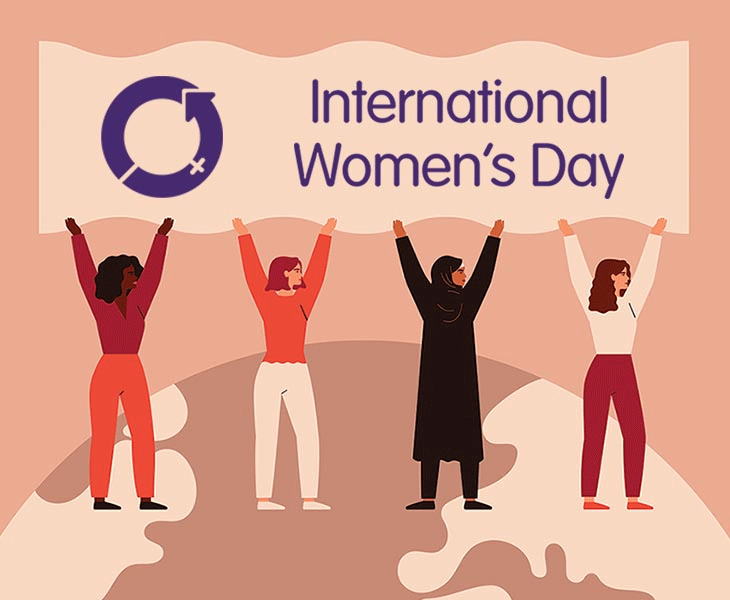
Nigeria is joining the rest of the world in commemorating the 2026 International Women’s Day, with the National Association of Seadogs, also known as Pyrates Confraternity, participating in the global celebrations to honor women and advocate for their increased involvement in political leadership and governance.
nThe theme of this year's International Women’s Day is "Rights, Justice, Action for all Women and Girls", according to a statement issued by the association's Cap'n, Dr Joseph Oteri, on Sunday.
nDr Oteri noted that despite women's crucial role in family stability, community development, and national progress, their representation in Nigeria's political leadership remains disturbingly low, with the association's statement highlighting the need to recognize the resilience and achievements of women.
nAccording to Dr Oteri, International Women’s Day serves as a reminder that the pursuit of gender equality is still incomplete, and he emphasized that Nigerian women make significant contributions to the country's development, yet their representation in political leadership remains disproportionately low.
nThe Cap'n of the National Association of Seadogs cited statistics showing that women hold only three out of 109 seats in the Senate and seventeen out of 360 seats in the House of Representatives, resulting in approximately 4.2 per cent representation in the National Assembly.
nThese figures, Dr Oteri pointed out, place Nigeria among countries with the lowest female representation in parliament globally, despite women making up nearly half of the country's population and actively participating in civic and democratic processes.
nGlobally, the average level of women's representation in national parliaments exceeds 26 per cent, according to the Inter-Parliamentary Union, with several African countries making notable progress in promoting gender-inclusive governance, Dr Oteri observed.
nThe National Association of Seadogs attributed Nigeria's poor performance in this regard to a combination of structural and cultural barriers that discourage women from seeking public office, including high nomination fees imposed by political parties and entrenched gender biases in the political space.
nDr Oteri specifically mentioned that high nomination fees, electoral violence, and weak institutional support remain major obstacles limiting women's entry into political leadership, emphasizing the need for reform.
nRwanda was cited by Dr Oteri as a notable African example where deliberate reforms and political commitment have significantly improved women's representation in governance, with women currently occupying more than 60 per cent of seats in the country's national legislature.
nAccording to Dr Oteri, inclusive governance strengthens democratic institutions and results in more balanced policy outcomes, and he added that societies that promote women's participation in leadership benefit from broader perspectives in decision-making.
nDr Oteri urged Nigerian political parties to reform internal processes that discourage female aspirants, particularly excessive nomination fees and opaque candidate selection processes, and also called on lawmakers to revisit policy proposals that encourage affirmative action.
nHe emphasized that democracy cannot reach its full potential when half of the population remains largely excluded from spaces where critical national decisions are made, stressing that Nigerian women must be fully represented as leaders, lawmakers, and architects of national policy.
nThe National Association of Seadogs further urged electoral institutions and security agencies to ensure that the political environment remains safe and accessible for women who often face intimidation and violence during electoral cycles.
nDr Oteri emphasized that empowering women to participate fully in political leadership is not merely an issue of fairness but a democratic necessity for Nigeria's development, as the country navigates complex social and economic challenges.
nThe organisation called on government institutions, political parties, civil society organisations, and citizens to work collectively toward creating a political system that reflects the strength, talent, and aspirations of all Nigerians, according to Dr Oteri.
Related Stories
 General News
CELEBRATING TWO YEARS OF TRANSFORMATIONAL LEADERSHIP IN THE PRESIDENTIAL AMNESTY PROGRAMME
Tomorrow, 14TH March 2026, as we look forward to the second anniversary, we reflect on the remarkable two years since the Administrator of the Preside
 General News
PRESIDENTIAL AMNESTY PROGRAMME PHASE 3: DISREGARD PURPORTED STATEMENT ON DELAYED ITA PAYMENTS — OFFICE OF NATIONAL CHAIRMAN
The Office of the National Chairman of the Presidential Amnesty Programme Phase 3, General Elaye ThankGod Dollar Slaboh, has called on beneficiaries a
 General News
RE: CLARIFICATION ON MY PERSONAL RELATIONSHIPS
PUBLIC NOTICErnrnRE: CLARIFICATION ON MY PERSONAL RELATIONSHIPSrnrnIt has become necessary to make this public clarification following the increasing