
Nigeria's economic system is stacked against the majority of its citizens, says Dele Oye, former OPS chairman.
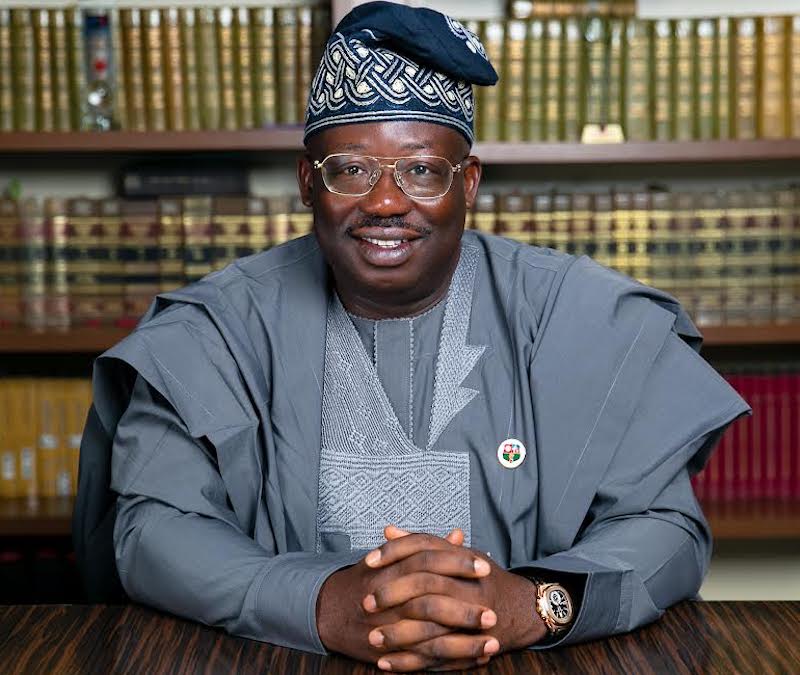
Nigerian Association of Chambers of Commerce, Industry, Mines and Agriculture's immediate past National President, Hon. Dele Kelvin Oye, has warned that the $74 billion livestock sector could face a similar fate as Ajaokuta if the government fails to facilitate its growth properly, emphasizing that when government tries to operate businesses, disaster follows.
nAs the current Chairman of Alliance for Economic Research and Ethics LTD/GTE and Chairman, Nigeria-Türkiye Business Council, Oye delivered a paper at the 2026 Edition of Vanguard Economic Discourse, titled ‘The government as facilitator, not operator: a new paradigm for Nigeria’s livestock industry’, where he expressed his concerns about Nigeria’s rent-seeking economy being rigged against most Nigerians.
nThe discourse, which was held under the theme ‘Food Security and Socioeconomic Stability: Options for Nigeria’s Agriculture Sector Rebound’, provided a platform for Oye to share his thoughts on the need for the government to facilitate the growth of the livestock sector, rather than trying to operate it.
nIn May 2023, Nigeria was on the verge of economic catastrophe, with debt servicing consuming between 65% and 124% of government revenue, and foreign debt service reaching $3.5 billion, making it the third-largest debtor to the World Bank’s International Development Association (IDA).
nThe country's foreign debt service alone reached $3.5 billion in 2023, while the World Bank had projected that debt servicing would gulp 123.4% of the Federal Government’s revenue in 2023, indicating a severe fiscal crisis.
nNigeria's inflation rate was approximately 22% when the new administration assumed office, with the official unemployment rate standing at 5.4% for 2023, according to the National Bureau of Statistics (NBS), although this figure masked the deeper crisis of underemployment and subsistence activity.
nFuel subsidies were draining the treasury at a rate of ¦ 4 trillion annually, which was projected to rise to ¦ 5.4 trillion by 2024 if the subsidy had not been removed, while the Naira was artificially propped up at approximately ¦ 460 to the dollar at the official window.
nPresident Bola Ahmed Tinubu, upon assuming office on May 29, 2023, implemented three foundational reforms, including the removal of the fuel subsidy, floating of the Naira, and consolidation of monetary and fiscal policy, which were structurally indispensable but caused short-term pain.
nThe short-term consequences of these reforms were severe, with inflation surging from approximately 22% in May 2023 to a peak of 34.80% by December 2024, and food inflation reaching an agonizing 40.53% by April 2024 before beginning a gradual descent.
nDespite the challenges, the reforms have yielded measurable macroeconomic stabilization, with GDP growth recovering to 3.84% in Q4 2024, driven by non-oil sector resilience, and external reserves stabilizing and growing to approximately $48–49 billion by early 2026.
nInvestor confidence has improved markedly, with capital importation jumping 88% to $23.21 billion in 2025, a testament to restored confidence in Nigeria’s macroeconomic framework, although the parallel market premium narrowed significantly, reducing arbitrage and corruption.
nHowever, the World Bank now projects Nigeria’s economic growth at approximately 4.1–4.2% for 2026, reflecting the durability of the reform gains, but the country still faces a paradox where GDP is growing, yet the people are getting poorer, with poverty rising to 63% in 2025.
nAccording to the World Bank’s October 2025 Nigeria Development Update, over 139 million Nigerians now live below the poverty line, indicating a severe poverty expansion, which is not inclusive growth, but rather growth that enriches the few while impoverishing the many.
nNigeria has become a rent-seeking economy, rigged against the majority of its people, with banks declaring record profits from purchasing Treasury Bills and government bonds, rather than funding agriculture, manufacturing, or the livestock sector.
nIn 2024, Nigerian listed banks earned a combined ¦ 5.93 trillion from investment securities, primarily Treasury bills and government bonds, a sharp rise that highlights how lenders leaned into safe, high-yield government debt rather than riskier private sector loans.
nThe evidence is damning, with Nigeria's total food import bill skyrocketing to ¦ 7.65 trillion in 2025, a direct consequence of the failure to invest in domestic food production, and the livestock sector, which could employ millions, being virtually ignored by formal finance.
nIf Nigeria is to translate GDP growth into actual inclusive growth, it must address a fundamental structural flaw: the government's insistence on being in business, which has led to catastrophic failures, such as the Ajaokuta Steel Plant, Aluminium Smelting Plant, and refinery rehabilitation disaster.
nThe government's attempts to operate businesses have resulted in monumental failures, including the Ajaokuta Steel Plant, which wasted over $8 billion, and the refinery rehabilitation disaster, which spent more than ¦ 11.35 trillion ($25 billion) with little to show for it.
nNigeria's livestock sector holds enormous potential, with an estimated 20.9 million cattle, millions of sheep, goats, and poultry, and a domestic market of over 220 million people, yet it remains primitive, characterized by subsistence herding and zero value addition.
nThe National Livestock Growth Acceleration Strategy (NL-GAS) 2025–2035 targets growth from $32 billion to $74 billion by 2035, and some projections suggest the sector could contribute as much as $94 billion to GDP if properly structured, but the sector requires proper institutional architecture to achieve this growth.
nThe livestock sector is not merely an agricultural subsector, but a microcosm of Nigeria's development challenge, with the country spending over $1.5 billion annually importing dairy products, despite having an estimated 58 million cattle, and the sector could eliminate the $1.5 billion annual dairy import bill and generate billions in exports if properly managed.
Related Stories
 General News
CELEBRATING TWO YEARS OF TRANSFORMATIONAL LEADERSHIP IN THE PRESIDENTIAL AMNESTY PROGRAMME
Tomorrow, 14TH March 2026, as we look forward to the second anniversary, we reflect on the remarkable two years since the Administrator of the Preside
 General News
PRESIDENTIAL AMNESTY PROGRAMME PHASE 3: DISREGARD PURPORTED STATEMENT ON DELAYED ITA PAYMENTS — OFFICE OF NATIONAL CHAIRMAN
The Office of the National Chairman of the Presidential Amnesty Programme Phase 3, General Elaye ThankGod Dollar Slaboh, has called on beneficiaries a
 General News
RE: CLARIFICATION ON MY PERSONAL RELATIONSHIPS
PUBLIC NOTICErnrnRE: CLARIFICATION ON MY PERSONAL RELATIONSHIPSrnrnIt has become necessary to make this public clarification following the increasing