
Nigeria's Challenges: The North Emerges as a Major Concern, Says Saror, Former Opposition Leader in the Senate
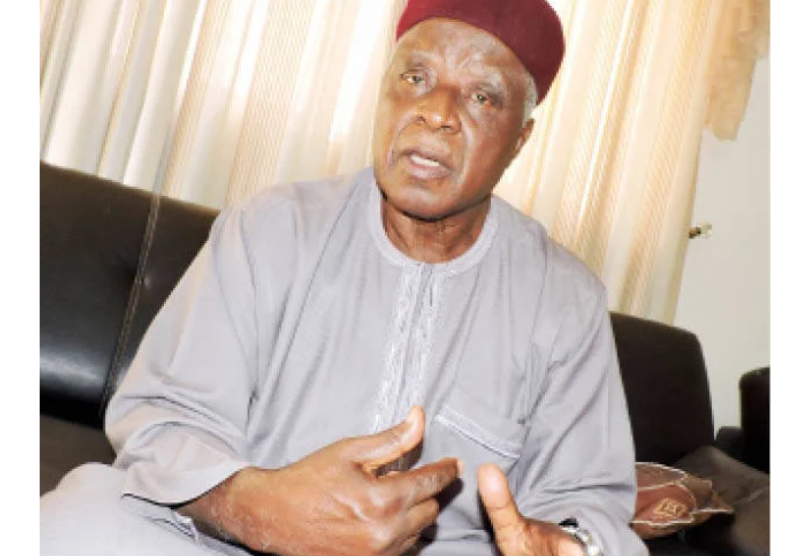
Prof Daniel Saror, a former Senate Minority Leader, has expressed his concerns about the state of insecurity in Nigeria, stating that it is diminishing the prospects of national unity, and that the livestock husbandry industry has become politicized, militarized, and weaponized.
nAt 85 years old, Saror fears that he may not live to see a better Nigeria, and believes that the northern leadership has paid little attention to the impact of ethnicity and religious intolerance in the country.
nSaror recalls that he was present at the Tafawa Balewa Square in 1960, where Nigeria gained independence, and notes that the country has not turned out as expected, with insecurity now a major issue.
nHe specifically highlights the North-West region, where states such as Sokoto, Zamfara, Katsina, and Kebbi are experiencing high levels of insecurity, and the North-East region, where states such as Borno, Yobe, and Adamawa are also affected.
nSaror also mentions the North-Central region, where states such as Benue, Taraba, Plateau, and Kwara are experiencing insecurity, and notes that the government seems incapable of addressing the problem.
nHe recalls that around 2011, there was an increase in Fulani herdsmen activities in the region, and that in 2014, a committee was set up to investigate the disturbances caused by Fulani herdsmen in Benue State.
nSaror notes that the committee found that the Fulani herdsmen were heavily armed and were destroying villages, and that the situation has become exponentially worse over the years.
nHe believes that the northern oligarchy needs to step up and make a decision on whether they want to have a country called Nigeria where everyone can live in peace, or if they want to dominate and control everyone's life.
nSaror thinks that the issue of insecurity in the North is complex and multifaceted, and that it is not just a matter of poverty and underdevelopment, but also of religion, control, and dominance.
nHe notes that the method of livestock husbandry in Nigeria has become politicized, militarized, and weaponized, and that the northerners are opposed to modern husbandry practices such as ranching.
nSaror recalls that he has lived among Fulani people before and never had any problems, but now Fulani herdsmen are carrying sophisticated arms and are hostile towards others.
nHe believes that the Nigerian government is complicit in the insecurity situation and that the military is also involved, with some personnel being told not to attack the insurgents.
nSaror notes that the presence of American troops in the country may have a salutary effect, but that it is not a long-term solution to the problem of insecurity.
nHe thinks that the northerners want to impose Sharia law on the whole country, and that this is a disturbing trend that goes against the principles of the Nigerian constitution.
nSaror compares his active politics years to the present day and notes that he is not impressed with the current state of politics in the country.
nHe recalls that he retired from active partisan politics in February 2016 and has not been involved in anything to do with partisan politics since then.
nSaror notes that during his time in politics, he worked to improve the quality of life of the people and participated in various committees, including the Appropriations and Finance committees.
nHe recalls that he was the chairman of the Telecommunications committee of the Senate when GSM was introduced, and that he served as the Minority Leader in the Senate before he left in 2007.
nSaror believes that there was a third term bid by former President Obasanjo, despite his denials, and that a lot of money was expended on the project.
nHe notes that he was offered money by late Tony Anenih to support the third term bid, but that he refused and played a role in defeating the bid on the floor of the Senate.
Related Stories
 General News
CELEBRATING TWO YEARS OF TRANSFORMATIONAL LEADERSHIP IN THE PRESIDENTIAL AMNESTY PROGRAMME
Tomorrow, 14TH March 2026, as we look forward to the second anniversary, we reflect on the remarkable two years since the Administrator of the Preside
 General News
PRESIDENTIAL AMNESTY PROGRAMME PHASE 3: DISREGARD PURPORTED STATEMENT ON DELAYED ITA PAYMENTS — OFFICE OF NATIONAL CHAIRMAN
The Office of the National Chairman of the Presidential Amnesty Programme Phase 3, General Elaye ThankGod Dollar Slaboh, has called on beneficiaries a
 General News
RE: CLARIFICATION ON MY PERSONAL RELATIONSHIPS
PUBLIC NOTICErnrnRE: CLARIFICATION ON MY PERSONAL RELATIONSHIPSrnrnIt has become necessary to make this public clarification following the increasing