
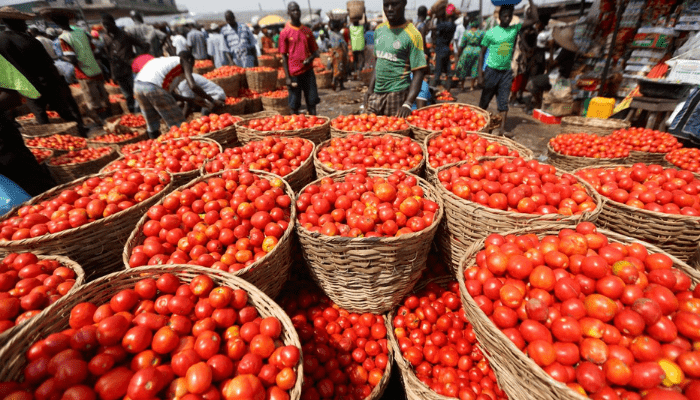
Nigerians can expect a significant drop in tomato costs by October, according to farmers' predictions.
…says US-Iran War, insecurity, high input prices, others triggered high prices
nBy Gabriel Ewepu, Abuja
nTomato farmers under the auspices of the Tomatoes and Orchard Producers Association of Nigeria, TOOPAN, on Sunday, assured Nigerians of tomato prices crashing in October.
nSpeaking with Vanguard, the president of TOOPAN, Mr Oyeleke Bola, said the current supply is far below meeting the current demand by those who consume the fresh tomato and large industries that use it as raw material.
nIn spite of the challenges in the value chain, Nigeria remains the second-largest tomato producer in Africa after Egypt, producing about 1.8 million to 2.3 million metric tonnes of tomatoes annually, with some peak estimates hitting closer to 3.6 million tonnes during optimal harvest years.
nHe said, “We will be looking at October 2026; prices will crash by that time. October is going to be the next harvesting month, and at that time there will be huge harvests because a lot of our farmers will be harvesting their tomatoes to complement others so that we can have enough in the market, and when we have enough in the market, the price will surely come down.
n“By October, we will be harvesting tomatoes from Jos, Kaduna, Kano, and Gombe and down south-west in Ogun, Ondo, Oyo, and part of Lagos States, which are the Badagry and Epe areas.
n“Our small-scale farmers are working very hard. Nigerians should have patience with us, as all of us need to come together to make sure that we solve this problem together.
n“Currently, we are doing 25, 30, and 35 tonnes per hectare. Some farmers in the north are doing 30 to 35 tonnes per hectare, while some farmers in the South-West are doing 25 to 30 or 20 to 25 tonnes per hectare.”
nAccording to him, the current price increase is as a result of the high cost of farm inputs traceable to the US-Iran war, where fertilisers were imported into the country; few farmers are going to cultivate tomatoes; there is a rising level of insecurity across tomato-producing states; the cost of seeds is high; there is poor access to finance for farmers; and there are other factors affecting productivity.
nHowever, he said his association is working hard to reduce these challenges, as they are collaborating with seed companies and also fertiliser-producing companies so farmers can purchase farm inputs at affordable prices, including training on best agronomic practices.
n nRelated Stories
 General News
CELEBRATING TWO YEARS OF TRANSFORMATIONAL LEADERSHIP IN THE PRESIDENTIAL AMNESTY PROGRAMME
Tomorrow, 14TH March 2026, as we look forward to the second anniversary, we reflect on the remarkable two years since the Administrator of the Preside
 General News
PRESIDENTIAL AMNESTY PROGRAMME PHASE 3: DISREGARD PURPORTED STATEMENT ON DELAYED ITA PAYMENTS — OFFICE OF NATIONAL CHAIRMAN
The Office of the National Chairman of the Presidential Amnesty Programme Phase 3, General Elaye ThankGod Dollar Slaboh, has called on beneficiaries a
 General News
RE: CLARIFICATION ON MY PERSONAL RELATIONSHIPS
PUBLIC NOTICErnrnRE: CLARIFICATION ON MY PERSONAL RELATIONSHIPSrnrnIt has become necessary to make this public clarification following the increasing