
Nigeria must be secure, stable before leading Africa, says Foreign Affairs Minister
By Kingsley Omonobi
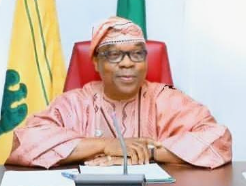
nABUJA — Minister of State for Foreign Affairs, Sola Enikanolaiye, has said Nigeria must first strengthen its economy, security and internal stability before it can effectively reclaim its leadership role in Africa and project greater influence on the global stage.
nThe minister stated this on Thursday in Abuja at the launch of Shadows of Power, authored by retired Rear Admiral Olusola Akinsola Oluwagbire.
nAccording to Enikanolaiye, the Federal Government’s “Nigeria First” policy places the interests of Nigerians at the centre of all diplomatic engagements and is designed to strengthen the country’s domestic foundations as a prerequisite for a more dynamic foreign policy.
n“You cannot have a dynamic and activist foreign policy if the home is weak, if the country is disunited, and if there is no harmony in Nigeria. How can you go outside and be taken seriously?” he said.
n“We believe these objectives are mutually reinforcing. Nigeria has to be secure and stable before it can effectively play the activist role in foreign policy that it traditionally played during the liberation struggle and other continental engagements.”
nThe minister explained that the country’s foreign policy is now being driven by a “Nigeria First” doctrine focused on advancing national interests, security, economic prosperity and the welfare of citizens.
n“The motto of the Ministry of Foreign Affairs is actually ‘Nigeria First’. Every foreign policy action we take must speak to Nigeria,” he said.
n“We are locating Nigeria and Nigerians at the core of our foreign policy priorities so that our national interests, security, defence and economic prosperity remain central to our diplomatic engagements.”
nWhile reaffirming Nigeria’s commitment to Africa, Enikanolaiye said the government was recalibrating its foreign policy approach to ensure that domestic priorities receive adequate attention.
nHe noted that Nigeria and its immediate neighbours now constitute the primary focus of diplomatic engagement because of their interconnected security and economic interests.
n“Our neighbours, our security, prosperity and development are intrinsically linked. If they are not secure, it has implications for us,” he said.
n“We have decided to prioritise that region before moving further into Africa, without jettisoning Africa as the cornerstone of our foreign policy.”
nThe minister also said Nigeria would continue to pursue strategic autonomy in its international relations by aligning foreign engagements strictly with national interests rather than ideological considerations.
n“What is strategic autonomy? Simply put, it means alignment to our national interest. Therefore, wherever the wind blows, that is where we go in pursuit of Nigeria’s interest,” he stated.
nHe added that Nigeria remains open to partnerships with both Western and Eastern countries, including China, Russia, Turkey, Saudi Arabia and Brazil.
n“We may have tilted a little to the West, but we have not abandoned our traditional partners. All of them remain important partners in Nigerian foreign policy,” he said.
nEnikanolaiye defended Nigeria’s renewed security and defence cooperation with the United States and other Western allies, describing it as a continuation of longstanding partnerships aimed at addressing current security challenges.
n“What has happened is a reinvigoration of those partnerships in a manner that addresses our current domestic security challenges,” he said.
n“The truth is that no aspect of domestic policy can succeed unless you identify its external components and pursue them equally.”
nThe minister expressed confidence that Nigeria remained on the right path despite concerns about declining international visibility.
n“Nigeria is still very much on course. Our visibility may have dimmed a little, but we are working to restore it,” he said.
nHe also disclosed ongoing efforts to reform the Ministry of Foreign Affairs through capacity building, institutional strengthening, professional training and merit-based postings.
n“We are rebuilding the institution in terms of systems, processes and capacity in a manner that instils confidence, morale and professionalism within the Ministry,” he said.
nCalling for closer collaboration between diplomatic and defence institutions, Enikanolaiye stressed that foreign policy and national security must be pursued in a coordinated manner.
n“Foreign policy is the flip side of defence policy, and both must be pursued together so that our country can be better secured, more prosperous and have a better future,” he added.
nSpeaking at the event, Rear Admiral Oluwagbire said his book examines how relationships with major world powers have influenced Nigeria’s national security architecture.
n“It was based on my research into how major powers have influenced Nigeria’s national security and how our relationships with them have shaped our security environment,” he said.
nHe noted that while nations pursue their own interests, countries must also develop the capacity to influence events beyond their borders.
n“Nigeria has historically played a leading role in Africa through peacekeeping, regional integration and liberation movements. We can continue to do so if we build the necessary capacity and influence,” he said.
nFormer President Olusegun Obasanjo was represented at the event by former Chief of Defence Staff, Martin Luther Agwai, while the Minister of Defence was represented by retired Rear Admiral Bankole.
nOther dignitaries at the launch included former Chiefs of Defence Staff, Ola Sa’ade Ibrahim and Lucky Irabor, as well as former Chief of Naval Staff, Awwal Gambo.
nThe 157-page, 11-chapter book was reviewed by former Deputy Chairman of the House of Representatives Committee on National Security and Intelligence, Hon. Adetoro Adeogun.
n nRelated Stories
 General News
CELEBRATING TWO YEARS OF TRANSFORMATIONAL LEADERSHIP IN THE PRESIDENTIAL AMNESTY PROGRAMME
Tomorrow, 14TH March 2026, as we look forward to the second anniversary, we reflect on the remarkable two years since the Administrator of the Preside
 General News
PRESIDENTIAL AMNESTY PROGRAMME PHASE 3: DISREGARD PURPORTED STATEMENT ON DELAYED ITA PAYMENTS — OFFICE OF NATIONAL CHAIRMAN
The Office of the National Chairman of the Presidential Amnesty Programme Phase 3, General Elaye ThankGod Dollar Slaboh, has called on beneficiaries a
 General News
RE: CLARIFICATION ON MY PERSONAL RELATIONSHIPS
PUBLIC NOTICErnrnRE: CLARIFICATION ON MY PERSONAL RELATIONSHIPSrnrnIt has become necessary to make this public clarification following the increasing