
Nigeria may have strayed off the path to democracy once more, according to Saraki
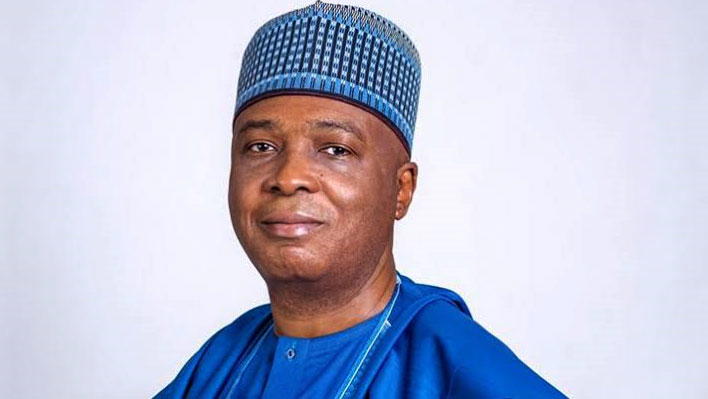
Bukola Saraki has made a passionate case for the National Assembly's role in Nigeria's democracy, emphasizing the need for strong institutions to prevent a repeat of the June 12, 1993 tragedy.
nSpeaking at The Platform Nigeria, Saraki invoked the significance of June 12, a date he said the Nigerian state had preferred to forget, but one that citizens had kept alive through their faith in its meaning.
nSaraki recalled the 1993 election, where Nigerians from all regions and faiths came together to cast their votes, only to have the mandate annulled, resulting in lives lost and a man imprisoned for defending it.
nDespite this, Saraki noted that the idea of democracy survived, and today, Nigeria celebrates Democracy Day, thanks to the refusal of ordinary Nigerians to surrender their belief in the ballot.
nSaraki's address was deliberately opened with the June 12 analogy, as he believed that everything he would say flowed from the truth that democracy in Nigeria was never handed to its people, but rather fought for.
nHe argued that what is fought for must be cherished, protected, and built upon, otherwise, it will be lost, and made his case for the legislature under three headings: securing democratic stability, strengthening governance, and driving national development.
nSaraki acknowledged that Nigerians often misunderstand the relationship between the executive and legislative arms of government, with many thinking of power as being held by the president alone.
nThe former Senate President stressed that the separation of powers was deliberate, with the framers of the Constitution understanding that the greatest danger to a free people is not a weak government, but an unchecked government.
nSaraki emphasized that the friction between the executive and legislative branches is not dysfunction, but rather a guarantee of freedom, and warned that a legislature that cannot say "no" is not a legislature at all.
nHe argued that an independent legislature is not rebellion against the government, but rather a means of strengthening the government's legitimacy, as a mandate that is never tested is a mandate no one can trust.
nSaraki drew a direct line from the annulled June 12 election to his central thesis about institutional weakness, stating that the lesson is plain: Nigeria did not lose democracy in 1993 because the people failed, but because the institutions that should have defended the people's verdict were too weak.
nThe former Senate President noted that the remedy is not less politics, but stronger institutions, with the legislature serving as the Republic's "pressure valve" for citizens to express their grievances and concerns.
nSaraki took aim at the narrative that the National Assembly "pads" the budget, arguing that the legislature is only doing what it has the power to do by the Constitution, and accused the executive branch of often seeking comfort in violating constitutional provisions.
nHe recalled the 2018 purchase of Tucano aircraft from the United States government, where money was spent before approval, and stressed that when a country borrows, it is not government money, but the obligation of Nigerians alive today, their children, and their children's children.
nSaraki revealed that he and others paid a "personal cost" for the Senate's exercise of its confirmation powers, citing the case of the acting chairman of the EFCC, who stayed in office despite being rejected by the Senate.
nThe former Senate President illustrated the legislature's role in citizens' daily lives with the story of Corporal Williams, a policeman dismissed in 1996 without trial, whose petition was reviewed by the Senate committee on ethics, leading to his dismissal being reversed.
nSaraki noted that many of Nigeria's laws are outdated, some written in the 1970s, and cited the Petroleum Industry Bill, which was not passed for 25 years, but was eventually signed by the 9th Senate after being taken up by the 8th National Assembly.
nDespite his defence of the legislature, Saraki did not shy away from its shortcomings, noting that the parliament is often seen as distant from the people it serves, with its proceedings feeling opaque, and members appearing more attentive to the executive than to their constituents.
nSaraki called for electoral reform as the foundation for a stronger legislature, stating that until the right people are elected, the foundation remains weak, and argued that the singular greatest reform that could make the National Assembly better would be for citizens to watch, ask, and vote on legislative records.
nThe former Senate President emphasized that strong legislatures are not enemies of the state, but rather a necessary component of a stable, prosperous, and free country, and stressed that the difference between military rule and democratic rule is the legislative arm of government.
nSaraki ended with a simple formula: a strong legislature promotes transparency, transparency inspires public trust, public trust strengthens democratic legitimacy, and democratic legitimacy produces stability, which is how Nigeria will have a better and stronger democracy.
Related Stories
 General News
CELEBRATING TWO YEARS OF TRANSFORMATIONAL LEADERSHIP IN THE PRESIDENTIAL AMNESTY PROGRAMME
Tomorrow, 14TH March 2026, as we look forward to the second anniversary, we reflect on the remarkable two years since the Administrator of the Preside
 General News
PRESIDENTIAL AMNESTY PROGRAMME PHASE 3: DISREGARD PURPORTED STATEMENT ON DELAYED ITA PAYMENTS — OFFICE OF NATIONAL CHAIRMAN
The Office of the National Chairman of the Presidential Amnesty Programme Phase 3, General Elaye ThankGod Dollar Slaboh, has called on beneficiaries a
 General News
RE: CLARIFICATION ON MY PERSONAL RELATIONSHIPS
PUBLIC NOTICErnrnRE: CLARIFICATION ON MY PERSONAL RELATIONSHIPSrnrnIt has become necessary to make this public clarification following the increasing