
Nigeria is responsible for one-fifth of the world's pregnancy-related fatalities, according to a recent study.

Nigeria's maternal mortality rate has sparked concern from the Centre for Journalism Innovation and Development, with the country accounting for nearly 20 per cent of global maternal deaths due to underfunding and systemic failures in the health sector.
nFelicia Dairo, Programme Manager of CJID, highlighted this issue during a two-day training for health journalists on investigative skills for reporting Nigeria's priority health challenges in Abuja.
nAccording to Dairo, Nigeria's health sector is experiencing a quiet structural emergency, exacerbated by poor accountability, opaque budgeting processes, and weak investigative reporting, resulting in a maternal mortality ratio that remains terrifyingly high.
nDairo noted that despite government commitments, the health sector continues to receive funding below the 15 per cent benchmark agreed under the Abuja Declaration, with many Primary Health Care facilities lacking functional water supply, electricity, and essential drugs.
nPublic institutions have been accused of shielding systemic failures from scrutiny through fragmented health data, bureaucratic bottlenecks, and inaccessible budget documents, allowing critical failures in healthcare financing and service delivery to persist unchecked.
nDairo emphasized that the overdependence on official narratives has weakened accountability journalism, with headlines often chronicling individual tragedies, such as mothers bleeding to death during childbirth or communities ravaged by preventable cholera outbreaks.
nShe stated that health data in Nigeria is deliberately scattered across bureaucratic silos, and national budget documents are intentionally opaque, hindering journalists' ability to hold institutions accountable.
nDairo stressed the need for journalists to move beyond emotional storytelling and adopt evidence-based, data-driven investigations to expose how public funds meant for healthcare disappear before reaching communities.
nShe emphasized that emotional op-eds are insufficient to address these issues, and instead, iron-clad, data-driven journalism is necessary to provide answers.
nThe training, according to Dairo, aims to equip journalists with investigative skills to track health budgets, analyse complex datasets, and uncover accountability gaps across critical health sectors.
nThe workshop focuses on six major areas, including primary health care, maternal and child health, family planning, immunisation, nutrition, and infectious diseases, to provide journalists with the necessary tools to tackle these issues.
Related Stories
 General News
CELEBRATING TWO YEARS OF TRANSFORMATIONAL LEADERSHIP IN THE PRESIDENTIAL AMNESTY PROGRAMME
Tomorrow, 14TH March 2026, as we look forward to the second anniversary, we reflect on the remarkable two years since the Administrator of the Preside
 General News
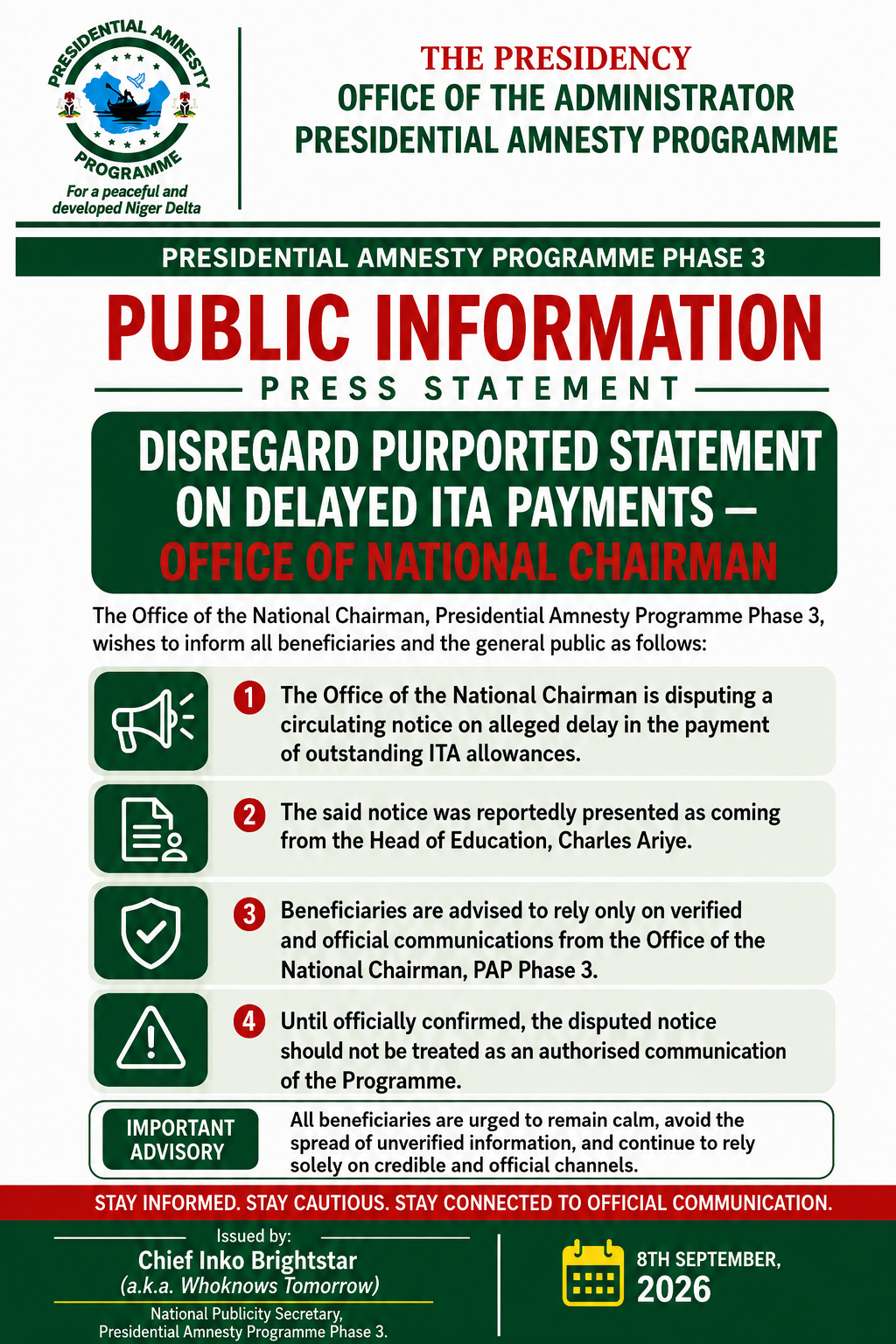
PRESIDENTIAL AMNESTY PROGRAMME PHASE 3: DISREGARD PURPORTED STATEMENT ON DELAYED ITA PAYMENTS — OFFICE OF NATIONAL CHAIRMAN
The Office of the National Chairman of the Presidential Amnesty Programme Phase 3, General Elaye ThankGod Dollar Slaboh, has called on beneficiaries a
 General News
RE: CLARIFICATION ON MY PERSONAL RELATIONSHIPS
PUBLIC NOTICErnrnRE: CLARIFICATION ON MY PERSONAL RELATIONSHIPSrnrnIt has become necessary to make this public clarification following the increasing