
Next pandemic is a matter of when, not if — WHO DG
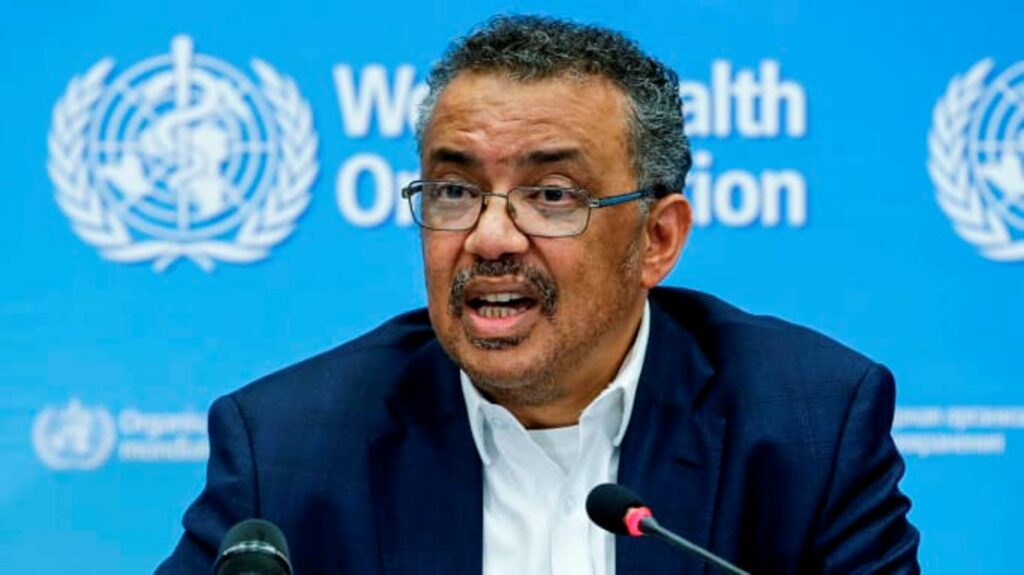
WHO chief, Tedros Ghebreyesus
nThe COVID-19 pandemic was the most severe global health crisis in a century, killing at least 20 million people and wiping more than 10 trillion dollars from the global economy.
nWHO Director-General, Dr Tedros Ghebreyesus, said on Friday during an online news conference that the pandemic exposed and worsened weaknesses in global health security, while teaching the world painful lessons.
nHe said countries must learn from those lessons because the next pandemic was not a question of if it would occur, but when.
nGhebreyesus said the ongoing Bundibugyo Ebola virus disease outbreak in the Democratic Republic of the Congo showed that outbreaks could begin anywhere and threaten neighbouring countries and the wider world.
nHe also cited the recent hantavirus outbreak aboard the MV Hondius as evidence that international threats require international responses.
nHe said cooperation among countries and partners, particularly Spain, helped control and stop the hantavirus outbreak.
nGhebreyesus said WHO had established 12 key initiatives since the COVID-19 pandemic to strengthen global health security across six major areas.
nHe said the initiatives included the Pandemic Fund with the World Bank and Universal Health and Preparedness Review to strengthen national preparedness capacities.
nAccording to him, WHO also established the WHO Hub for Pandemic and Epidemic Intelligence in Berlin to strengthen disease surveillance and early warning systems.
nHe said efforts to improve equitable access to vaccines and other health tools included COVAX, the mRNA Technology Transfer Programme and the Biomanufacturing Workforce Training Initiative.
nGhebreyesus said WHO had also established the BioHub in Switzerland to promote international sharing of pathogen samples and strengthen global preparedness.
nHe said the Global Health Emergency Corps was established to strengthen countries’ capacity to respond effectively to health emergencies.
nHe noted that Member States adopted amendments to the International Health Regulations in 2024, strengthening the international legal framework for pandemic prevention, preparedness and response.
nHe said countries also adopted the WHO Pandemic Agreement in 2025, describing it as a landmark international legal instrument for strengthening global pandemic preparedness.
nThe WHO boss said the remaining piece was the Pathogen Access and Benefit Sharing system, which countries were still negotiating to complete the pandemic preparedness framework.
nHe expressed confidence that countries would overcome their remaining differences and reach agreement on the Pathogen Access and Benefit Sharing system.
nHe said reaching agreement was essential to enable countries to begin ratifying the Pandemic Agreement and allow it to enter into force.
nGhebreyesus rejected misinformation portraying the Pandemic Agreement as a “power grab” that would transfer national sovereignty to WHO.
nHe said the agreement was negotiated and adopted by sovereign countries acting in their own national interests, stressing that shared threats require shared responses.
nHe said an approach in which every country acted alone would not work against pandemics, noting that the same principle underpinned the political declaration being discussed at the UN high-level meeting.
nAccording to him, the declaration contains commitments to concrete, measurable and urgent action to address existing gaps in pandemic prevention, preparedness and response.
nHe thanked WHO Member States for their commitment and commended Armenia and Rwanda, as co-chairs, for leading negotiations on the political declaration.
nGhebreyesus said WHO looked forward to the declaration’s adoption and would support countries in implementing the commitments they had made.
n(NAN)
n nRelated Stories
 General News
CELEBRATING TWO YEARS OF TRANSFORMATIONAL LEADERSHIP IN THE PRESIDENTIAL AMNESTY PROGRAMME
Tomorrow, 14TH March 2026, as we look forward to the second anniversary, we reflect on the remarkable two years since the Administrator of the Preside
 General News
PRESIDENTIAL AMNESTY PROGRAMME PHASE 3: DISREGARD PURPORTED STATEMENT ON DELAYED ITA PAYMENTS — OFFICE OF NATIONAL CHAIRMAN
The Office of the National Chairman of the Presidential Amnesty Programme Phase 3, General Elaye ThankGod Dollar Slaboh, has called on beneficiaries a
 General News
RE: CLARIFICATION ON MY PERSONAL RELATIONSHIPS
PUBLIC NOTICErnrnRE: CLARIFICATION ON MY PERSONAL RELATIONSHIPSrnrnIt has become necessary to make this public clarification following the increasing