
Mystery surrounds emerging contenders for vice presidency, including Shettima, Kwankwaso, Amaechi, and Lamido.
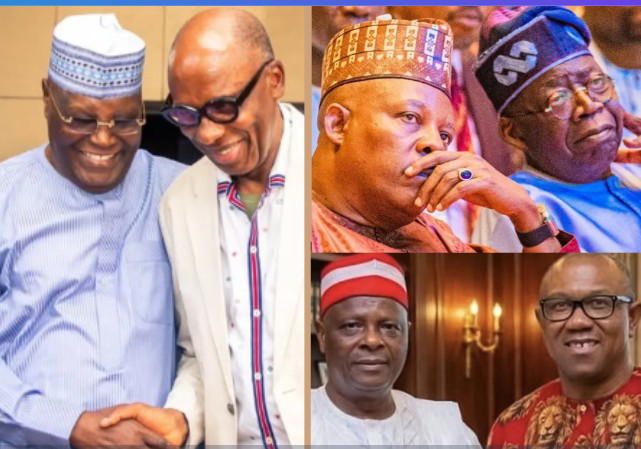
Nigeria's presidential election, scheduled for January 16, 2027, may mark a significant shift in the country's political landscape, as the old formula of zoning, ethnicity, and religious balancing is being challenged by a growing emphasis on competence and governance.
nFor months, opposition politicians have spoken about the need for unity and cooperation to defeat the ruling All Progressives Congress (APC), but as the election draws closer, the opposition is fragmenting, with multiple contenders emerging and several parties preparing separate presidential campaigns.
nThe traditional formula of Nigerian presidential politics, which has long revolved around zoning, ethnicity, and regional balancing, is being questioned, with some strategists asking whether competence may now matter more than geography in the battle for Aso Rock in 2027.
nThe opposition's central dilemma is that while unity is emotionally attractive, ambition remains politically stronger, as evident in the fact that despite the public rhetoric of cooperation, familiar tensions are brewing beneath the surface.
nPeter Obi, Rabiu Musa Kwankwaso, and Rotimi Amaechi are among those who have retained their independent national appeal, youthful support base, and fiercely loyal northern political structure, making it difficult for the opposition to coalesce around a single candidate.
nThe ghost of 2015, when disparate opposition forces came together to defeat an incumbent president, continues to haunt the opposition, with many analysts believing that the atmosphere is fundamentally different now, with multiple ambitious centers of power and a fragmented opposition.
nCheta Nwanze, lead partner at SBM Intelligence, has argued that fragmentation remains the opposition's biggest weakness, as the APC continues to benefit from the scattering of anti-incumbent votes across several parties.
nA new argument is emerging, one that prioritizes competence, governance, economic management, and policy capacity over traditional considerations of zoning, ethnicity, and regional balancing, driven by the country's worsening economic realities and growing disillusionment with political elites.
nPeter Obi has repeatedly framed leadership as a competence issue, rather than an ethnic calculation, urging Nigerians to demand "leadership built on competence, character, capacity, credibility, and compassion rather than reward ethnic division and bad governance."
nEven former President Olusegun Obasanjo has emphasized the importance of leadership quality, arguing that "appointment at the leadership level should be based on competence, knowledge, and experience; any other consideration will be sub-optimal."
nInside Atiku's camp, the debate is reportedly influencing vice-presidential discussions, with a source involved in consultations saying, "The thinking now is different. Some people are asking whether Nigeria needs another political deal or an actual governing team. Hunger is changing political psychology."
nThe calculation partly explains the growing interest in technocrats and governance-oriented figures rather than traditional political heavyweights, as the opposition seeks to present a credible alternative to the APC.
nThe changing political value of the South is also a significant factor, with several political strategists believing that parts of the South-East have become politically consolidated around Peter Obi's movement, making traditional elite endorsements less influential than before.
nThe South-South presents a different challenge, with competing loyalties, shifting alliances, and multiple centers of influence, making it difficult for the opposition to navigate the region's complex political landscape.
nA strategist involved in opposition calculations told Sunday Vanguard that the question is whether a running mate from a particular region still adds significant electoral value if that region already appears firmly aligned with another candidate.
nThe implication is profound, as the old political marketplace built around geographical compensation may be losing value, with some camps increasingly discussing competence, governance experience, and economic credibility in their vice-presidential conversations.
nFor many veteran politicians, this is an uncomfortable possibility, as they have long relied on the traditional formula to navigate the country's complex political landscape.
nThe calculation inside the opposition is that the old thinking is no longer sufficient, with a growing recognition that whoever wins in 2027 will inherit a very difficult country, requiring a different set of skills and competencies to govern effectively.
nOne source familiar with ongoing consultations said, "People assume every vice-presidential discussion is about votes. That's no longer entirely true. There is a growing recognition that governance and economic management will be critical in the next administration."
nThe battle for the vice presidency is intense, with several combinations being considered, including Tinubu/Shettima, Atiku/Amaechi, and Obi/Kwankwaso, each with its strengths and weaknesses.
nThe Tinubu-Shettima pairing is institutionally stable, preserving APC's northern coalition, but the Muslim-Muslim debate remains unresolved, with critics arguing that it reinforces exclusion in a religiously sensitive country.
nAn Atiku-Amaechi combination may be one of the strongest elite pairings, but the relationship remains complicated, with Amaechi openly rejecting ADC's presidential primary outcome and questioning the credibility of the process.
nThe Obi-Kwankwaso combination looks devastating on paper, with Obi retaining extraordinary youth appeal and urban support, and Kwankwaso influential across Kano and sections of the North-West, but the chemistry question remains central.
nCan two strong political brands genuinely coexist on one ticket without destabilizing each other, or will their independent structures and loyal followings create tension and undermine the ticket's chances?
nThe Jonathan-Lamido speculation refuses to disappear, with some sections of the political elite viewing Jonathan as a stabilizing figure, but obstacles remain enormous, including a fractured PDP and younger voters who may not respond strongly to political nostalgia.
nThe Makinde-Bala Mohammed combination represents a different possibility, a generational recalibration, with Makinde's rising national visibility and Bala Mohammed's northern network creating an interesting equation, but they remain structurally disadvantaged against APC's nationwide machinery.
nAdewole Adebayo continues to position himself as a governance-focused outsider, challenging establishment politics, but his central problem is not message but structure, and whether smaller ideological platforms like SDP can benefit from voter fatigue with recycled elite alignments.
nThe question remains whether competence can beat structure, as APC still enters 2027 with enormous institutional advantages, controlling most state governments, possessing deeper financial structures, and enjoying nationwide political networks built over years of coalition management.
nAn opposition strategist admitted that hardship is a major issue, but elections are not won by anger alone, they are won by structure, governors, money, agents, and coalition discipline, and that reality continues to haunt opposition calculations.
nAcross markets, campuses, churches, and urban neighborhoods, a different political language is emerging, one that prioritizes survival economics over identity politics, with people discussing fuel, food, electricity, rent, school fees, jobs, and survival, rather than traditional party loyalty or regional identity.
nEven online political conversations now revolve around governance performance rather than regional identity, with some political economists arguing that the old formula assumed voters could tolerate hardship if their region was symbolically represented, but the current hardship is becoming too personal, and that's what politicians are now afraid of.
Related Stories
 General News
CELEBRATING TWO YEARS OF TRANSFORMATIONAL LEADERSHIP IN THE PRESIDENTIAL AMNESTY PROGRAMME
Tomorrow, 14TH March 2026, as we look forward to the second anniversary, we reflect on the remarkable two years since the Administrator of the Preside
 General News
PRESIDENTIAL AMNESTY PROGRAMME PHASE 3: DISREGARD PURPORTED STATEMENT ON DELAYED ITA PAYMENTS — OFFICE OF NATIONAL CHAIRMAN
The Office of the National Chairman of the Presidential Amnesty Programme Phase 3, General Elaye ThankGod Dollar Slaboh, has called on beneficiaries a
 General News
RE: CLARIFICATION ON MY PERSONAL RELATIONSHIPS
PUBLIC NOTICErnrnRE: CLARIFICATION ON MY PERSONAL RELATIONSHIPSrnrnIt has become necessary to make this public clarification following the increasing