
Mexico unveils 100,000-strong security deployment for World Cup
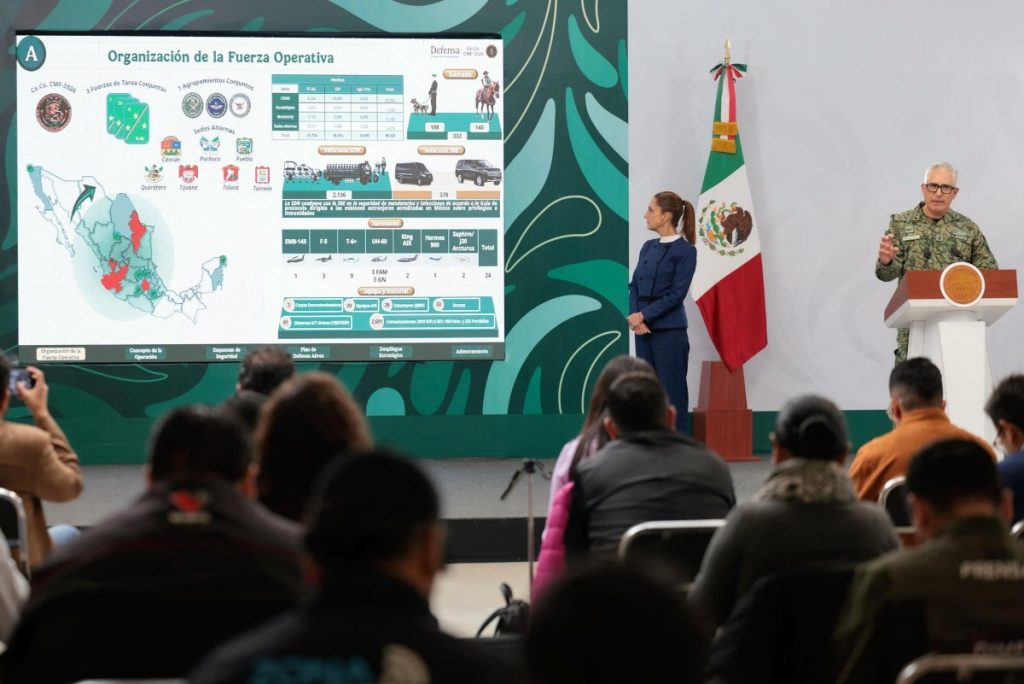
Handout photo released by the Mexican Presidency press office of Mexicos President Claudia Sheinbaum (C) looking at a screen as General Roman Villalvazo Barrios (R), Chief of central co-ordination for security for the 2026 FIFA World Cup, speaks during Sheinbaum’s daily press conference at a military base in Zapopan, Guadalajara state, Mexico, on March 6, 2026. Mexico will deploy 100,000 police, military and private security forces to secure the 13 games it will host during this summer’s football World Cup, the government said. (Photo by Handout / Mexican Presidency / AFP) / RESTRICTED TO EDITORIAL USE-MANDATORY CREDIT AFP PHOTO / MEXICAN PRESIDENCY-NO MARKETING NO ADVERTISING CAMPAIGNS-DISTRIBUTED AS A SERVICE TO CLIENTS
nMexico said Friday it would deploy nearly 100,000 security personnel to protect fans at the football World Cup in three host cities, one of which, Guadalajara, has been plagued by cartel violence.
nMexico is co-hosting the biggest World Cup in history, along with the United States and Canada, from June 11 to July 19.
nGuadalajara, capital of Jalisco state, Mexico City and the northeastern city of Monterrey will host 13 games between them, including opening match on June 11 at Azteca Stadium in the capital.
nPresident Claudia Sheinbaum unveiled the country’s security plan less than two weeks after an explosion of violence in Guadalajara, and other parts of the country, triggered by the death of a notorious drug lord.
nMexico City and Monterrey were spared by the violence.
nSheinbaum presented her plan at a military base in Zapopan, a suburb of Guadalajara, which was rocked by the killing of Nemesio “El Mencho” Oseguera, leader of the fearsome Jalisco New Generation Cartel (JNGC) in an army raid on February 22.
nOseguera was Mexico’s most wanted man and was also sought by the United States, which had a $15 million bounty on him.
nHe was buried Monday in a gold-colored coffin in a cemetery near the military base in Zapopan.
nAfter news of his death broke, members of his cartel went on the rampage.
nThey blocked roads in 20 of Mexico’s 32 states and torched vehicles and businesses, including in Guadalajara and the Jalisco tourist resort of Puerto Vallarta.
nOver 70 people were killed during the operation to capture Oseguera and subsequent clashes between the security forces and JNGC gunmen.
nBoth FIFA and Sheinbaum have said that the violence has no bearing on the World Cup and that visiting fans have nothing to fear.
n– Anti-drone systems –
nMexico is expecting millions of visitors over the course of the monthlong World Cup.
nPlan Kukulkan, named after the serpent deity of the Mayan civilization, covers the host cities as well as nearby tourist destinations.
nGeneral Roman Villalvazo Barrios, head of Mexico’s World Cup coordination center, said the nearly 100,000-strong security deployment would include 20,000 military personnel, including National Guard troops, and 55,000 police officers, as well as members of private security companies.
n“That gives us a total of just over 99,000 personnel,” he said, adding that the government was coordinating with the United States and Canada on security.
nThe operation will draw on around 2,500 military and civilian vehicles, 24 aircraft, anti-drone systems, and dogs trained to detect explosives and other substances, he said.
n– ‘Very reassured’ –
nGuadalajara is one of the Mexican states worst affected by drug cartel violence.
nMore than 12,575 people are reported missing in the state, many of them kidnapped or killed by armed groups.
nAfter Oseguera’s killing, FIFA moved quickly to dispel speculation that it could move games out of Guadalajara, which will host four matches.
nThe head of the world football body Gianni Infantino told AFP two days after Oseguera’s killing that he was “very reassured” about Mexico’s hosting of the tournament.
nInfantino and Sheinbaum spoke on February 26 by phone about preparations for the tournament.
nAnd on Thursday, Security Secretary Omar Garcia Harfuch, met with FIFA representatives.
n nRelated Stories
 General News
CELEBRATING TWO YEARS OF TRANSFORMATIONAL LEADERSHIP IN THE PRESIDENTIAL AMNESTY PROGRAMME
Tomorrow, 14TH March 2026, as we look forward to the second anniversary, we reflect on the remarkable two years since the Administrator of the Preside
 General News
PRESIDENTIAL AMNESTY PROGRAMME PHASE 3: DISREGARD PURPORTED STATEMENT ON DELAYED ITA PAYMENTS — OFFICE OF NATIONAL CHAIRMAN
The Office of the National Chairman of the Presidential Amnesty Programme Phase 3, General Elaye ThankGod Dollar Slaboh, has called on beneficiaries a
 General News
RE: CLARIFICATION ON MY PERSONAL RELATIONSHIPS
PUBLIC NOTICErnrnRE: CLARIFICATION ON MY PERSONAL RELATIONSHIPSrnrnIt has become necessary to make this public clarification following the increasing