
Meet Sankoh, first deaf black woman to earn a STEM PhD
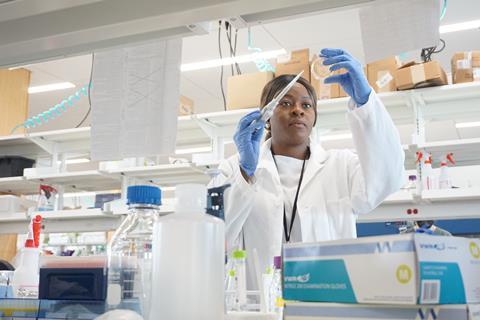
Sankoh Photo: Donald Danforth Plant Science Center/Patrick Bowey
nAmie Fornah Sankoh, a Sierra Leone-born scientist who lost her hearing at about three years old, has become the first deaf Black woman to earn a doctorate in a science, technology, engineering or mathematics field in the United States, and possibly worldwide.
nFornah received her PhD in biochemistry and cellular and molecular biology from the University of Tennessee, Knoxville, on May 20, 2023.
nHer achievement marks a remarkable turnaround from a childhood in Sierra Leone, where she struggled in school because of her hearing loss. She was later sent to the United States, where she was adopted by a family friend and learned American Sign Language, according to Chemistry World.
n“My father sent me to live with his best friend in America, who adopted me,” she said. “Doctors in the US could not cure my deafness, but I was able to join the deaf community where I learned American Sign Language [ASL] over the next few years.”
nFornah said mathematics became her strongest subject because of its visual nature.
n“Mathematics is just very visual, and I was able to enjoy that,” she said. “Anytime a person talked, I didn’t understand anything, but when they would write out the formulas then I could see it and I could see each step of how to solve that problem.”
nAfter learning ASL and receiving interpreter support in high school, she developed a passion for chemistry.
n“In high school, I really fell in love with the more complex mathematics, which is why I got into chemistry,” she said.
nShe later earned an associate degree and a bachelor’s degree in biochemistry from Rochester Institute of Technology’s National Technical Institute for the Deaf, worked as a lab technician, and then entered the PhD programme at the University of Tennessee.
nHer doctoral research examined the effects of hormones on plant-pathogen interactions, and she has co-authored four scientific publications.
nFornah said communication has been one of her greatest challenges in science, especially during the Covid-19 pandemic.
n“When Covid came, I remember my first thought was, ‘Oh, well, that’s it for graduate school for me’ – communication was challenging enough, and then we had masks and Zoom was not friendly,” she said.
nShe credited supportive mentors and colleagues for helping her overcome those barriers through transparent masks and written communication.
nReflecting on her journey, Fornah said she hopes her success will encourage other deaf scientists.
n“I feel very, very proud for persisting,” she said. “But I’m very happy that I am able to inspire the next generation of deaf scientists, so they can see their potential.”
nFollowing graduation, Fornah took up a postdoctoral position at the Danforth Plant Science Center in Missouri, where she plans to continue her research and advocacy work with the deaf community.
n nRelated Stories
 General News
CELEBRATING TWO YEARS OF TRANSFORMATIONAL LEADERSHIP IN THE PRESIDENTIAL AMNESTY PROGRAMME
Tomorrow, 14TH March 2026, as we look forward to the second anniversary, we reflect on the remarkable two years since the Administrator of the Preside
 General News
PRESIDENTIAL AMNESTY PROGRAMME PHASE 3: DISREGARD PURPORTED STATEMENT ON DELAYED ITA PAYMENTS — OFFICE OF NATIONAL CHAIRMAN
The Office of the National Chairman of the Presidential Amnesty Programme Phase 3, General Elaye ThankGod Dollar Slaboh, has called on beneficiaries a
 General News
RE: CLARIFICATION ON MY PERSONAL RELATIONSHIPS
PUBLIC NOTICErnrnRE: CLARIFICATION ON MY PERSONAL RELATIONSHIPSrnrnIt has become necessary to make this public clarification following the increasing