
Makinde’s coronation of three Ibadan high chiefs in absentia sparks fresh legal controversy
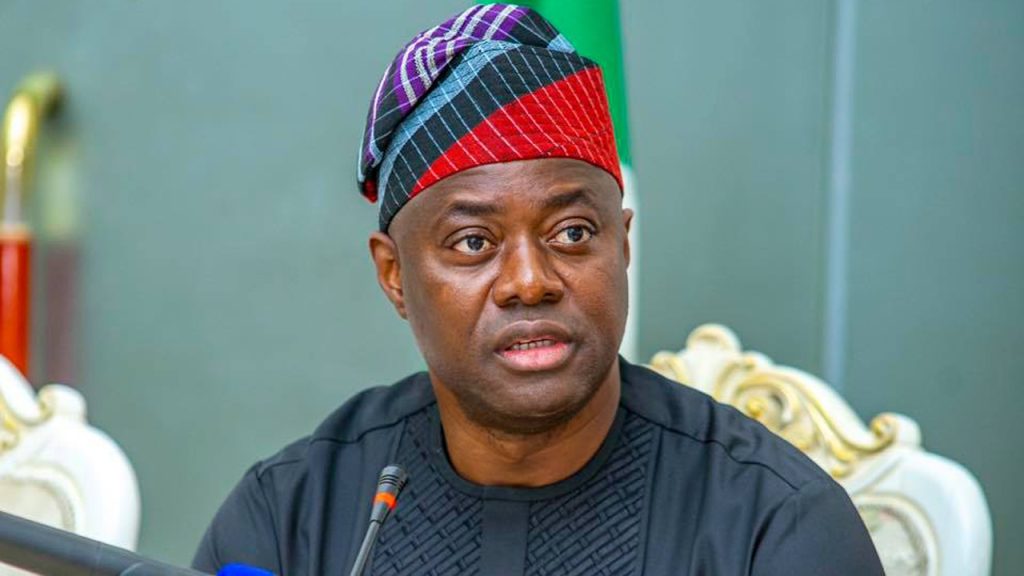
Gov Seyi Makinde of Oyo State.
nBy Adeola Badru
nGovernor Seyi Makinde’s decision to crown three Ibadan High Chiefs as Obas in absentia has triggered fresh legal controversy in Oyo State, with constitutional lawyers and traditional authorities questioning the validity of a coronation conducted without the physical presence and participation of the appointees on Friday, despite their formal request for a postponement.
nThe affected chiefs, Sharafadeen Alli, Akeem Bolaji Adewoyin, and Oyekola Babalola, had notified the state government of their inability to attend the scheduled ceremony and sought a new date.
nAlli was conferred with the title of Ekaarun Balogun of Ibadanland, while Adewoyin and Babalola were installed as Ekeerin Balogun and Ekaarun Olubadan of Ibadanland, respectively.
nHowever, the request was declined, and the coronation proceeded, with the government declaring the chiefs duly installed.
nThe development has since provoked widespread debate among legal practitioners, scholars, and traditional authorities, centring on whether a traditional ruler can be validly installed in absentia under Nigerian law.
nIn a detailed legal opinion, Adebisi Adeyemo, Esq., firmly rejected the validity of such a process, adding,
“A coronation conducted in absentia has no basis in either law or established customary practice. It is, in my considered view, fundamentally defective.”
Adeyemo acknowledged that the 1999 Constitution (as amended) vests executive powers in a state governor but emphasised that such authority is limited by constitutional principles.
n“Executive powers are not absolute. They are circumscribed by the supremacy of the Constitution and the rule of law. Government cannot create legitimacy where the law does not recognise it,“ the lawyer explained.
nHe drew a clear distinction between the approval of a chieftaincy appointment and the actual installation, noting, “While a governor may approve or recognise an appointment, installation is a separate and deeply rooted customary process.“
n“It requires the personal participation of the appointee, something that cannot be delegated or performed in absentia,“ he said.
nAccording to him, essential elements of the process, including the acceptance of insignia and oath-taking, are inherently personal acts.
n“These rites are not symbolic formalities; they are the very foundation of legitimacy in traditional institutions,” he added.
nCiting judicial precedents, Adeyemo referenced established Supreme Court authorities to support his position.
n“The courts have been unequivocal on this issue,” he said. “In Adefulu v. Oyesile (1989), strict compliance with prescribed procedures was held to be indispensable, while Oladele v. Aromolaran II (1996) reaffirmed that any deviation renders the process invalid.”
nHe further argued that proceeding with the coronation despite the chiefs’ request for postponement raises constitutional concerns.
n“Taking a decision that affects an individual’s legal status in their absence, and against their expressed wishes, raises serious questions about the right to a fair hearing,” he warned.
nOn this basis, Adeyemo noted that the government’s action may be legally unsustainable,” stating, “Where no law permits coronation in absentia, and customary law requires personal participation, such an exercise is ultra vires, beyond the powers of the authority that undertook it and therefore void.“
nThe controversy also drew criticism regarding the use of public resources for the ceremony.
n“If the legal foundation of the exercise is questionable, then the expenditure of public funds on it becomes equally questionable,” Adeyemo remarked.
n“Chieftaincy institutions are governed by law and tradition, not administrative convenience. Any attempt to bypass due process risks undermining both legal certainty and cultural integrity,“ he said.
nAs the debate continues, other legal experts maintain that legitimacy in chieftaincy matters cannot be conferred by executive declaration alone but must derive from strict adherence to established law and custom.
nResidents have also cautioned that the incident could set a troubling precedent if not addressed.
n nRelated Stories
 General News
CELEBRATING TWO YEARS OF TRANSFORMATIONAL LEADERSHIP IN THE PRESIDENTIAL AMNESTY PROGRAMME
Tomorrow, 14TH March 2026, as we look forward to the second anniversary, we reflect on the remarkable two years since the Administrator of the Preside
 General News
PRESIDENTIAL AMNESTY PROGRAMME PHASE 3: DISREGARD PURPORTED STATEMENT ON DELAYED ITA PAYMENTS — OFFICE OF NATIONAL CHAIRMAN
The Office of the National Chairman of the Presidential Amnesty Programme Phase 3, General Elaye ThankGod Dollar Slaboh, has called on beneficiaries a
 General News
RE: CLARIFICATION ON MY PERSONAL RELATIONSHIPS
PUBLIC NOTICErnrnRE: CLARIFICATION ON MY PERSONAL RELATIONSHIPSrnrnIt has become necessary to make this public clarification following the increasing