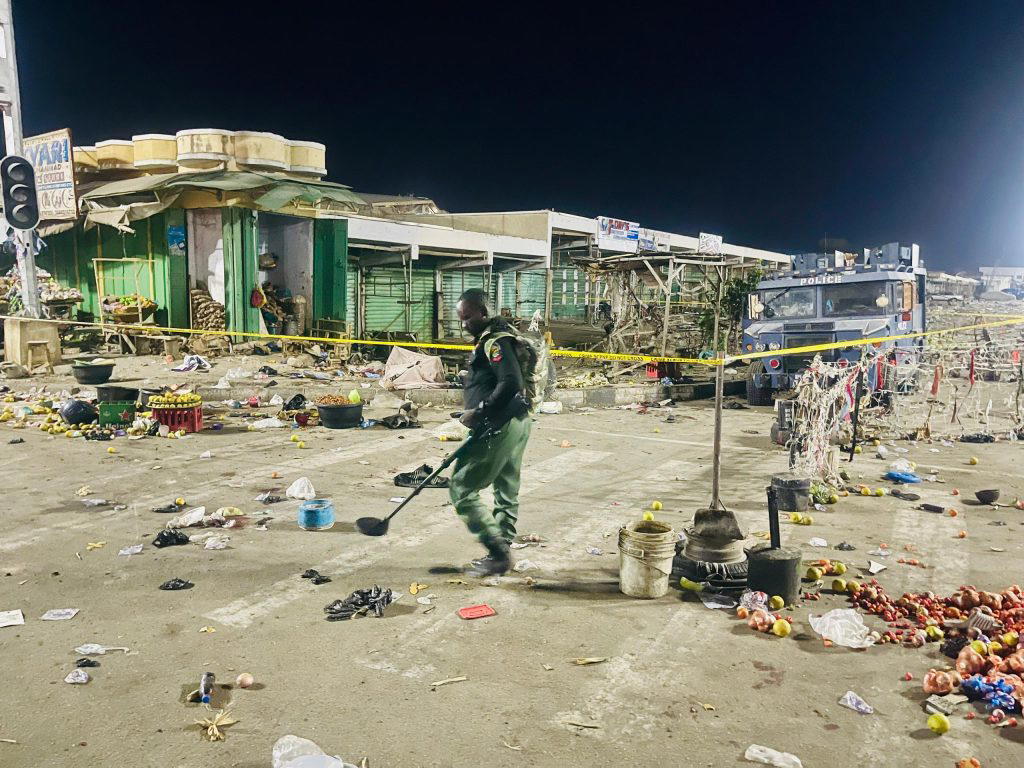
Monday, March 16, 2026, will be remembered as the day suicide bombing terrorism made a gruesome comeback to its origins in Nigeria, specifically in Maiduguri, the capital of Borno State.
Although no group had claimed responsibility for the heinous act at the time of reporting, it is widely suspected that the Islamic terrorist groups Boko Haram and the Islamic State in West Africa, ISWA, were behind the attack.
President Bola Tinubu proceeded with his scheduled official visit to King Charles of England, accompanied by his wife, Senator Remi Tinubu, but he ordered top military officials, including General Olufemi Oluyede and the Chief of Army Staff, Lt. Gen Waidi Shuaibu, to relocate to Maiduguri.
The coordinated suicide blasts targeted crowded areas of the Maiduguri Metropolitan Council, such as the Monday Market, Post Office, and University of Maiduguri gate, resulting in the loss of 23 lives and injuring 108 people.
This incident marked the first time in approximately two years that bomb blasts, which were once rampant in the city and other parts of the North during the early days of the Boko Haram terror from 2012 to 2016, had recurred.
The attacks serve as a stark reminder for security agencies and all Nigerians, particularly those living in cities like Abuja and surrounding areas, to exercise vigilance and implement safety measures to prevent escalation.
Recently, Islamic terrorists have increased their attacks, especially against military personnel and installations in Borno State, with numerous reported casualties.
Since the US bombing of terrorists' camps in Sokoto State on Christmas Day, which targeted groups attacking Christians and other innocent Nigerians, there has been a noticeable surge in attacks by bandits, insurgents, and jihadists across the North.
According to recent media reports, Nigeria has spent approximately N32.8 trillion on defense over 15 out of the 17 years it has been plagued by Islamic terror, primarily due to terrorism in Northern Nigeria.
Upon arrival in Maiduguri, Gen. Oluyede addressed the officers and men of the Nigerian Army, emphasizing that many local indigenes were complicit in perpetuating these terrorist wars against their own people.
The involvement of not only local residents but also influential political, religious, and traditional figures in the North with the terrorists makes it extremely challenging for the military to defeat the insurgency.
As long as the collusion with "sacred cows" who use terror for power or religious expansionism is tolerated, the problem will persist.
Having been defeated in the Middle East, global Islamic terror networks have now invaded Nigeria and its surroundings, making this a challenge that extends beyond Nigeria's borders.
Unless Nigeria receives assistance to contain this threat, the entire world may soon face the consequences of terrorism emanating from Nigeria.



Comments
Please login to leave a comment.
No comments yet. Be the first to share your thoughts!