
Machine learning takes over from cephalopod oracle for 2026 soccer tournament predictions
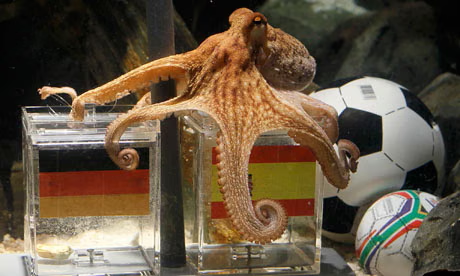
Generative AI chatbots are making their debut in the 2026 World Cup, with various systems predicting the final winners, including ChatGPT and Claude, which are betting on Spain, while Le Chat from France’s Mistral favors Les Bleus.
nChina’s DeepSeek and Qwen, on the other hand, are rooting for Argentina, showcasing the diverse predictions from these non-human entities, reminiscent of Paul the Octopus, who famously predicted winning teams during the 2010 contest.
nThe current trend of seeking non-human answers marks a significant shift, especially considering that OpenAI’s ChatGPT was only released to the public on November 30, 2022, during the last World Cup in Qatar, when few outside Silicon Valley were aware of generative AI.
nInstitutions such as banks and universities are now testing the football foresight of generative AI systems, with Bank of America analysts finding that their Microsoft CoPilot chatbot favored Spain and France equally, while around 40 percent of fans tipped France.
nTech news site Tom’s Guide consulted Google’s Gemini, ChatGPT, and Perplexity, with each predicting Spain as the winner and France as the second pick, further solidifying their chances.
nMeanwhile, Decrypt received similar results from western chatbots like ChatGPT and Anthropic’s Claude, but found that Chinese competitors DeepSeek and Qwen both predicted Argentina as the winner.
nResearchers at Germany’s Ludwig Maximilian University (LMU) are conducting a more scientific analysis, tracking the accuracy of each AI model in game-by-game predictions on the public website, LLM SoccerArena.
nAccording to LMU management researcher Stefan Feuerriegel, the question of whether language models can reliably support real decision-making situations is critical, and benchmarks are needed to test their ability to handle dynamic information and uncertainty.
nFeuerriegel added that the Munich researchers are testing both the AI’s forecasts based on their internal knowledge and their ability to integrate online information about factors like injuries, squad selections, and betting markets into their predictions.
nBeyond predicting the final outcome, AI is also supporting various stakeholders, including coaches, medical staff, referees, and even ticket scammers, as noted by researchers from Australia’s University of the Sunshine Coast.
nThe researchers from the University of the Sunshine Coast wrote that while an AI agent is unlikely to score a goal or call the shots, the winner of the tournament will undoubtedly have relied on AI in some capacity along the way.
Related Stories
 General News
CELEBRATING TWO YEARS OF TRANSFORMATIONAL LEADERSHIP IN THE PRESIDENTIAL AMNESTY PROGRAMME
Tomorrow, 14TH March 2026, as we look forward to the second anniversary, we reflect on the remarkable two years since the Administrator of the Preside
 General News
PRESIDENTIAL AMNESTY PROGRAMME PHASE 3: DISREGARD PURPORTED STATEMENT ON DELAYED ITA PAYMENTS — OFFICE OF NATIONAL CHAIRMAN
The Office of the National Chairman of the Presidential Amnesty Programme Phase 3, General Elaye ThankGod Dollar Slaboh, has called on beneficiaries a
 General News
RE: CLARIFICATION ON MY PERSONAL RELATIONSHIPS
PUBLIC NOTICErnrnRE: CLARIFICATION ON MY PERSONAL RELATIONSHIPSrnrnIt has become necessary to make this public clarification following the increasing