
Local petrol production hits 48m ltrs per day – FG
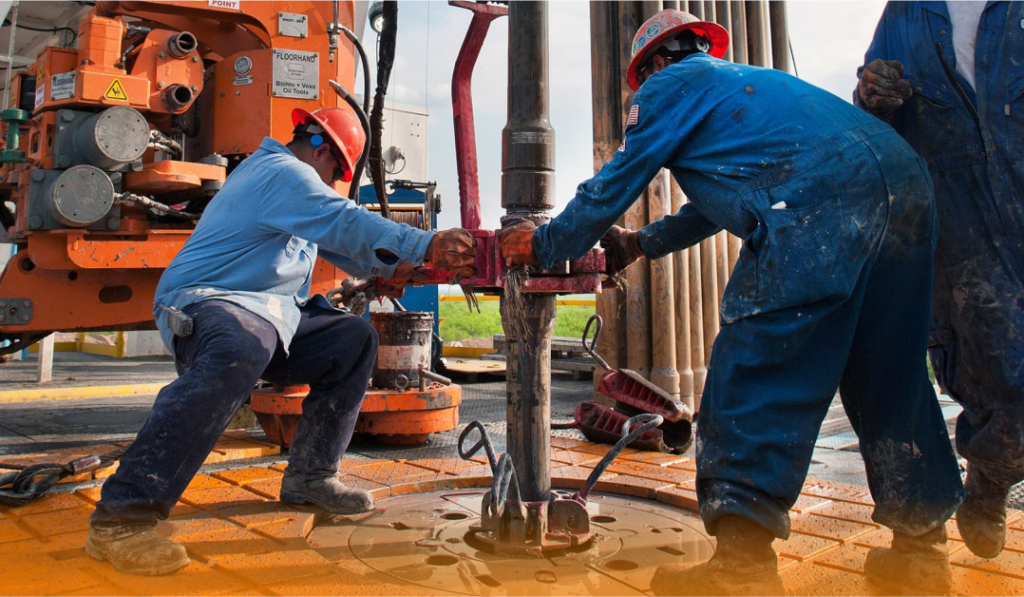
FILE IMAGE
nThe federal government has disclosed that local production of petrol has moved from effectively zero in 2023 to about 48 million litres per day.
nMrs Olu Verheijen, Special Adviser to the President on Oil and Gas, disclosed this at the Nigerian-British Chamber of Commerce Energy Day 2026.
nA text of her presentation at the event, held recently in Lagos, was made available to the News Agency of Nigeria on Tuesday.
nSpeaking on the topic, “Energy in Nigeria: From Potential to Reality”
Verheijen noted that, for the first time in a generation, the majority of the petrol Nigerians consume is now refined at home.
“This is where energy reform meets the strength of the naira.
n“For decades, every cargo of imported petrol was a standing demand for scarce dollars, a structural drain that weakened our currency.
n“As local refining has risen, that drain has eased: petrol imports fell from about N2.3 trillion in the first quarter of 2025 to under N90 billion a year later.
n“Fewer dollars spent on fuel means less pressure on the naira. Energy security and currency stability are not separate goals. They are the same goal,” she said.
nOn crude oil and condensate production, the special adviser said the country had restored investors’ confidence.
nAccording to her, crude oil and condensate production averaged 1.64 million barrels per day in 2025.
nShe said the production was up by roughly 400,000 barrels a day since 2023 and was at the highest onshore level in two decades.
nVerheijen also disclosed that over
four billion dollars in international oil company divestments had been concluded.
She said the divestment had helped to deepen Indigenous participation in onshore, while the majors refocused on deepwater and integrated gas.
n“Pipeline uptime is now consistently high, and illegal refining sharply reduced.
n“Every additional barrel matters — for revenue, for jobs, and for the strength of the federation,” she said.
nReflecting on what the administration met on the ground with in 2023, Verheijen said that the sector was under severe strain.
nShe recalled that subsidies had become fiscally unsustainable while foreign-exchange distortions had weakened investment.
n“Production was below potential; power-sector debt was strangling the gas-to-power chain.
n“The country had resources, but the system was not converting them into national value.
n“So our first task was to stop the bleeding and rebuild the foundations,” she said.
nIn addressing the challenges, Verheijen recalled that President Tinubu’s administration restored fiscal credibility by removing the fuel subsidy and reforming the exchange rate.
nAccording to her, the decisions were hard but necessary.
n“The results are visible. Total federation revenue rose to about N21 trillion in 2024, up from roughly N12 trillion in 2023 – nearly doubling in a single year,” she said.
nShe noted that in spite of the deregulation, the government has prevented the chronic nationwide petrol queues that once defined scarcity. (NAN)
n nRelated Stories
 General News
CELEBRATING TWO YEARS OF TRANSFORMATIONAL LEADERSHIP IN THE PRESIDENTIAL AMNESTY PROGRAMME
Tomorrow, 14TH March 2026, as we look forward to the second anniversary, we reflect on the remarkable two years since the Administrator of the Preside
 General News
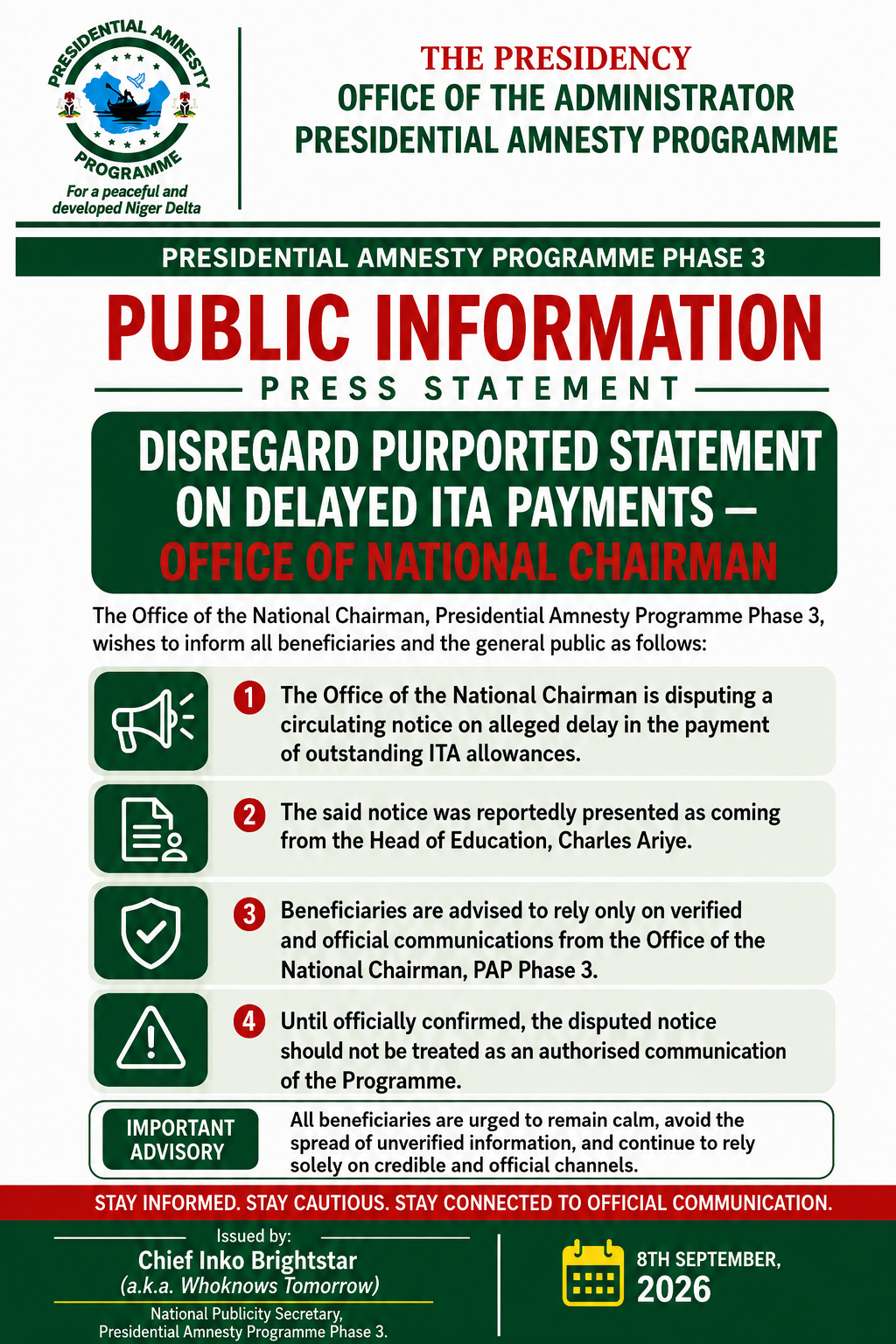
PRESIDENTIAL AMNESTY PROGRAMME PHASE 3: DISREGARD PURPORTED STATEMENT ON DELAYED ITA PAYMENTS — OFFICE OF NATIONAL CHAIRMAN
The Office of the National Chairman of the Presidential Amnesty Programme Phase 3, General Elaye ThankGod Dollar Slaboh, has called on beneficiaries a
 General News
RE: CLARIFICATION ON MY PERSONAL RELATIONSHIPS
PUBLIC NOTICErnrnRE: CLARIFICATION ON MY PERSONAL RELATIONSHIPSrnrnIt has become necessary to make this public clarification following the increasing