
Lejja community in Enugu stakes its claim as the birthplace of West African civilization
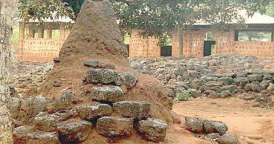
Research conducted by the University of Nigeria, Nsukka, in collaboration with the University of Oxford, has dated materials found in Lejja to approximately 2000 BCE.
nThis discovery has significant implications, as it suggests that Lejja may be one of the oldest iron-smelting sites in the world, with the people of Lejja considering it a part of their identity, heritage, and a claim to being a cradle of civilisation in West Africa.
nThe heart of this historic narrative is Otobo Ugwu, a sprawling square in Dunoka village, where hundreds of cylindrical and crescent-shaped slag blocks, remnants of iron smelting, are arranged in striking formations, with some blocks weighing as much as 57 kilograms.
nScientific investigations have led to the carbon-dating of these materials to approximately 2000 BCE, placing Lejja's ironworking tradition centuries earlier than the widely accepted origins of the Iron Age in South-West Asia, which is traditionally dated around 1500 BCE.
nThe implication of this discovery is profound, suggesting that Africa, and specifically Lejja in Enugu State, may have independently developed iron-smelting technology far earlier than previously believed.
nFor decades, conventional academic thought held that ironworking technology spread into Africa from other regions, but the findings in Lejja challenge this assumption, with the scale of the site and the discovery of pipes, furnace remnants, and other materials indicating advanced high-temperature smelting techniques.
nArchaeologists have uncovered over 800 slag blocks concentrated in specific locations, pointing to organised, large-scale industrial activity, and suggesting that ancient inhabitants of Lejja had mastered iron production in a sophisticated and sustainable way.
nThe significance of iron in human history cannot be overstated, as its discovery and application marked a turning point in the evolution of societies, enabling the transition from subsistence hunting to organised agriculture, and the creation of weapons that shaped warfare, territorial expansion, and the rise of empires.
nAccording to Professor Damian Opata, an indigene of Lejja community, iron smelting in Lejja enabled the clearing of dense forests, tilling of soils, and increased food production, and also enabled the creation of weapons that shaped the course of human history.
nThe discovery that Lejja may have been among the earliest centres of the iron revolution elevates its importance beyond regional history to global significance, with stakeholders in the community arguing that it lays the foundation for civilisation as it is known today.
nInterestingly, the Lejja site was not solely industrial, as the placement of slag within village squares suggests a fusion of economic activities with social and political life, with Otobo Ugwu doubling as a communal arena where villagers historically gathered for deliberations, conflict resolution, and cultural ceremonies.
nThe community of Lejja is uniquely known for celebrating both Omaba and Odo cultural traditions, an uncommon duality in the region, with the Okiti Omaba shrine, a towering pillar, embodying the spiritual heritage of the people.
nTo the locals, the stones are not mere relics; they are sacred, with some believed to possess spiritual significance, and strict taboos governing their interaction, and oral traditions passed down through generations insisting that these stones predate even the oldest known ancestors.
nElders in the community recount stories that blur the line between history and myth, speaking of a time when Lejja was a formidable settlement, never defeated in war, and renowned for its blacksmithing prowess, with iron tools produced here being central to both agriculture and warfare.
nThe traditional ruler of the community, Igwe Boniface Nwaala, echoes these sentiments, emphasising the pride Lejja brings to African heritage, and noting that while foreign researchers have long been fascinated by the site, much of the excavated material was taken abroad, leaving the community with little physical evidence of its own history.
nRecent collaborations with Nigerian scholars have begun to shift this dynamic, offering renewed hope for local ownership and recognition, but despite its global significance, Lejja remains largely underdeveloped, with poor access roads, minimal infrastructure, and a lack of preservation and promotion of the site.
nThe community is calling for government intervention to transform the area into a major tourist and research destination, which would not only boost the local economy but also reposition Africa within the global narrative of technological advancement.
nThe passage of time poses its own challenges, with traditional practices like blacksmithing gradually fading, as younger generations pursue modern livelihoods, and cultural tensions emerging between traditional beliefs and newer religious influences, threatening the preservation of ancient relics.
nLejja stands today at a crossroads between obscurity and global recognition, with its ancient stones holding answers to questions that historians are only beginning to ask, and if fully explored and preserved, this community could reshape the understanding of early human innovation, not just in Africa, but across the world.
Related Stories
 General News
CELEBRATING TWO YEARS OF TRANSFORMATIONAL LEADERSHIP IN THE PRESIDENTIAL AMNESTY PROGRAMME
Tomorrow, 14TH March 2026, as we look forward to the second anniversary, we reflect on the remarkable two years since the Administrator of the Preside
 General News
PRESIDENTIAL AMNESTY PROGRAMME PHASE 3: DISREGARD PURPORTED STATEMENT ON DELAYED ITA PAYMENTS — OFFICE OF NATIONAL CHAIRMAN
The Office of the National Chairman of the Presidential Amnesty Programme Phase 3, General Elaye ThankGod Dollar Slaboh, has called on beneficiaries a
 General News
RE: CLARIFICATION ON MY PERSONAL RELATIONSHIPS
PUBLIC NOTICErnrnRE: CLARIFICATION ON MY PERSONAL RELATIONSHIPSrnrnIt has become necessary to make this public clarification following the increasing