
Leadership Man of the Year: Why Abdul Samad, Nduka matter
By Garba Shehu
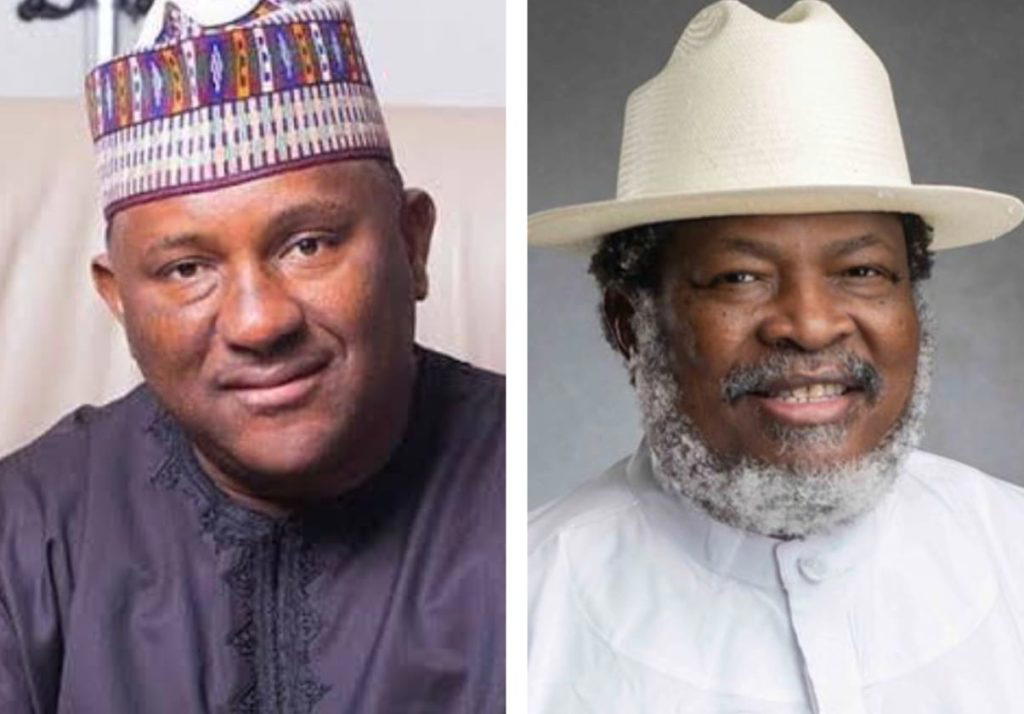
nThis year, the Leadership newspaper is conferring its prestigious Man of the Year award on two Nigerian icons in recognition of their leadership journeys:
nPrince Nduka Obaigbena, one of Nigeria’s most famous and admired media figures, is a man who shaped, and continues to shape, different eras in Nigerian journalism.
nAbdul Samad Isyaku Rabi’u, born on August 4, 1960, is a Nigerian billionaire businessman and cement magnate.
nHis is a name that goes far beyond the boardroom. While he is renowned as the chairman of BUA Group of Companies, which he transformed into a global business empire, his contributions extend well beyond the corporate world.
nAbdul Samad’s philanthropy is a beacon of hope for millions, and his selfless giving continues to leave lasting impressions on Nigeria, Africa, and the world.
nBy showing that business can move beyond the notion of profit, Samad, as fondly called by friends, has showcased how true leadership is not only about business success but also about creating a lasting social impact.
nAs the executive chairman of BUAFOODS, he drove the expansion of the conglomerate into Nigeria’s most capitalized company, with a share price of approximately N760.60 and a market capitalization of roughly N13.69 trillion.
nCurrently, he is Africa’s second-richest person, with a net worth estimated at between $13 billion and $19 billion in 2026.
nSamad has always stood for more than business. To Nigerians, he personifies kindness, purpose, and institution-building. He is Nigeria’s, indeed Africa’s, philanthropic giant.
nWhen the COVID-19 crisis rocked and racked livelihoods, lives, and even nations across the globe, Nigerian business leaders formed what they called the Coalition Against COVID-19, known as CACOVID. Led by Aliko Dangote, Africa’s wealthiest man, the coalition was backed by Access Bank Group, Zenith Bank, Guaranty Trust Bank, and several others, including the BUA chairman, Abdul Samad.
nRather than solely funding temporary relief, which he noted was the major shortcoming of the CACOVID relief programmes he and the others put in place, Abdul Samad seized the momentum to sharpen and accelerate his visionary legacy of transforming lives in Nigeria through philanthropy and social-impact initiatives.
nIt is the famous American author and motivational speaker Tony Robbins who said, “By changing nothing, nothing changes.”
nLike a bolt from the sky came, in 2021, the Abdul Samad Rabi’u Foundation, ASR Africa Initiative, which is the brainchild of the industrialist and philanthropist, with an annual pledge of $100,000,000 (USD), with Nigeria to benefit $50,000,000 (USD) yearly and the rest of Africa, $50,000,000 (USD), in what is the largest private philanthropic giving of its kind by an individual on the continent.
nHe believes in using wealth to uplift society and to address some of the most pressing challenges facing humanity. From education to healthcare, water supply to rural development, Samad’s charitable efforts have touched countless lives.
nAs one of the world’s leading philanthropists of the 21st century, Abdul Samad’s compassionate ethos of giving is evident in his generous donations to education and healthcare.
nASR has built, among many other projects, a N310 million students’ hostel at the Federal University of Technology, Minna; a N270 million Abdul Samad Rabi’u Sports Complex at the University of Jos; a N250 million admin block at the Federal University of Technology, Owerri; a N250 million sports centre at UNIPORT; a N1 billion learning facility at UNILORIN; another N1 billion Integrated Agric Centre at Bayero University, Kano; and a language centre at the Nigerian Defence Academy (NDA).
nThe foundation has, to its credit, several other projects, including lecture theatres, auditoria, classrooms, libraries, laboratories, staff quarters and offices, ICT facilities, books, journals and periodicals, machines and other research equipment, provided to institutions of learning in Nigeria, Ghana, and other African countries.
nASR Africa has also made contributions to the well-being of our defence and security agencies through projects such as the N2 billion Nigerian Navy medical centre in the FCT; a N500 million immigration staff accommodation for the Immigration Service and another N500 million for the Correctional Centre (Prisons Service); a 150-bed mega hospital for the police in Abuja; and a hospital for the Immigration Service in Bauchi.
nThe foundation has built a palace for the Royal Igbogila Kingdom in Ijesha in Ogun State for N1 billion; made a contribution of N5 billion to the IBB National Library project; and is supporting the ongoing construction of the Malam Abdulkarim Juma’a Mosque in Zaria.
nThe history and extent of his passionate support for health and welfare is another little-known detail about Samad.
nThrough this foundation (ASR), he (Samad) has enabled the construction and rehabilitation of healthcare facilities, equipping them, developing research capabilities for researchers, healthcare practitioners, and community-level service providers.
nAmong the many projects executed are a N2.5 billion teaching hospital at Akwa Ibom State University, Uyo; a N2.5 billion school of nursing at Sokoto State University in Tambuwal; a N2.5 billion school of health technology in Gwadabawa, also Sokoto State; a N2.5 billion oncology and diagnostic centre in Ilorin; a N2.5 billion Stella Obasanjo Hospital in Edo State; a N250 million clinic at the Nigerian Law School; as well as a record number of hospitals in Kano, Katsina, FCT, Bauchi, and Sokoto given ambulances and tuberculosis centres. Ten states got kits for sexual assault response centres.
nIn his effortless stride of giving, Samad sparked a national enthusiasm when he offered a cash reward package of up to USD 1.5 million to the Super Eagles during the 2025 Africa Cup of Nations (AFCON) in January 2025.
nIn the end, we lost the semi-final to the host nation, Morocco, in a penalty shootout.
nDespite the defeat, he still went ahead, dishing out USD 500,000 in appreciation of the team’s “resilience, passion, and strong performance throughout the tournament.”
nThrough philanthropy and strong conviction, with an eye on nation-building, Abdul Samad continues to create and support countless social-uplift programmes in areas such as health, education, national security, water, sports, livelihoods, and social welfare, all with one core purpose—to improve the quality of life of those it touches at home in Nigeria and in other countries in Africa.
nHis selection as the 2026 “Man of the Year” by the Leadership Media Group is an eloquent testimony to why Abdul Samad, a major global player, matters.
n… And Nduka Obaigbena.
nI have told my Nduka story on these pages before, but given the importance I attach to it, it bears repeating.
nMany years ago, we met at his instance to decide if we would partner with him in his upcoming magazine, TheWeek, with ties to Time Magazine, where Mr. Obaigbena had worked in the past.
nAfter all had been said, our representative at the meeting asked an important question:
nWhat happens if the beautiful dream crashes? Is there a fallback to it?
nOur host, Nduka Obaigbena, shoved aside the issue, saying we were all taking a risk; there was nothing to lose. None of us here has a family.
nWe (I and my editor, Malam Kabiru Yusuf) decided that this would be a dangerous journey; the guy is not a serious person, we concluded.
nTheWeek took off and crashed, but in its place, he went on to found ThisDay.
nMalam Kabiru, with a few friends, started the Daily Trust, which has gone on to break so many barriers and myths about the success, or lack of it, in publishing in Northern Nigeria. The Trust newspapers are today printed simultaneously in Abuja, where they are headquartered in a five-storey building, in Kano, Maiduguri, Lagos, and Port Harcourt—the only one to do so in the country.
nNduka Obaigbena has built ThisDay (Leaders and Company) into one of the country’s most respected media organisations, comprising not only the flagship ThisDay but also several other publications and the Arise International TV network.
nRecognising the potential importance of digital media, Nduka launched Lekeelekee, the first global social media platform built out of Africa, “blending TikTok, X, WhatsApp into a culturally aligned, mobile-first experience for Africa and the diaspora.” Users say Lekeelekee is fun and easy to use.
nIn this growing communications empire, ThisDay has a reputation for thorough, accurate, and well-written journalism, setting standards for politics, economy, business, and society reporting. Through this paper, Nduka gave this country its first all-colour newspaper.
nIn 1998, the Nigerian Guild of Editors gave him an award in recognition of his transformative contributions to journalism and media in the country.
nArise continues to grow in size and reputation, with a tradition of being a watchdog for misdeeds by politicians and aggressive interviewing techniques that have become a subject of discussion among communications scholars and practitioners. Nduka must be credited with a rare ability to create and manage this world-class media empire, and with the people he chooses to run it: the choice of a top-flight management team, and a willingness on his part to support the staff in and out of office, even when pressured to do otherwise.
nIn addition to being publisher, Nduka has led the Newspaper Proprietors Association of Nigeria (NPAN) and is a patron of the Nigerian Press Organisation (NPO), after leading it as president, giving him, overall, a latitude of authority, wealth, financial power, social privilege, and outstanding public respect.•Shehu (OON, FNGE) is a former presidential spokesman.
n nRelated Stories
 General News
CELEBRATING TWO YEARS OF TRANSFORMATIONAL LEADERSHIP IN THE PRESIDENTIAL AMNESTY PROGRAMME
Tomorrow, 14TH March 2026, as we look forward to the second anniversary, we reflect on the remarkable two years since the Administrator of the Preside
 General News
PRESIDENTIAL AMNESTY PROGRAMME PHASE 3: DISREGARD PURPORTED STATEMENT ON DELAYED ITA PAYMENTS — OFFICE OF NATIONAL CHAIRMAN
The Office of the National Chairman of the Presidential Amnesty Programme Phase 3, General Elaye ThankGod Dollar Slaboh, has called on beneficiaries a
 General News
RE: CLARIFICATION ON MY PERSONAL RELATIONSHIPS
PUBLIC NOTICErnrnRE: CLARIFICATION ON MY PERSONAL RELATIONSHIPSrnrnIt has become necessary to make this public clarification following the increasing